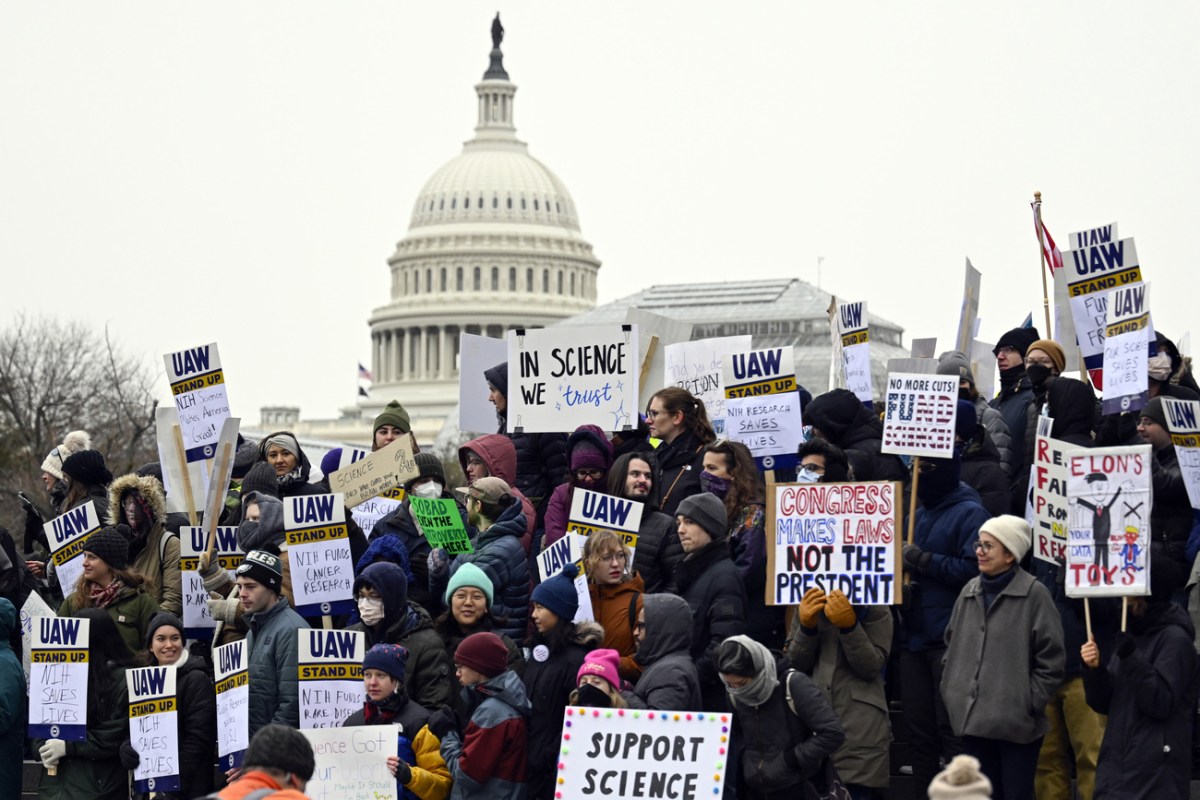

In February 2025, researchers from universities and the National Institutes of Health protested in Washington D.C. against massive budget cuts.
John McDonnell / Keystone
In Switzerland, science enjoys greater public trust than the police, government or parliament. But what exactly is the role of science in a democracy, and how does it differ in dictatorships?
This content was published on
September 8, 2026 – 09:00
For many years, the police were the institution that the Swiss population trusted most. This emerges from the yearly Security Study by the federal technology institute ETH ZurichExternal link. Today, however, another body comes out on top: science.
For Naomi Oreskes, a science historian at Harvard University, this is good news. It shows that the Swiss public values “high-quality information” more than its counterpart in the United States.
The Security Study has been examining levels of trust in science since 2018External link. At the time, it justified the introduction of the category based on trends seen “particularly in the United States”.
‘Follow the Science’
In countries such as Switzerland, the Covid-19 pandemic propelled debate about the role of science in society into the political limelight.
According to political scientist Eri Bertsou, the rhetoric at the start of the pandemic set off her “personal alarm bells”. Her research at the University of St Gallen focuses, among things, on technocracy – that is, the idea that political decisions should be based more heavily on expert knowledge.
In spring 2020, then-British Prime Minister Boris Johnson justified government decisions with the slogan “Follow the Science”. “I remember thinking: gosh, this isn’t good,” says Bertsou. It was the use of the definite article, “the”, rather than the actual policy choice that she was reacting to. “The science, as if there were one settled answer to follow. There wasn’t one at the time.” Data was constantly coming in, and assumptions were being rethought.
“Scientific assessments and models changed accordingly over the course of the pandemic.” says Bertsou. When governments then modified their pandemic policies, science was blamed. “Precisely because governments had claimed to be following it.”
The idea that science can provide clear-cut answers to politically complex questions sounds tempting. But the role of science, Bertsou says, is to contribute its findings as a basis for democratic debate: “The decision must lie with those who have to live with the outcomes.”

Boris Johnson, who was British Prime Minister at the time, addressed the public every day at the start of the pandemic. Pictured here on Sunday, 22 March 2020.
Ian Vogler / Keystone
However, the “Follow the Science” slogan conveyed the message that political decisions could derive directly from scientific findings. “In so doing, the boundary between scientific advice and political responsibility blurred,” Bertsou explains.
She has noted a strong polarisation of public attitudes towards science in many places. These attitudes are “context-specific”. Thus, in Eastern Europe after the end of the Cold War, it was mainly people on the political left who were sceptical of science. Today, attitudes there have aligned more closely with Western Europe where, as in the United States, right-wingers tend to be more sceptical. The same holds true for Switzerland, where the Security Study shows that trust decreases “the further to the right one moves on the political spectrum”.
Bertsou is not surprised to see such high trust in science among the Swiss population as a whole. “My guess is that in a world full of uncertainties, there is an additional need to have something to guide one.” Data from a study across 68 countriesExternal link, in which Bertsou was involved, show that many people want scientists to be more active in politics.
Trust is often regarded as a vanishing commodity. In recent years, dwindling public confidence in institutions in many countries has given rise to growing concern.
>>Trust in politics and the authorities is also comparatively high in Switzerland. Read our latest article on the subject here:
More

More
Swiss democracy
High Swiss trust in government sparks little interest abroad
This content was published on
Jul 15, 2026
In most countries, only a minority of people feel their government listens to them. Switzerland is the exception.
Read more: High Swiss trust in government sparks little interest abroad
Yet Bertsou says that trust does not disappear – it merely shifts, just like in the law of conservation of energy: “Trust is relative; you have to direct it somewhere.” Those who lose trust in politics may place it in a populist figure – or in science. If politics is perceived as corrupt, some people pin their hopes on experts whom they see as being outside the system.
Technocracy – or the call to “follow the science” – can capitalise on the promise that there is an objectively correct, scientifically justifiable policy.
When science serves the authoritarian state
In dictatorships, there is no critical tension between science and government, says political scientist Ralph Weber, who conducts research on China at the University of Basel. “On the contrary. In China, science is supposed to help the Party exercise its rule.” It is no coincidence, he adds, that authoritarian governments often have a technocratic understanding of science: the notion of a “best solution” is closely linked to autocratic rule.
This may sometimes be efficient. However, open discussion is precisely one of the strengths of science in democracies. “We can debate what the problem actually is. Authoritarian states bypass this. The regimes decide and the problem is laid down from above,” says Weber.
During his research and advisory work with a “wide variety of members of the scientific community”, Weber is often confronted with the question of who scientists should cooperate with and how. Modern science operates as an interconnected global network, but science has a different function and self-image in authoritarian states – and this poses challenges for democratic countries such as Switzerland.
More

More
Swiss democracy
Our democracy newsletter
If you are a fan of democracy, then you’ve come to the right place. We report on the latest democratic developments, debates and challenges.
Read more: Our democracy newsletter
On the one hand, it’s all about “keeping ahead in the global competition for knowledge and innovation”, says Weber. At the same time, though, it is vital to avoid inadvertently contributing to a further weakening democracy in the long term.
For Weber, this means staying open without being naïve. What is needed is investment in “fully informed scientific cooperation”. Exchange, research and cooperation should be facilitated. But “if someone is conducting research into hydraulics with China, they should be able to gauge what the lack of distinction between civilian and military research means for the project.” No one should be completely taken aback afterwards to discover that their findings have contributed to the construction of long-range missiles.
When Weber talks about challenges in cooperation, he is no longer thinking solely of authoritarian states such as China – but rather, globally, of democracies that “face many internal authoritarian challenges”, such as India and the United States. The proportion of democracies worldwide has decreased in recent decades.
Like many others, Weber is currently concerned about the situation in the United States. “We are witnessing first-hand how a traditionally strong scientific partner is changing.”
>>When is a democracy no longer a democracy? Read our article on this issue:
More

More
When is a democracy no longer a democracy?
This content was published on
Apr 16, 2026
Beyond Switzerland’s borders, democracy is under pressure. But with gradual decay as much the cause as violent coups, it’s not always clear when, or if, it really “ends”.
Read more: When is a democracy no longer a democracy?
Challenges for universities: from YouTube to Trump
Weber is surprised at the high level of trust that the Swiss place in science.
He has rather observed that, “not least as a result of digitalisation”, scepticism towards science is on the rise. In his student days, he would have thought long and hard before daring to contradict his professor, but today, thanks to digital channels, people are readier to question societal authorities. “This goes hand in hand, however, with a blurring of the line between opinion and knowledge. In the worst-case scenario, I look for something on YouTube that reinforces my opinion and then declare that to be knowledge.”
This puts universities on the spot. “They need to demonstrate their value to society and find the right language to convey how scientific knowledge is generated,” says Weber; for example, to explain that the humanities and social sciences often produce a different kind of knowledge than laboratory evidence, or what the difference is between objective knowledge and well-founded interpretation.

Researchers from Eawag collect insects from a floating trap at Tschamut in May 2026. The research aims to investigate levels of PFAS pollution in insects.
Keystone / Gaetan Bally
Harvard historian Oreskes is also calling for better communication on the different ways that science contributes to the public good. Many scientists, she notes, are struggling to deal with the growing polarisation and loss of trust in science among sections of the United States population.
The “leaders of the scientific communities” should consider, in dialogue with disciplines such as sociology and political science, how science can better “address human needs” and demonstrate “how our work does help the societies we live in”.
She sees science as a force against authoritarianism. “Science, as an enterprise, threatens authoritarian governments, because science is a source of independent thinking and with that, potentially a source of an independent voice.” Even though, of course, not all scientists have championed democratic principles at all times.
Science as a whole is a value-driven endeavour, Oreskes argues. The search for truth remains paramount.
A high level of trust in science is justified because it has “a strategy for identifying and correcting error”. It is also necessary “because science involves complex questions that none of us can answer on our own”.
In the Security Study, trust ratings for science were consistently higher than for the Swiss government.
Edited by Meret Michel. Adapted from German by Julia Bassam/sb.
More
Have you lost faith in politics?
Declining trust in government and rising populism are issues that concern many people. Let us know your views.
View the discussion
Articles in this story