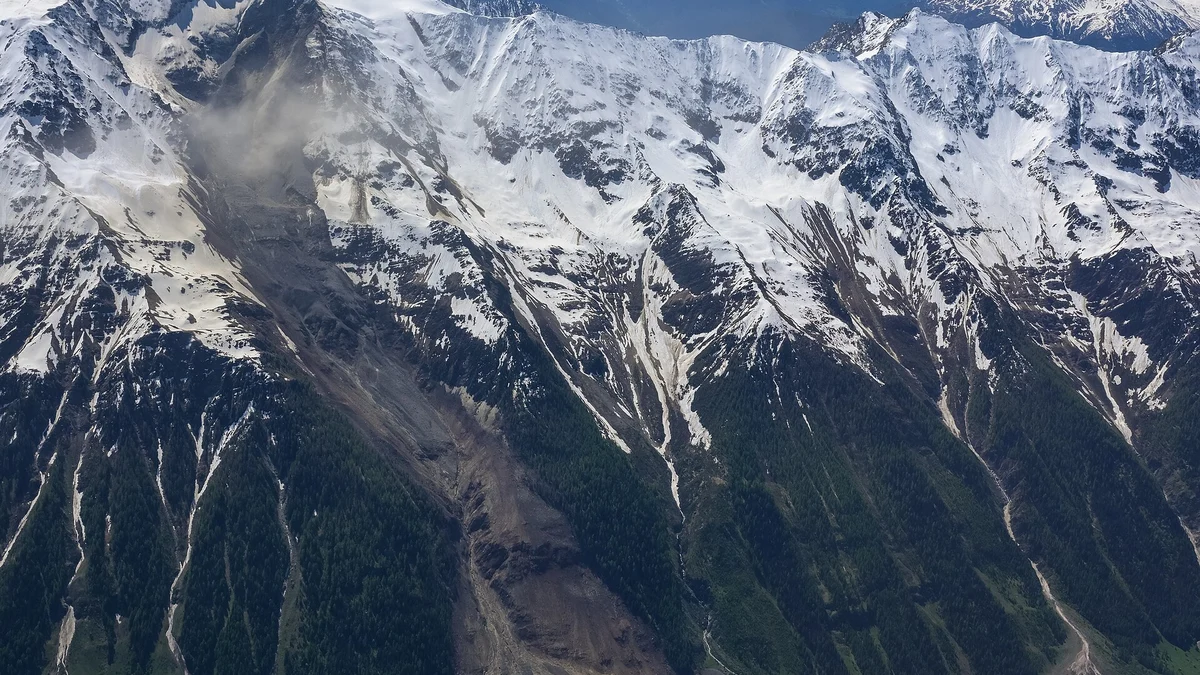
The May 28, 2025 collapse released about 9.3 million m³ of rock and ice from the Kleines Nesthorn–Birch Glacier area above Blatten in Switzerland’s Lötschental valley.
The avalanche crossed the valley floor, ran more than 200 m (656 feet) up the opposite slope, buried large parts of Blatten beneath deposits up to about 34 m (112 feet) thick, dammed the Lonza River, and caused additional flooding. One person was killed.
A new reconstruction of the event, published in Communications Earth & Environment on September 7, 2026, investigated why the avalanche was able to travel so far. It combined high- and low-frequency seismic records, geomorphological observations, geotechnical measurements, and granular-flow modeling.
Kang et al. (2026) tested the avalanche with the depth-averaged SHALTOP model and a three-dimensional Material Point Method (MPM), comparing simulations against both the reconstructed force history and mapped deposits.
Constant Coulomb friction reproduced some aspects of the avalanche’s runout but could not simultaneously match its complex deposit geometry and force evolution. The best combined solutions required dynamically changing effective friction. The SHALTOP model used a lower-limit μ(I) friction coefficient of μ1 = 0.03, while the three-dimensional MPM model used μ1 = 0.02, corresponding to lower friction-angle bounds of about 2° and 1°, respectively.
Those near-zero values are calibrated bulk model parameters, not measurements showing nearly frictionless contact between rock, ice and the ground. Different physical processes can produce similar effective values. The authors describe this as an equifinality problem: the modeling constrains the degree of weakening required by the observations but cannot uniquely identify the process responsible for it.
Seismic observations provided an independent record of the avalanche’s motion. Ground shaking corresponded to a local magnitude Mₗ3.1 event, and long-period waves were recorded hundreds of kilometers away. The LAUCH station, about 5 km (3.1 miles) from Birch Glacier, recorded roughly 100 seconds of strong motion. Researchers inverted lower-frequency signals from stations 33–110 km (21–68 miles) away to reconstruct the three-dimensional force exerted by the moving mass.
The force history separated the event into four stages. During the first 51 seconds, the avalanche accelerated, and the force reached about 6 × 10¹⁰ N, with comparatively little high-frequency seismic radiation. From 51 to 70 seconds, the mass entered the narrow gorge and struck the valley floor; the reconstructed force direction rotated by about 180°, while high-frequency energy increased as internal collisions intensified. Run-up on the Weissenried counterslope redirected the flow toward Blatten between about 70 and 92 seconds, followed by slower spreading and deposition.
Field mapping identified overlapping flow pulses, including later channelized surges that traveled almost 2 km (1.2 miles) downstream beyond Blatten and incised earlier deposits. Constant-friction simulations could not reproduce those features together with the seismic force evolution; the extended runout required the strong weakening permitted by the variable-friction formulation.
Several processes could contribute to the effective weakening. About 32% of the mobilized volume was glacier ice. The study also examines fragmentation, transient excess pore pressure, and meltwater generated through frictional or impact heating.
An energy-balance calculation estimated that frictional and impact heating could have generated approximately 88 000–221 000 m3 (3.1–7.8 million ft3) of meltwater during the avalanche, although the estimate depends strongly on assumptions about how much potential energy was converted to heating.
Geotechnical measurements found relatively low hydraulic conductivity in sampled deposits, compatible with pore pressure persisting during motion, but the observations do not establish pore pressure — or any other single process — as the dominant mechanism.
More than two weeks of precursor failures were also recorded before May 28. Rockfall activity from Kleines Nesthorn intensified on May 14, depositing debris onto Birch Glacier roughly 600 m (1 969 feet) below. According to the Canton of Valais, the approximately 300 residents of Blatten had been evacuated on May 19. Glacier motion subsequently accelerated to tens of meters per day, and a smaller ice avalanche detached on May 27 before stopping roughly 400 m (1 312 feet) above the Lonza River.
The precursor observations do not establish a transferable early-warning rule. Kang et al. instead use Blatten as a data-constrained benchmark linking precursor seismic monitoring, main-event force inversion, field observations, and runout modeling. The study places such cascading failures within the wider context of glacier retreat and permafrost degradation.
References
1 Kang, J., Lucas, A., Mangeney, A. et al. Frictional weakening in the highly mobile 2025 Blatten rock and ice avalanche in Switzerland. Commun Earth Environ 7, 722 (2026). https://doi.org/10.1038/s43247-026-03983-1