
Will exotic fruits soon be grown in Switzerland?
Keystone
Global warming could mean exotic fruits will also become established in Switzerland. What might grow here in the coming years? An agricultural scientist’s predictions.
Listen to the article
Listening the article
Toggle language selector
English (US)
English (British)
Generated with artificial intelligence.
This content was published on
September 15, 2026 – 09:00
Summers in Switzerland are becoming hotter and drier. As a result, conditions for fruit growing are also changing. “When the fruit trees were planted, different temperatures and rainfall patterns were taken into account,” explains Achim Walter, professor of crop science at the federal technology institute ETH Zurich.
Many traditional fruit varieties are already suffering from drought. While the intense sunshine makes them sweeter, it also causes them to be smaller. This results in significantly lower yields. The sector is therefore being called upon to rethink its strategies.
More

More
Climate adaptation
Sushi rice instead of potatoes? Swiss agriculture adapts to climate change
This content was published on
Oct 17, 2025
In Switzerland farmers are experimenting with new crops that can withstand heat and drought. But the transition has its challenges.
Read more: Sushi rice instead of potatoes? Swiss agriculture adapts to climate change
The fruit must be frost-resistant
As for Switzerland’s quintessential fruit, the apple, heat-resistant varieties such as Pink Lady are becoming increasingly important. At the same time, fruits typical of southern regions could play a more significant role in Swiss agriculture.
“Producing countries will gradually shift further north,” Walter predicts.
North of the Alps, there are already farms growing olive trees. With climate change, this cultivation could expand further. What’s more, the main olive-producing countries are facing problems linked to plant diseases.
“These difficulties are making it increasingly challenging to grow olives in the way that has been done for decades,” Walter says.
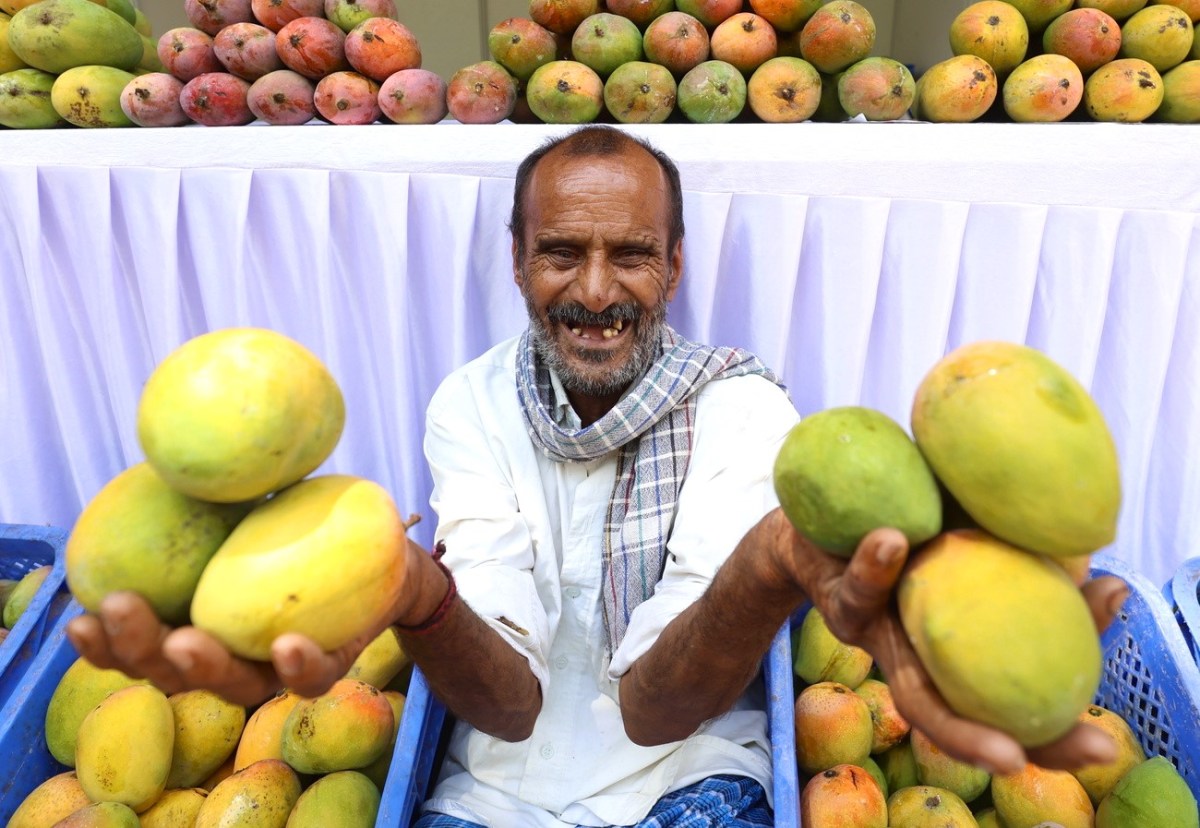
The pawpaw, known as the northern banana, could also become of interest in the coming years. This fruit, native to North America and resembling a mango, is already featuring in specialist agricultural journals.
“It could grow well in Switzerland, as it can withstand very severe winter frosts, with temperatures as low as -30°C, and it particularly thrives in the heat of summer,” Walter explains.
In principle, the almond tree would also be suited to a warmer climate. However, the Swiss climate, which can be damp at times, encourages the onset of fungal diseases. “Appropriate plant protection products would need to be authorised to ensure stable production,” he says.
More

More
Climate solutions
Legumes – Swiss farmers’ secret weapon against climate change
This content was published on
Jul 22, 2024
A group of farmers is betting on lentils and chickpeas as part of the solution to climate change in Switzerland.
Read more: Legumes – Swiss farmers’ secret weapon against climate change
Mangoes in Swiss greenhouses?
The cultivation of tropical fruits such as bananas, mangoes or avocados, on the other hand, seems far less realistic. “Due to winter frosts, it is practically impossible to grow tropical trees in Switzerland, unless they are grown in greenhouses,” Walter says.
Large-scale production is only economically viable in countries where winter temperatures do not fall below zero. On the other hand, according to Walter, mangoes grown in Spain could reach Swiss supermarkets in the “not too distant” future.
Ultimately, however, it will not be just the climate and growing conditions that determine which fruits will succeed. Consumers will also play a key role.
Growing new varieties on Swiss land, which is generally small in size and fragmented, involves high costs. For this reason, Walter considers it unlikely that Swiss peaches or nectarines will be able to compete with low-cost imported produce.
More

More
Six trend foods that grow in Switzerland
This content was published on
Sep 19, 2018
Crops once exclusive to South and Central America are flourishing in Switzerland as the demand for unusual foods with specific health benefits grows.
Read more: Six trend foods that grow in Switzerland
The potential of persimmons
The influence of the market on crop production is also evident in the case of persimmons. Until about ten years ago, this fruit played a marginal role in Switzerland, mainly due to low demand. Today, the situation is changing.
“The persimmon is a fruit that has only recently begun to gain recognition among the general public and which could be grown more widely in Switzerland in the future,” Walter says.
Heat and drought are therefore paving the way for new varieties and new crops. By 2050, in addition to apples and pears, Swiss consumers could also find Swiss-grown olives, pawpaws and even almonds on the shelves.
Translated from Italian, sub-edited by lj/ts
Articles in this story