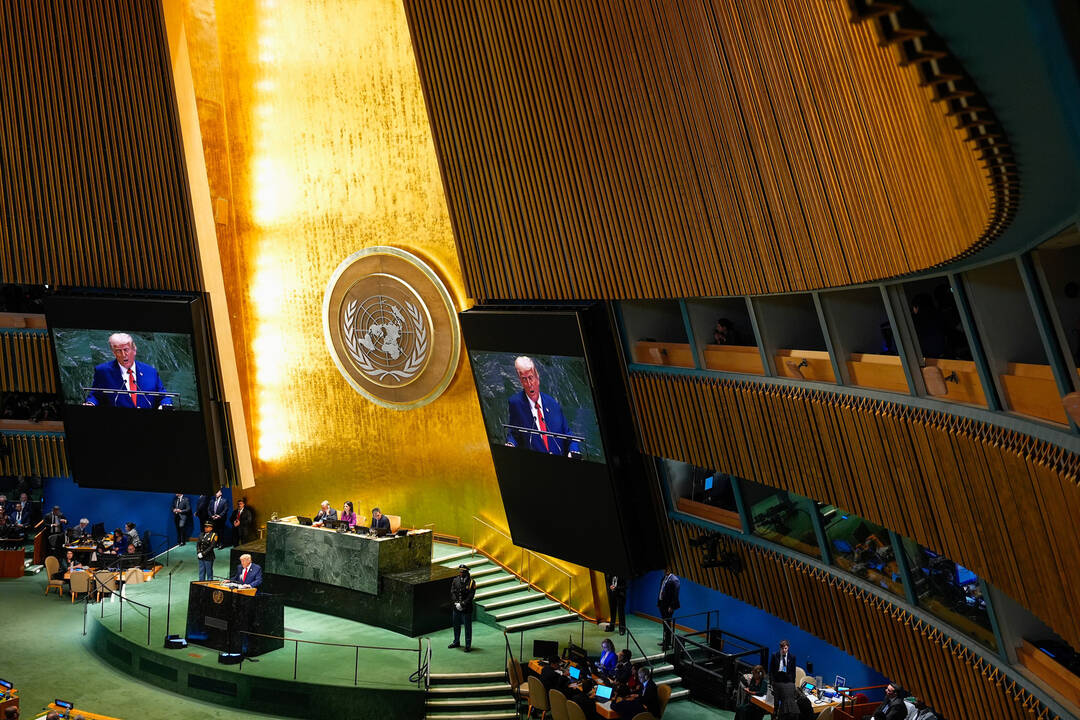
It’s that time of year again when world leaders descend on New York for the United Nations’ annual general assembly. In this special podcast episode, Dulcie Leimbach, editor-in-chief of PassBlue, and Paula Dupraz-Dobias, journalist at Geneva Solutions, sit down to discuss some of the critical issues at stake for the multilateral organisation.
The United Nations General Assembly will hold its high-level week starting Tuesday 22 September, where world leaders will tackle a packed agenda, from conflicts to climate change to pandemic preparedness, against a backdrop of growing discord between members and pressures on the multilateral system. As tradition requires, Donald Trump is scheduled to speak as the second head of state after Brazil on Tuesday, ahead of most of the other 193 member states.
At the same time, the 81-year-old body is grappling with a long list of its own challenges. Last week, the United States paid around $827m of its unpaid dues towards its regular budget, which, alongside late payments by China and other countries, has helped steer the UN away from the brink of bankruptcy.
“The focus appears to have now shifted to a broader reflection on where reforms will go, including mergers, efforts to reduce resolutions and mandates, and a reconsideration of staff compensation,” says Geneva Solutions journalist Paula Dupraz-Dobias.
“It will be interesting to see how the reforms and geopolitics play out not only at UNGA but also through the fall and into the new year, given the big leadership race heating up at the UN,” she adds.
None of the eight candidates has emerged so far as a clear favourite to succeed António Guterres as secretary general, sparking concerns over whether Security Council members will decide before his term ends on 31 December.
A third non-binding straw poll will be held on Friday afternoon in New York.
“Everyone is watching to see which of the eight candidates might get a score of nine or above. The nine is the threshold, meaning they have nine or the 15 council members’ support,” says Dulcie Leimbach, editor-in-chief of PassBlue.
Only Costa Rican economist and politician Rebeca Grynspan has scored over nine “encourage” votes so far, in the first round.
“Many diplomats and countries and NGOs…are hoping that a woman will finally be selected to run the UN after more than 80 years of male leadership,” she added.
Listen to the full podcast episode on Spotify:
This podcast was created in collaboration with PassBlue, a US-based women-led news platform covering foreign affairs. Olivia Ndubuisi produced the podcast. It was recorded at the International Peace Institute in New York.