Davis Cup

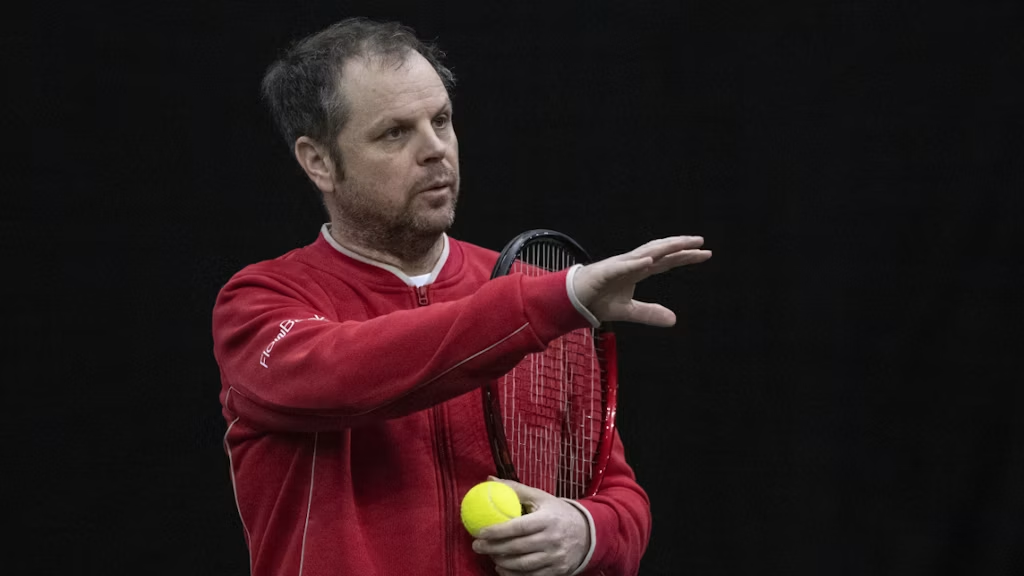
Going through a tough stretch: The Swiss Davis Cup team, led by Captain Severin Lüthi
Keystone
There was no upset in Brazil, so the Swiss Davis Cup team will remain in the second division next year as well. Given the current difficult situation in men’s tennis, that’s all they can hope for.

Today at 11:35
 Today at 11:35
Would the outcome have been different if Stan Wawrinka (ATP 134) had capitalized on his clear 4-1 lead in the second-set tiebreak against Gustavo Heide (ATP 123) to win the match? Would Captain Severin Lüthi have had more success if he’d fielded a different singles player than Dominic Stricker (ATP 262) against João Fonseca (ATP 29)? Was Switzerland simply unlucky in the draw when playing on the road against Brazil, led by Swiss Indoors champion Fonseca?
Hardly. For one thing, Lüthi’s team would have been the clear underdog even against other seeded teams—and thus potential opponents—such as Australia, Argentina, the Netherlands, Hungary, Denmark, or Serbia. Last year, the team was eliminated after a dismal performance in Biel against India, a team that was supposedly far inferior. This time, the South Americans were clearly in a league of their own.
“Brazil deserved to win,” Severin Lüthi states matter-of-factly. “Sure, we had our chances, especially in Stan’s match. But overall, they were clearly the better team.” A victory in any one of the matches would have done little to change the clear verdict—the outcome had already been decided at 0–3 after just three of the five possible matches.
No Swiss player in the top 100 for two years
This means that Switzerland will once again not be among the 28 teams in the top group with a chance to win the Davis Cup next year. Potential Swiss opponents include nations such as Bolivia, the Dominican Republic, Bosnia, Lebanon, or Morocco. Stan Wawrinka’s return—which also marked his farewell—is a painful reminder of more glorious days, with the 2014 Davis Cup victory as the highlight. The fact that the 41-year-old veteran came closest to a victory is a sign that more lean years lie ahead.
Instead of Dominic Stricker, Severin Lüthi could have fielded Rémy Bertola (ATP 187) or Jérôme Kym (ATP 284) as the second singles player, but their chances of winning against Fonseca would have been just as slim. The current state of Swiss men’s tennis is the bleakest it has been in at least half a century. September 30, 2024, marked the last time a Swiss player was in the top 100 of the ATP rankings (Alexander Ritschard spent one week at No. 99). Currently, the country is far from that level.
This year, Stan Wawrinka was the only Swiss player to make it into the main draw of a Grand Slam tournament—and on three of those four occasions, only thanks to a wild card. His two impressive victories earlier this year at the Australian Open were therefore the only Swiss successes at the highest level. In Rio de Janeiro, the player from Vaud was unable to cap off his illustrious Davis Cup career, partly because he reached his physical limits in the third set.
A Thank You to Wawrinka
It’s not up to him to pull Swiss men’s tennis out of its slump. Rather, Lüthi once again expresses his admiration for the three-time Grand Slam champion and Olympic gold medalist in doubles (with Roger Federer). “We’re very pleased and happy that he played for so long and made the long trip to Brazil once again.”
Wawrinka will likely make his competitive farewell in October at the Swiss Indoors in Basel. However, after losing his singles match early Saturday morning, the ambitious competitor’s spirit clearly shone through once again. “I definitely had my chances and could certainly have done better,” he noted. “Toward the end, I tried to force things a little too much. It was a tough match, and of course I’m very disappointed.”
More disappointments loom in the post-Wawrinka era if the younger Swiss players can’t turn things around soon.