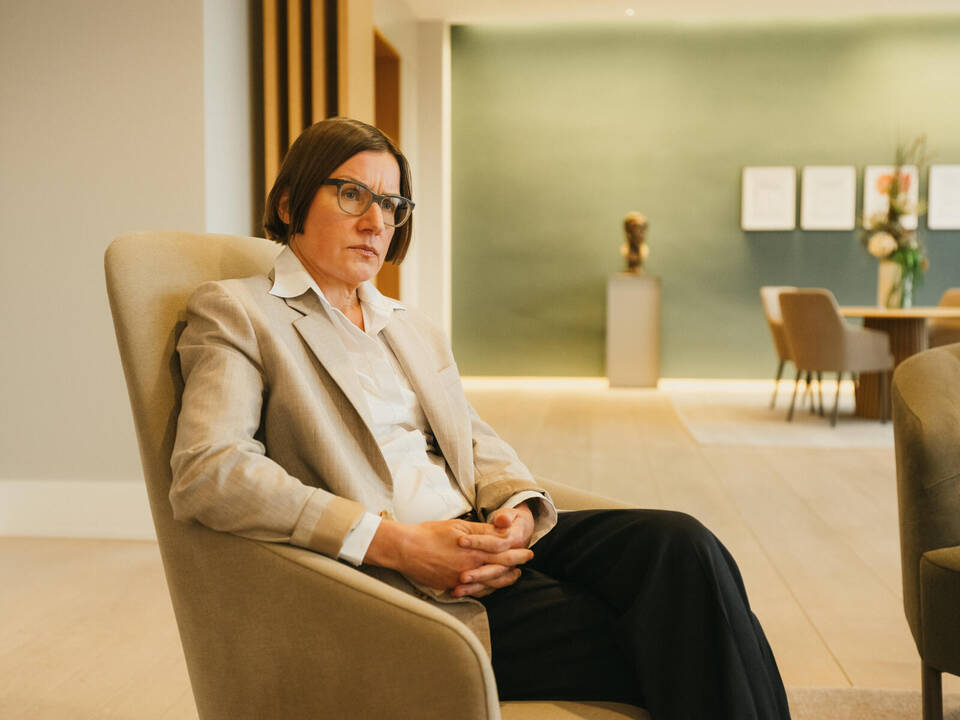
The ICRC president calls for a paradigm shift as the organisation must now engage directly with heads of state. She deplores the the international community’s moral failure in addressing the crisis in Gaza.
When Mirjana Spoljaric Egger took over as president of the International Committee of the Red Cross in autumn 2022, the organisation was in turmoil. After an era of over-expansion and ambitions to act like a “mini UN”, humanitarian aid cuts forced the Geneva-based body to confront its financial reality.
To steer the ICRC back on course, the Basel-born leader of Croatian descent – who previously worked at the Swiss foreign affairs ministry and later as a regional director for the UN Development Programme – took action on two fronts: she oversaw restructuring and budget cuts while developing a new strategy. Her efforts earned praise from UN officials, who were also grappling with financial hardship.
Now, at 55, Spoljaric Egger is beginning her second term amid an increasingly complex humanitarian landscape.
Le Temps: You are about to continue as ICRC president for another four years starting in October. What is your assessment of your first term?
Mirjana Spoljaric Egger: I could never have imagined facing such a series of critical events affecting the ICRC’s mandate during my tenure. The number and nature of conflicts far exceed anything the ICRC has seen in recent years. Yet I am very proud of how the organisation has risen to these challenges. There was the financial crisis of 2023, followed by drastic cuts to humanitarian aid. The year 2027 will be the first under my leadership without any budget reductions – though restructuring will continue.
Much has changed within our organisation, particularly in financial management and human resources. We can finally stabilise our operations. But as the challenges grow, we must prioritise our activities even more sharply. Despite the world’s difficulties, I am heartened to see that ICRC staff remain highly motivated and proud to serve an institution that is both hugely important and widely respected on the global stage.
Do you still enjoy broad support?
Political support for the ICRC has indeed grown because we have demonstrated – in Sudan, the Middle East, Gaza and Europe – our ability to carry out critical operations that no other organisation can replace and for which our universally recognised neutrality is fundamental.
Given the massive geopolitical shifts, you believe the ICRC can no longer operate as it once did. What changes have you made?
We are currently witnessing a clear escalation of tensions in the Middle East. Paradoxically, states are pursuing conflicting national policies, even though the world remains deeply interdependent. Despite frequent claims that international law and multilateralism are dead, I have never seen a time in my professional and diplomatic career when international humanitarian law has been so prominently valued – whether in agendas or as a basis for negotiation. Everyone recognises that none of today’s problems can be solved without it. Everyone agrees that upholding international humanitarian law is essential for maintaining good relations between states, as it provides a minimal common ground for agreement.
Swiss voters will decide on 27 September whether to enshrine neutrality in their constitution. How important is Swiss neutrality to the ICRC, and how does it differ from the ICRC’s own neutrality?
The distinction is crucial. Given the strong relationship and firm support between the Swiss Confederation and the ICRC, there is a tendency to conflate the two forms of neutrality. For us, neutrality helps us obtain humanitarian access – it is an essential condition to fulfilling our mandate.
A state does not need to be absolutely neutral. Some neutral states pursue various objectives and interests, which may be humanitarian but are often security-related, economic or political. This is why neither Switzerland nor the ICRC benefits from blending these two types of neutrality.
When Switzerland adopts EU sanctions against Russia, does this affect the ICRC?
In a 2023 op-ed I published in the New York Times, I emphasised that states are not required to be neutral, but they have chosen to create a neutral institution called the ICRC. After World War II, they recognised the need for an organisation that could act as an intermediary when states themselves could not. The primary duty of any government is to protect its people. The ICRC’s primary duty is to protect all those affected by conflict, regardless of nationality or ethnicity. We must remain available and equidistant to all parties in a conflict to reach those who need our support.
In 2023, you launched the global initiative to strengthen international humanitarian law, which initially had six participating states and now has 118. How does this initiative – whose high-level Conference on Humanity in War will take place in Jordan in December – change the game?
For us, it represents a paradigm shift. We needed to refocus priorities. States decide how wars are waged – we have no influence in that area. But we can influence how certain military operations are conducted. Until recently, the ICRC deliberately avoided political engagement to prevent the politicisation of humanitarian law. But given the severity of today’s conflicts, we realised that without political involvement, we cannot advance humanitarian access. Many of these are large-scale wars between states, often involving major powers. Military strategy and operations are ultimately decided by heads of government, who are also commanders-in-chief. Through this initiative, we encourage heads of state to prioritise the protection of civilians.
For some time now, states’ permissive interpretation of humanitarian law poses a real problem for us. That permissiveness has allowed those states to believe they are still complying with IHL even when attacking hospitals and civilian infrastructure. It allows them to tolerate a growing number of civilian casualties. That attitude reduces human life to mere statistics and fosters public indifference. This is dangerous because it normalises human suffering.
Can you measure the impact of this change?
Political support for our work has grown. States recognise that the escalation of conflicts and the disregard for humanitarian law pose dangers for everyone. They also understand that insecurity is a global phenomenon. A conflict in one region can have repercussions elsewhere due to technological advancements and the radicalisation of non-state armed groups, which increasingly cooperate across borders.
The world has long been partly governed by norms, yet international norms are now under attack from all sides.
I often use the philosophical term human condition, which, contrary to what one might think, is highly norm-dependent. Without norms, humans quickly revert to a state of nature. This is why organisation is necessary. Even within families, there are rules. Humans naturally seek stability through mutual agreements to enhance their own security. We often fail to realise how much we rely on such norms in our daily lives.
You recently joined the UN secretary general in urging immediate action on autonomous weapons and artificial intelligence. Why?
The integration of new technologies into cheap, widely accessible weapons systems poses a real danger. If we allow the proliferation of algorithm-controlled weapons, we could face a threat as grave as that of nuclear arms. States must urgently agree to ban certain types of weapons that operate without human oversight and to restrict others. On this, there can be no compromise: we must never allow a machine or algorithm to decide matters of life and death.
Isn’t it too late to act?
It is never too late.
What are your biggest challenges ahead?
Maintaining our field operations and promoting international humanitarian law – both of which lie at the heart of our mandate. To do this, we must understand and embrace the complexities of digital transformation.
A confidential letter you wrote to president Joe Biden was leaked to The New Yorker, in which you criticised the US administration’s stance on Gaza. Did you face any backlash?
The leak did not come from the ICRC. While it is rare, we are never pleased to see highly confidential documents shared with journalists. However, we did not experience any substantially negative reactions from any party. There is now a broad recognition that what has happened in Gaza should have been prevented, including the approximately 60,000 Palestinian deaths recorded. It is also imperative that the current situation does not continue. It represents a total moral failure. Living conditions have not improved: the people of Gaza remain without homes, infrastructure or healthcare. They are now confined to just 30 per cent of the Gaza Strip. Urgent political action is needed to lift them out of this misery – yet the will to act remains invisible. The world’s continued tolerance of this suffering will have grave consequences for future conflicts.
You still meet with Israeli authorities. Do you now have access to Palestinian detainees?
No, we are working intensively on this. We insist that we seek access to Palestinian detainees under our usual conditions – but these have not yet been met. We hope to return to the situation that existed before 7 October 2023.
How do you explain such a profound moral failure?
It is a process of slow erosion. At some point, you realise it is too late and that you have crossed red lines that should never have been crossed. We must not forget: the more international humanitarian law is violated, the harder it becomes for future generations to reconcile, as trauma and reconstruction costs mount.
What about Ukraine?
The security situation there is deeply concerning for both the population and our teams. Without electricity and clean water this winter, people may be forced to flee. It is urgent to end the hostilities.
Do you speak with Ukrainian and Russian authorities?
We maintain regular contact with both Russian and Ukrainian authorities. Cooperation has never stopped. The dialogue is concrete, intense and generally constructive. We have made progress in some areas, such as notifications to families about their missing relatives. This is important, as we have recorded 275,000 missing persons – both military and civilian. This is the highest number the ICRC has recorded since World War II. However, I would like us to regain access to Ukrainian prisoners of war held in Russia, which has not been possible since 2024. This remains a key point in my discussions with Russian authorities.
This article was originally published in French in Le Temps. It has been adapted and translated into English by Geneva Solutions. Articles from third-party websites are not licensed under Creative Commons and cannot be republished without the media’s consent. Geneva Solutions used an AI tool to assist with the translation of this article. The final version was verified and edited by our editorial team.