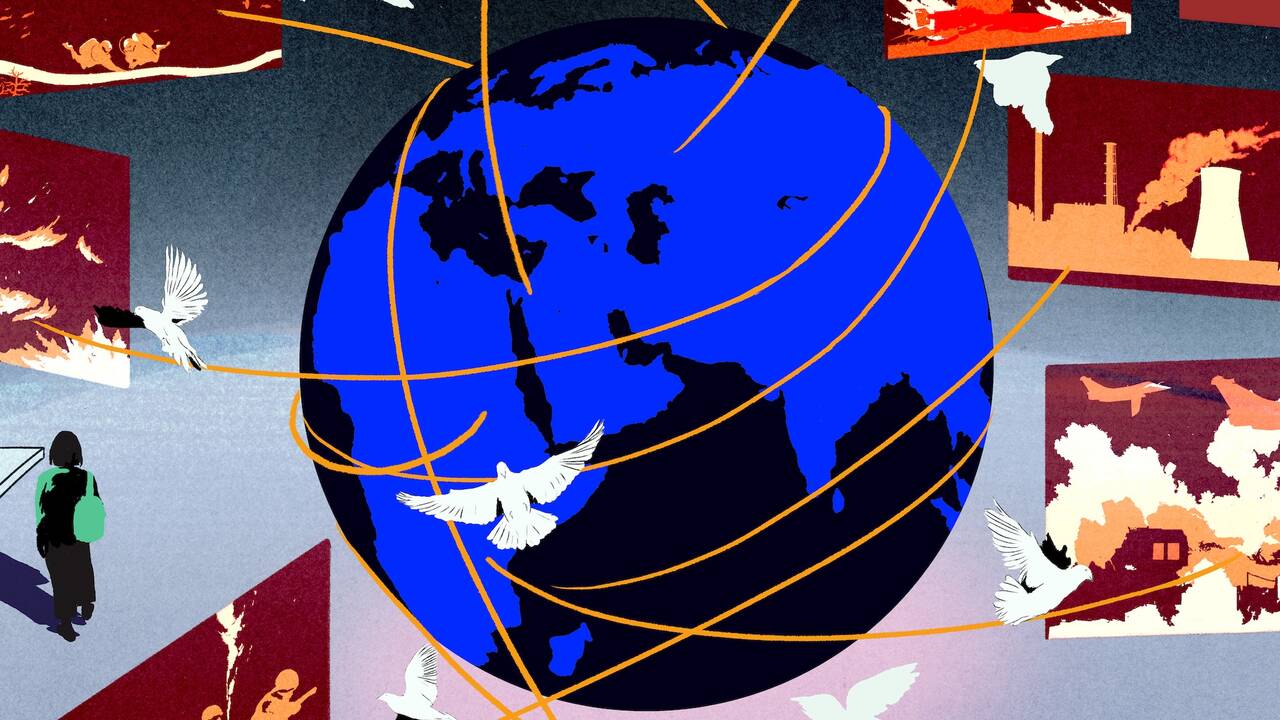
Competition for scarce resources, widening inequalities, mounting demographic pressures – as technological weapons become increasingly accessible, the world is growing ever more dangerous, writes Keith Krause, director of the Geneva Graduate Institute’s Centre on Conflict, Development and Peacebuilding.
The gods of war would surely be pleased with 2025 and 2026. According to the Swedish Uppsala University’s Conflict Data Project, the number of active armed conflicts has reached unprecedented levels – 65 ongoing conflicts – and the official number of conflict deaths in 2025 – 244,600 – was the highest since the Rwanda genocide. Military spending is also at historical highs: more than $2.8 trillion in 2025, according to the Stockholm International Peace Research Institute. Behind these headlines, democratic backsliding and social polarisation have set the stage for rising levels of political violence and political repression in places such as Iran, Chad, Haiti, Myanmar and Nepal.
The Roman war god, Mars, was a disciplined defender of the state and reflected martial virtues. By contrast, the Greek war god, Ares, exemplified the disorder, chaos and savage brutality of war. No doubt today Ares is ascendant, as the wars in Gaza, Sudan and Ukraine perfectly illustrate, with war crimes, civilian victimisation, unattainable war aims and violent stalemates. Given this context, can we make any sense of the wide array of forms of violence and armed conflict that we see today and what the future might hold? At least three important forces are at play.
Elusive victory
The Russian invasion of Ukraine is now in its fifth year – or more if we consider that the invasion of Crimea took place in 2014. Palestinians continue to die in Gaza, three years after the 7 October Hamas attacks in Israel. The warring factions in Sudan have been locked in violence since 2023 – once again in the long history of armed conflict in Sudan – and a civil war that has killed more than 80,000 people ebbs and flows in Myanmar since 2021. And the 2026 American-Iranian war has no clear endpoint.
So “victory” (whatever its meaning) remains elusive in today’s wars due to military stalemates where the advantage – in technology (US-Iran) and personnel (Russia-Ukraine) – are offset by strong defensive strategies. The temptation of “cheap and easy” victory that both presidents Vladimir Putin and Donald Trump fell prey to displays the hubris of power and the tenacity of adversaries. In other conflicts (Sudan, Myanmar), external parties have provided critical support (financial and military) that prolongs the fighting and reduces incentives for negotiation.
At the same time, as military spending reaches all-time highs in state budgets, the “barriers to entry” for the entrepreneurs of violence have declined. Small arms and light weapons, including militarised drones, are now readily available and circulate relatively easily in many regions, as the work of the Geneva-based Small Arms Survey has amply documented. Armed drone attacks by state forces, private military contractors and gangs are widespread in Port-au-Prince, Haiti, while in Myanmar, both the army and armed groups rely on drone warfare, often with inexpensive and modified commercial technology.
Cheaper and more accessible weapons
Aside from the low costs associated with mobilising for violence, current technology appears to favour the weaker side. Inexpensive drones costing tens of thousands of dollars can destroy much more expensive equipment, as is happening to Russian forces in Ukraine. Of course, the technological balance shifts over time, but the drone revolution, coupled with the growing threat of lethal autonomous weapons systems – UN language for AI-powered weapons with limited human control – suggests that we are facing a 21st century revolution in military affairs akin to that of the Industrial Revolution or the invention of gunpowder and artillery.
Armed forces in advanced industrial states are slow to adapt, and it will take time for this revolution to transform military structures and deployments – even if the lessons of the Ukrainian defence against Russia’s aggression are being closely observed in Nato and elsewhere.
International humanitarian law (IHL) was designed to channel violence in ways that states found acceptable –no killing of prisoners, no deliberate targeting of civilians, etc. While never fully respected, they at least provided a framework for accountability. Today, IHL is widely disregarded, with mass atrocities and blatant disregard of any norms of restraint by both state and non-state armed actors in places such as Gaza or Sudan. A growing sense of impunity, despite indictments from the International Criminal Court, is difficult to dispel and can only encourage further violations.
Predictions are best left to oracles. But at least we can firmly reject the idea, popularised by Harvard Professor Steven Pinker more than ten years ago, that we are progressively moving towards a more peaceful order, both within and between states. Aside from the liberal hubris in his argument, this is not just a question of the trends in conflict – which can go down as well as up – but of the underlying conditions that reduce the risk of violent conflict between human groups.
Conditions for peace no longer there
Three conditions made peace possible over the past 150 years: 1) cheap energy that allowed rapid economic growth, including bringing millions of people out of poverty; 2) few or no resource constraints since land and water were abundant and frontiers were opening; and 3) population growth that did not – until recently – over-stretch the Earth’s capacity.
Of course, the warning signs were visible as long ago as the Club of Rome’s 1972 report Limits to Growth, also known as the Meadows report, but the implications are now crystal clear: intense competition at the global and local levels over scarce resources, rising inequality between the “haves” and the “have-nots”, demographic pressures and the crossing of many of the sustainable planetary boundaries beyond just the climate crisis.
Scarcity, inequality and intense competition are breeding grounds for conflict. When the political and social institutions and mechanisms for channelling conflicts towards peaceful resolutions – courts, negotiation and informal agreements – break down, then the resort to violent means becomes almost inevitable. Ares is ascendant, and a peaceful order an ever more distant dream.
Keith Krause was professor of international relations at the Geneva Graduate Institute from 1994-2025, and is the director of its Centre on Conflict, Development and Peacebuilding. From 2000 until 2016, he was also programme director of the Small Arms Survey, an internationally recognised research NGO he founded in 2000.
Geneva Solutions publishes opinions and columns proposed by or requested from external contributors and experts. These texts reflect the point of view of their authors and do not represent the position of the media.