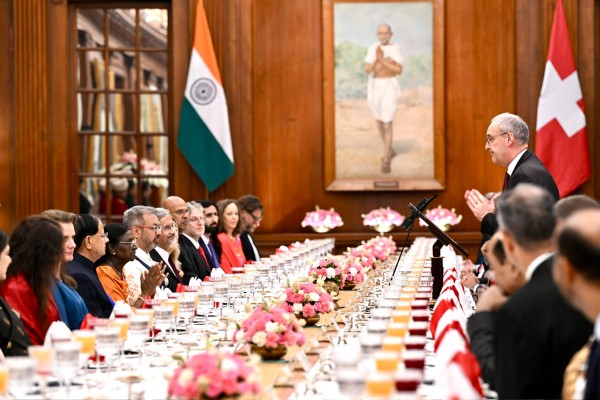
 Swiss President Guy Parmelin (right, standing) at the state banquet hosted in his honour by President Draupadi Murmu at Rashtrapati Bhavan in New Delhi on October 5, 2026.
India and Switzerland agreed to deepen cooperation in trade, investment, mobility, technology, infrastructure and people-to-people ties during talks between Prime Minister Narendra Modi and Swiss President Guy Parmelin on Monday.
The discussions focused heavily on implementing the India-European Free Trade Association (EFTA) Trade and Economic Partnership Agreement (TEPA), which entered into force last year.
Parmelin arrived in India on Monday for a three-day state visit accompanied by a high-level delegation of officials and business leaders. External Affairs Minister S Jaishankar also met Parmelin and welcomed his commitment to deepening bilateral ties, particularly by building on opportunities created by TEPA.
Modi described TEPA as India’s first free trade agreement with a European economic bloc and said it provided a framework for investment, innovation, employment and economic growth. “This is also an ambitious blueprint of investment, innovation, jobs and mutual prosperity,” Modi said.
Under TEPA, India aims to attract $100 billion in investment from EFTA countries over 15 years and generate one million direct jobs. Modi said the two sides had taken decisions to expand market access for Indian exports and facilitate investment. India and Switzerland also agreed to establish a special mechanism to address issues arising from TEPA’s implementation and promote trade and investment.
Swiss companies are active in sectors including transportation, logistics, financial services, manufacturing, pharmaceuticals, biotechnology, technology and electronics. Parmelin said he viewed the implementation of TEPA positively and expected it to boost bilateral trade in the coming years. Mobility was another focus, with India and Switzerland signing a Migration and Mobility Partnership.
“The arrangement provides for multiple-entry visas valid for up to five years, with stays of up to six months, while renewable one-year permits will be available to eligible students,” Secretary (West), Ministry of External Affairs, Sibi George, said. The two countries also signed an agreement on the exchange of young professionals, allowing young people to gain work experience and develop professional and language skills in each other’s countries.
The mobility arrangements cover students, skilled professionals, young workers and business travellers, while also providing for cooperation against irregular migration and human trafficking. Taxation-related cooperation was also discussed, including the exchange of information between the two countries’ authorities.
George said the exchange of information under the existing framework had been continuing, with India and Switzerland having worked together on tax-related information for several years.
The Ukraine conflict also figured in the discussions. India reiterated its position that the conflict should be resolved through dialogue and diplomacy, while the two sides exchanged views on international developments and diplomatic efforts to address conflicts.
The leaders also discussed multilateralism and reform of international institutions, including the United Nations. India reiterated its position that global institutions should better reflect contemporary geopolitical and economic realities.
India and Switzerland signed agreements covering transportation technologies, mobility systems and infrastructure. Areas of cooperation include sustainable transport, electric mobility, mountain infrastructure, tunnels and specialised technologies.
Science, technology and innovation also featured in the talks. A Letter of Intent was signed between India’s Department of Science and Technology and the Swiss National Science Foundation. An implementation arrangement with the Zurich University of Applied Sciences will promote cooperation in innovation, technology transfer and entrepreneurship.
Education and research were also discussed, with Switzerland inviting Indian students and researchers to explore opportunities at its universities. Swiss institutions have also been encouraged to examine opportunities for partnerships in India.
Modi invited greater Swiss participation in India’s creative industries and encouraged Swiss companies to explore opportunities under the country’s manufacturing and investment programmes.
Parmelin said the relationship was built on shared democratic values, trust and mutual respect, describing his visit as a step towards further strengthening bilateral ties.
Bilateral ties had “never been this close and dynamic”, he said, pointing to trade and investment, research and innovation, sustainable development and people-to-people contacts as areas of cooperation.