
A team led by the Swiss Federal Laboratories for Materials Science and Technology has found that removing the solvent stage from debinding produces denser sintered parts from extrusion-printed AA6061 aluminium. Combining single-step wick debinding with a longer sintering hold, the researchers reached relative densities of up to 97.9%. The study was published in Progress in Additive Manufacturing on 15 October 2026.
The work was led by Elham Montakhab, Montakhab, Sebastian Dariusz Linchard-Syta, Amir Hadian and Frank Clemens, with co-authors from AGH University of Krakow and the University of Applied Sciences and Arts Northwestern Switzerland. An earlier version appeared as a Research Square preprint on 12 May 2026, so October marks journal publication rather than the first release of the results.
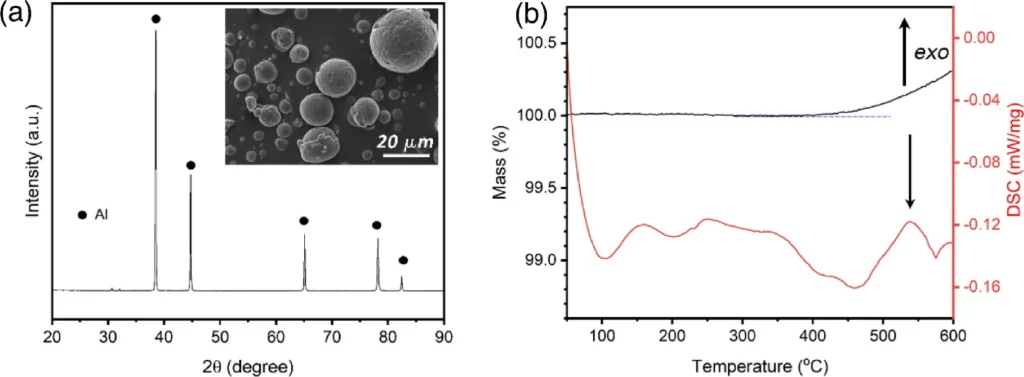 As received aluminum powder a XRD analysis with an inset of SEM image revealing the spherical morphology and b TG/DSC under a synthetic air flow. Image via Empa.
A 400 °C ceiling on debinding
In material extrusion (MEX-AM), a printer lays down a “green” part made of metal powder held in a thermoplastic binder, which must be removed before the part is sintered. Binder is usually removed with a solvent bath followed by burn-off in air. Aluminium complicates both steps because it oxidises readily, and the resulting surface oxide blocks sintering. Thermal analysis showed the 6061 powder begins to oxidise at around 400 °C, below the roughly 500 °C program the binder suppliers recommend.
The team mixed gas-atomised AA6061 at 60 vol.% with three commercial binders: EnCeram from Chemische Fabrik Budenheim, Kcmix3.3, and EmbemouldCC from KRAHN Chemie. EmbemouldCC separated during extrusion and was dropped. The remaining two feedstocks were pelletised and printed into 20 mm discs on a Tumaker Voladora NX+ pellet-screw printer.
Solvent baths left an oxidised shell
Following the suppliers’ instructions, the researchers first used solvent debinding followed by thermal debinding in air at 350 °C. This removed at least 96% of the binder, but sintered density was poor. EnCeram parts, soaked in water, reached only about 75%. The water had turned the powder surface into hydroxide, which converted to oxide on heating and left a porous outer layer of unbonded particles. Kcmix parts treated in high-purity acetone reached around 94%, but their edges still failed to densify fully.
The team then dropped the solvent step. Instead, printed parts were placed in a porous alumina powder bed that draws out the liquid binder by capillary action during one 24-hour heat treatment in air. At 350 °C, this removed over 97% of the binder with no cracking, blistering or deformation. Raising the temperature to 400 °C backfired. In a separate test, the aluminium powder gained about 0.25% in mass from oxidation after 24 hours at that temperature, and parts wick-debound at 400 °C sintered to lower density.
A ten-hour hold pushes density to 98%
After wicking at 350 °C and sintering in nitrogen at 635 °C for two hours, Kcmix parts reached 96.7% density and EnCeram parts 93.6%. Extending the hold to 10 hours raised these to 97.9% and 96.8% respectively, with even densification from centre to edge. The authors note these values exceed most reported for additively manufactured aluminium feedstocks. They add that the same feedstocks could also be warm-pressed, extruded or injection moulded.
The best result still requires 24 hours of debinding and 10 hours of sintering in nitrogen. The team measured only density and microstructure, and says mechanical properties must be evaluated before the method can move toward industrial use.
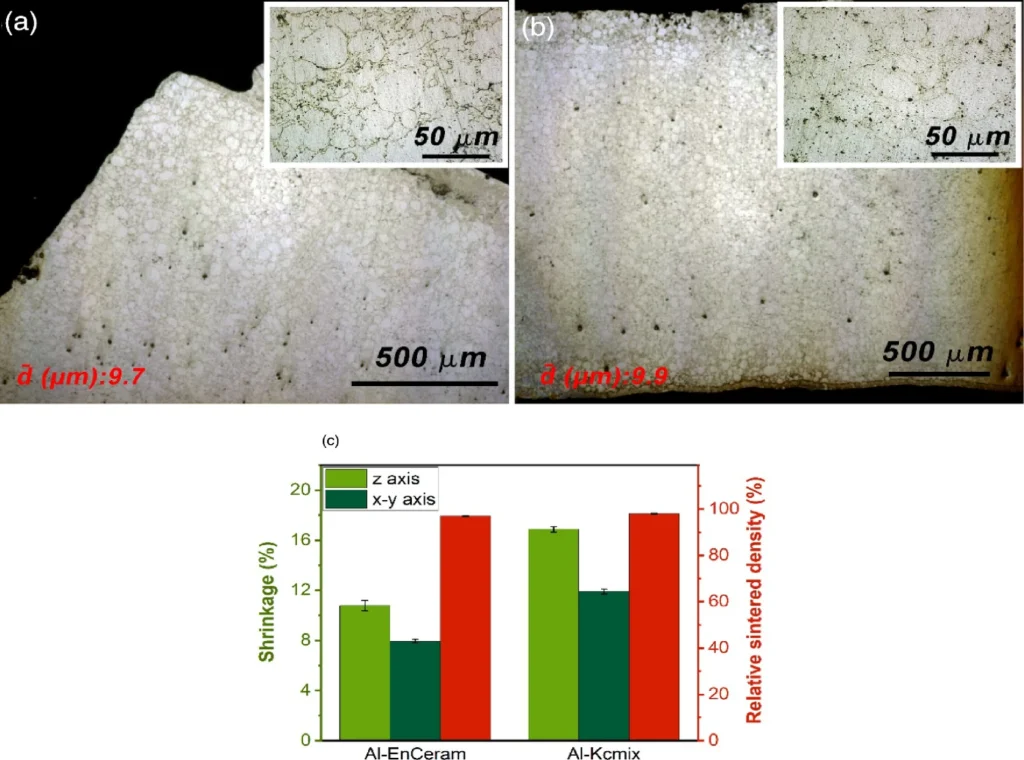 Optical microscopic images of a EnCeram-350-10, b Kcmix-350-10 and corresponding geometrically measured c shrinkage in x-y and z axis and relative density of the samples sintered at 635 °C for 10 h. Image via Empa.
The long road to sintered aluminium
The Swiss-Polish team is taking a low-equipment approach to an alloy that metal AM has struggled to sinter. Rather than developing new binders or specialised powders, it focuses on the step between printing and the furnace. The goal is a debinding route that runs in air on standard extrusion hardware, using binders anyone can buy.
Most progress on sinter-based aluminium so far has come from binder jetting and depended on engineered powders. Desktop Metal and Uniformity Labs launched a sinterable 6061 aluminium powder for binder jet 3D printing, which the companies said beat wrought 6061 on yield and tensile strength with similar heat treatment. Its selling point was sintering without the usual workarounds, such as coated particles, sintering aids, nanoparticle-laden binders, or added lead, tin or magnesium. ExOne presented a 99% dense 6061 binder jetting material validated with Ford at AMUG 2021. Separately, McGill University tests showed Equispheres’ AlSi10Mg powder could be sintered without compaction to over 95% density.
Extrusion-based aluminium has moved more slowly. When Markforged unveiled the Metal X desktop metal 3D printer at CES 2017, 6061 and 7075 aluminium were listed only as beta materials. The Virtual Foundry later tested a microwave sintering method for 3D printed metal parts on its own Aluminum 6061 Filamet, as a potentially quicker and cheaper alternative to a furnace. Even so, aluminium has typically needed sintering carbon or controlled gases because it reacts with oxygen.
Powder makers have shown that aluminium can be sintered to high density. The Swiss result suggests the debinding step, not the alloy, may be what has held extrusion back. Mechanical data will decide whether it matters.
To stay up to date with the latest 3D printing news, don’t forget to subscribe to the 3D Printing Industry newsletter or follow us on LinkedIn.
Explore the full Future of 3D Printing and Executive Survey series from 3D Printing Industry, featuring perspectives from CEOs, engineers, and industry leaders on the industrialization of additive manufacturing, 3D printing industry trends 2026, qualification, supply chains, and additive manufacturing industry analysis.
Featured image shows Optical microscopic images of a EnCeram-350-10, b Kcmix-350-10 and corresponding geometrically measured c shrinkage in x-y and z axis and relative density of the samples sintered at 635 °C for 10 h. Image via Empa.