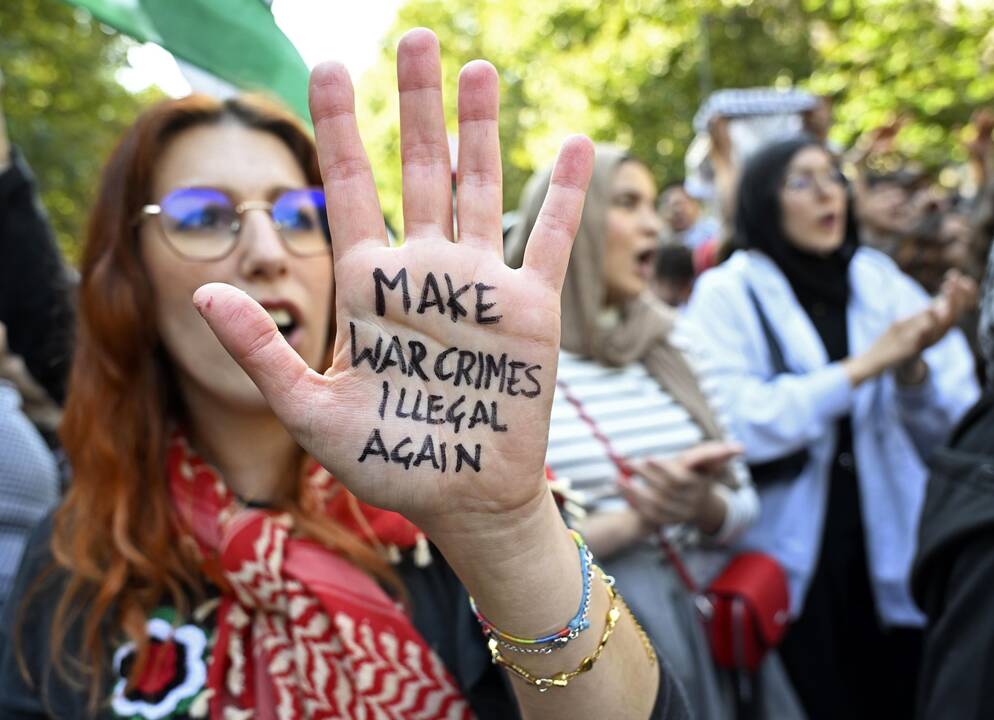
In Geneva this week, government experts will present practical recommendations to strengthen the implementation of international humanitarian law ahead of leaders meeting next month in Amman to support the Geneva Conventions.
Barely a day goes by without suspected violations of the rules of war making headlines. Last week, the United Nations said Sudanese government forces and the paramilitary Rapid Support Forces continued to commit abuses, including killing and injuring civilians and demolishing schools, displacement sites and basic utilities. In Ukraine, a Russian drone strike hit the Dnipro train station, killing at least 14. Many other violations went unreported.
According to a recent study, conflicts have reached their highest number since World War Two, while the International Committee of the Red Cross (ICRC) reports more than 130 active armed conflicts in over 60 countries, nearly double the number compared to 15 years ago.
“We are really in a decade of war, and simultaneously, we are seeing the number of violations of the law of war increasing,” said Anne Quintin, head of the Global International Humanitarian Law Initiative at the ICRC’s legal division, echoing concerns by the organisation’s president, Mirjana Spoljaric. “Narratives regarding the respect and the use of the law tend more and more to become an attempt to use humanitarian law to justify the level of destruction and the number of people who are injured and killed.”
In response to the abuses, the ICRC, together with Switzerland, as the depository state for the Geneva Conventions, has been working with countries to strengthen implementation of the conventions, as hosts of the Global Dialogue on International Humanitarian Law. On Tuesday and Wednesday, state representatives will meet in Geneva to present the outcome of talks aimed at drawing up recommendations on how to improve their implementation.
‘Non-politicised’ discussions
Over the past two years, more than 160 countries were involved in five rounds of consultations, involving thematic or logistically-focused workstreams – such as naval warfare, the use of information and communication in warfare and the protection of hospitals – with input from experts, including officials implementing the law.
“We succeeded in bringing states, including those currently involved in conflict, to the same table for discussions that remained non-politicised and focused on substantive issues,” Quintin explained, noting the participation of countries directly affected by, or engaged in conflict, including the United States, Israel and Russia.
Among the concrete recommendations made by countries participating in the dialogue were directives on how the military refers to enemy populations, ensuring that the armed forces receive cultural briefings to understand how to operate in other countries and stressing the importance of essential services for the survival of civilian populations. Mapping of civilian infrastructure and related services, such as electrical plants that supply hospitals and road networks needed for medical supplies, was also recommended.
The dialogue was part of a plan, the Global Initiative to Galvanise Commitment to International Humanitarian Law, launched in 2024 by Brazil, China, France, Jordan, Kazakhstan and South Africa, to reboot global commitments to the law and make it a political priority for governments. Since then, the initiative has grown to include some 127 countries, though Israel, Russia and the US have not formally joined. A high-level summit is planned for 7 December in Amman, Jordan, to underscore governments’ support for international humanitarian law.
Quintin highlighted the Initiative’s dual approach. “The civilian population caught up in armed conflict wants us to be more forceful and aware of what they are exposed to and how they suffer. We therefore must strengthen our direct engagement with political, legal and military levels of government, to try to influence and improve the situation on the ground for those suffering.”
Insider-outsider effect
Advocates of the initiative say it represents an important step to bolster the rules in the current context, where major powers are violating the Geneva Conventions. “It is meant to produce recommitment and a clarification of the rules, and to show that there is a broad international consensus, almost 80 years after the Geneva Conventions, that they are the core guidelines for how to wage war, and this is something that cannot be simply set aside,” said Nico Krisch, international law professor at the Geneva Graduate Institute.
He said the vast coalition behind the Initiative may, by its numbers, signal that those who haven’t joined are responsible for breaking the rules and not distinguishing between civilian and military targets. “Symbolism plays a great role in international politics,” he added. “Yes, we don’t have a global police force to enforce international norms. Everything depends on reputational effects of insider-outsider definitions, to get countries to see that it is not costless to ignore the rules.”
But violating those laws still has consequences, as Andrew Clapham, also a professor of international law at the Geneva Graduate Institute, stressed. Despite US mounting sanctions on the International Criminal Court, with Secretary of State Marco Rubio vowing to dismantle it “brick by brick”, he noted the arrest warrants issued by the court against Russians accused of war crimes. “There are definitely people thinking about the rules as they engage in those activities, realising that one day, they can be held accountable.”
Added legal value
Clapham, who recently edited a collection of essays titled New Dynamics of War, participated in the dialogue’s workstream on naval warfare. He said that the outcome documents got into a lot of detail, “going beyond what’s available in agreed treaty law.”
In naval warfare, where rules are mostly based on custom and government-published manuals, he said, states discussed issues never dealt with before. These included submarine cables, questions regarding merchant shipping – a major issue now in the Strait of Hormuz and the Strait of Bab el-Mandeb, at the southern limit of the Red Sea – and references to blockades, which cannot be used to starve civilians or excessively in relation to the anticipated military advantage, Clapham added.
The US State Department told Geneva Solutions the US participated “actively” in discussions of the seven workstreams of the Initiative, and “shared information regarding interpretations of IHL and the US military’s good practices for implementing IHL.
“Every state has an interest in how the rules are explained and how they are articulated,” commented Clapham, who recently edited a collection of essays titled New Dynamics of War.
In its email, the State Department wrote that the US “is still considering its further engagement with the Initiative”.
The Israeli mission in Geneva did not respond to questions regarding their government’s participation in the process.