
 Zermatt recently closed the Furgsattel 71 piste on the Furgg Glacier indefinitely due to the glacier’s melting. | Credit: Matterhorn Chalets
In heartbreaking news for European skiers, Zermatt recently closed its famous Furgsattel 71 piste indefinitely due to significant melting on the Furgg Glacier. According to an Instagram post from a Zermatt ski instructor, Jason Wright, the glacial retreat has revealed a large rock face at the top of the piste, as well as a sizable crevasse in the middle of the slope, making it unsafe for skiers.
“The glacier has melted and changed this slope forever,” Wright wrote in his Instagram post.
Zermatt has not yet commented on the status of the slope, but the Furgsattel 71 no longer appears on the resort’s list of slopes. Because of this, it is likely that Zermatt is completely abandoning the run, which was traditionally used by families. According to French news source 24 Heures, the topographical changes made to the slope occurred at an altitude of over 3,200 meters, significant given the melting at such a high elevation.
 Wright’s Instagram video revealed the massive rock and crevasse on the Furggsattel 71 piste. | Credit: Jason Wright Instagram, @jasonleftwrightleft
The Furgsattel 71’s melting is part of a larger trend of glaciers retreating across Europe and the Alps. Back in March, the Austrian Alpine Club issued a “red alert” after recording the most severe glacier retreat since its monitoring began in 1891. The club monitors 79 glaciers across Europe and recorded an average retreat of 66.6 feet in 2024-25. In 2021-22, the average was 94.2 feet. At their current pace, scientists estimate that more than half of the region’s glacier ice could vanish by the end of the century.
“Many glaciers not only lose their length, but are increasingly entering a phase of structural decay,” Andreas Kellerer-Pirklbauer from the University of Graz and Head of the Glacier Measuring Service of the Alpine Club added.
Structural decay is exactly what we’re seeing happen at Zermatt. Glaciers are massive rivers of compressed snow that slowly flow downhill under their own weight. Over decades and centuries, they develop internal fractures, pressure zones, and fragile layers. Warming trends have weakened those structures, revealing boulders and widening crevasses.
The closing of the Furgsattel 71 is just one of many glacial issues Zermatt has dealt with over the past few months. The biggest of which was the closing of the Theodul Glacier over the summer, which typically remains open. Back in July, Matterhorn Bergbahnen AG announced that operations had to be temporarily suspended on the Theodul Glacier due to extreme alpine heat and a lack of overnight freezing, causing the glacier to experience extreme melting. The conditions have even brought dangerous situations, with rocks scattered across the glacier and the stability of the lift towers being questioned. National alpine ski teams have used the glacier to train in the off-season, but its closing forced them to look elsewhere, with some even opting for indoor ski slopes.
The Furgsattel 71 is just one of thousands of ski runs on glaciers in the world, but its closure is a troubling sign for ski resorts that use glaciers for operations. Glacial collapse does not show any signs of slowing down as retreat measurements continue to be stubbornly high. And unless governments around the world strictly implement effective climate policy to slow down global warming, the mountains and their communities will experience serious tragedy.
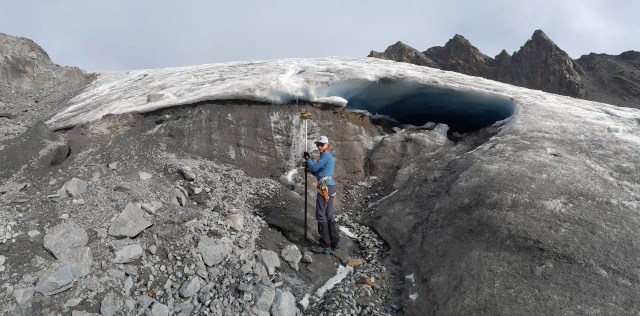 Measurement work at the Guslarferner, Ötztaler Alps, in 2025. | Credit: ÖAV Glacier Measuring Service/Martin Stocker-Waldhuber