As the EU’s new AI labelling rules on images take effect, debates grow over whether labels alone are enough to distinguish between what is real and fake. Both UN experts behind the policies and photographers say labels cannot settle it alone.
Artificial intelligence-generated images are flooding the internet at breakneck speed and are becoming increasingly realistic. The EU has responded with labelling rules, and standards bodies are building tools to show where an image came from. But experts don’t think these tools can entirely show whether an image is true. Photographers share the same belief: maintaining trust in a photo still depends on human input.
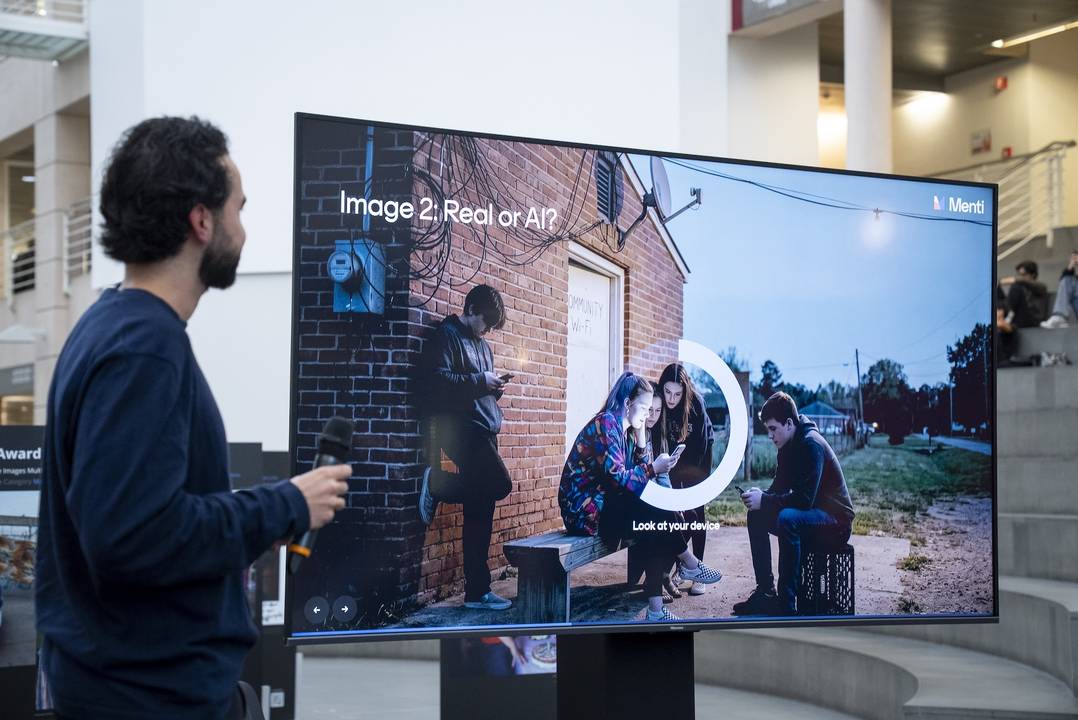
These tensions were the focus of a panel discussion last month around AI and truth in images, hosted in Geneva by Giga, a Unicef and ITU initiative working to connect all schools to the internet. The audience was asked to distinguish between synthetic images and real photos. As most participants mistakenly identified some authentic photographers as AI generated, the experiment made it clear that perception and intuition alone are no longer enough for its distinction.
The evening took place behind the winning works of the Giga Photo Award, which bans AI generated images. “This event focuses on generative AI precisely because of the questions it poses for photography today,” Daniel Ginsianmung, coordinator of the award, told Geneva Solutions.
Trust in an AI-generated world
Historically, humans have assigned trust to tangible evidence – a photograph, a signed document or a recording. “Nothing I see online now is true,” Christopher Fabian, the head of digital inclusion at Unicef and co-founder of Giga, told Geneva Solutions. “The fundamental substrate of our reality is changing aggressively and fast,” he added.
Data on how trustworthy people consider these images globally is scarce, though recent studies suggest intuition is no longer reliable. A survey of 401 US consumers by Clutch, a directory for finding and vetting business service providers, found that, on average, 57 per cent of its participants failed to identify whether an image was AI-generated, while a Microsoft research study of over 12,500 participants worldwide found an overall detection accuracy of 62 per cent.
The scale of the issue is large: Google’s latest statistics from May 2026 show more than 50 billion images have been generated with their Nano Banana image generation model, while OpenAI’s ChatGPT reported that around 3 billion images are created every week.
Some photographers are wary of the rise of AI-generated images and their impact on trust and credibility. Clément Lambelet, head of the photography masters at the school of design and art in Lausanne, ECAL, who spoke at the event, told Geneva Solutions: “I do not see how trust can be rebuilt after the emergence of AI.”
Photojournalist Hannah Reyes Morales, a Pulitzer finalist, and another panelist stated she doesn’t use AI at all and views it as a trend in her industry. She told Geneva Solutions: “Those who use AI in photography are not photographers. Photography is about observation; it happens in the encounter, in the real world. It’s a human endeavour.” She also believes the emergence of AI has increased the value of photojournalism, not decreased it.
The regulator’s bet
Governments and policy makers have began to regulate the use of these images, as they can manipulate and deceive public trust in both traditional and social media. However, regulation efforts have been underway. In 2024, the UN convened a high-level Advisory Body on Artificial Intelligence to develop recommendations on international AI governance.
In the same year, a group of standard bodies led by the World Standards Cooperation (WSC), an alliance between standard-setting organisation the International Telecommunication Union (ITU), the International Organization for Standardization (ISO), and the International Electrotechnical Commission (IEC), alongside tech companies and policy makers, launched a multi- stakeholder initiative called AMAS, aiming to guide AI global governance and combat its misuse, disinformation, and misinformation.
However, regulation remains fragmented. There are no global binding rules for AI-generated images. Since 2 August 2026, the EU’s AI act transparency rules require providers of generative AI systems to add machine-readable marks so AI-made content can be detected, and those who deploy the systems to disclose deep fakes.
Other countries are moving in the same direction: China requires visible labels and embedded metadata while India requires visible watermarks. Switzerland has no AI specific law yet, though it plans to incorporate the Council of Europe’s AI convention.
A group of tech and AI experts from the UN and the IT private sector recently wrote a policy paper for the WSC aimed at offering governments guidance. Responding to questions from Geneva Solutions, Silvia A. Carretta of Newcode.ai, Venkatesen Mauree of ITU’s standardisation bureau, and Alessandra Sala of Shutterstock, warned of the “growing convergence around transparency but fragmentation in implementation”. The authors explained by email that jurisdictions differ over what must be labelled, who is responsible, what form disclosure takes and what happens when obligations are breached.
Do the labels hold up?
Under the EU AI act, the duty to mark content falls mainly on the companies that build AI systems, with social media platforms covered separately by the digital services act.
Though labels have proved a positive first step, evidence shows they’re not watertight. One investigation by AI Forensics covering three European countries found only half of TikTok’s AI content was properly labelled, against 23 per cent on Instagram. Meanwhile, a Reuters Institute survey conducted in nine countries found that only 24 per cent of people had seen a label saying that content was made with AI on a news website or app.
“It is impossible to label AI generated content properly,” said ECAL’s Lambelet, noting that markers can be removed.
Newsrooms rely on people, not labels. Photo editor Anne Wyrsch at Le Temps said they “depend on photographers bound by the same ethics code” and thoroughly check images with specialised tools, not accepting AI-generated pictures at all.
Giga’s award works similarly, Ginsianmung said. “Jurors check metadata, use reference images and fact-check entries.”
The policy paper authors flag labels as a risk to manage. One solution they point to starts with the camera, which can cryptographically sign its images.
They argue that labelling is not enough to trust an image; provenance provides a much more trustworthy record of where content came from. But that has limits too. “It cannot, on its own, answer, is what I am seeing true? Truth still requires context, corroboration, journalism, forensic analysis, trusted institutions and human judgement,” they explained.
The experts warned against creating a “technical oracle of truth”.