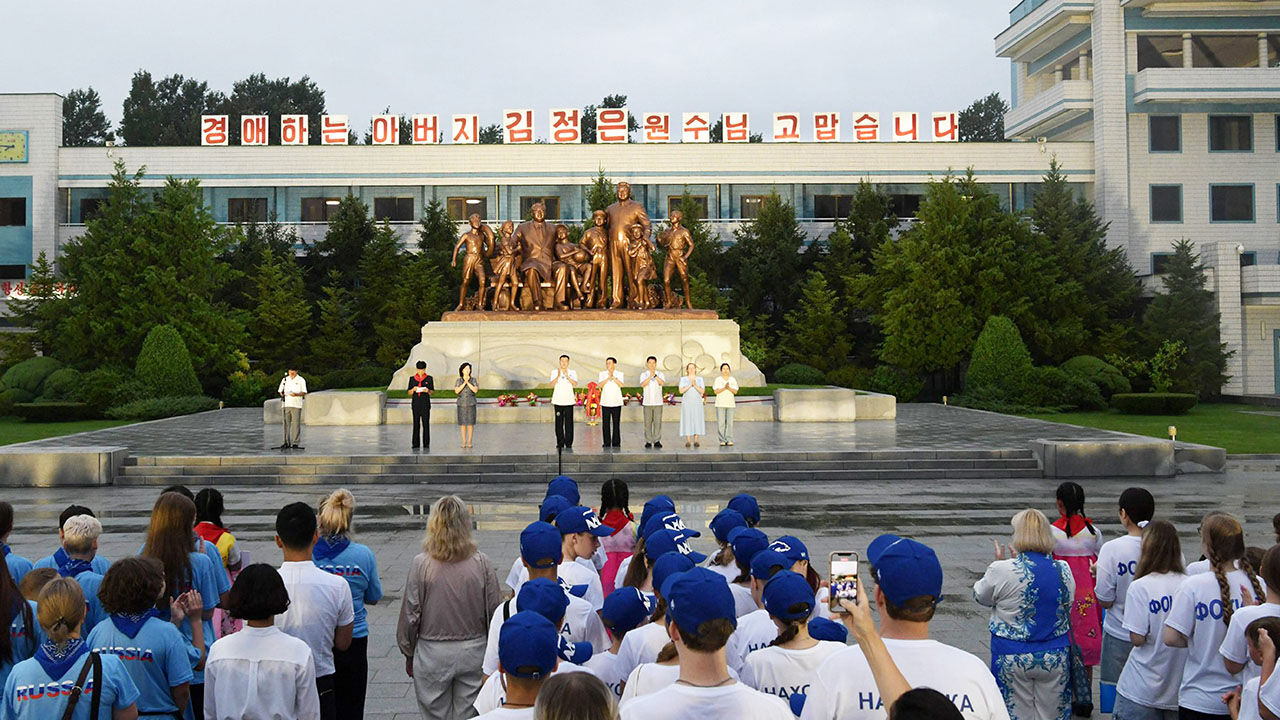
▲ North Korea’s Korean Central News Agency reported that an opening ceremony was held on July 19 at the Songdowon International Children’s Camp for ‘Songdowon Friendship Camp-2026,’ attended by student delegations from North Korea, Russia, and China.
Following the United Kingdom and the European Union, Switzerland has also added North Korea’s Songdowon International Children’s Camp to its sanctions list targeting Russia.
Voice of America (VOA) reported today that the Swiss Federal Department of Foreign Affairs and the State Secretariat for Economic Affairs (SECO) added the Songdowon International Children’s Camp in Wonsan, Kangwon Province, North Korea, to Switzerland’s sanctions list on November 3.
VOA reported that the Swiss Foreign Ministry and SECO stated this in a response sent to VOA yesterday.
Explaining the grounds for the sanctions, the Swiss government said, “According to EU information, the Songdowon Camp participated in an organized program in cooperation with Russian-linked forces to transfer children from occupied territories of Ukraine to North Korea.”
Under the sanctions, the Songdowon Camp’s assets in Switzerland are frozen, and providing funds to the institution is prohibited.
The Songdowon Camp was previously sanctioned by the UK in May and by the EU in September, and has now been added to Switzerland’s sanctions list as well.
The Swiss government added that this decision came as the Swiss Federal Council adopted EU sanctions related to the war in Ukraine to respond to Russia’s serious violations of international law.
Switzerland, which is not an EU member state, does not automatically apply EU sanctions.
The measure appears to have been taken after Switzerland opened its diplomatic office in Pyongyang last month.
Swiss Foreign Minister Ignazio Cassis visited North Korea late last month, meeting with Workers’ Party Secretary Jo Yong-won and Foreign Minister Choe Son-hui, and attending the official opening ceremony of the diplomatic office.
Songdowon Camp opened in August 1960 to promote the superiority of the North Korean system to youth from pro-North Korea countries.
At the summer camp held in July, students of Russian and Chinese nationality gathered there to interact.
Meanwhile, VOA reported that the European Commission has decided to establish the ‘EU Sanctions Office’ in January next year, a dedicated body bringing together the entire sanctions lifecycle—from policy design to implementation, blocking circumvention, and coordination with third countries—to enhance the effectiveness of member states’ sanctions, including sanctions on North Korea.
The European Commission explained that the EU Sanctions Office will be established under the Secretariat-General of the Commission, initially addressing sanctions on Russia and Belarus, but covering all of the EU’s sanctions regimes, including North Korea and Iran.
The Commission also appointed Lars Danielsson, a veteran Swedish diplomat who served as Sweden’s ambassador to South Korea, as the new sanctions envoy.
The key mission of the sanctions envoy is to engage directly in consultations with non-EU third countries to reduce the risk of EU sanctions being undermined by sanctions evasion.
VOA projected that this move would further refine the EU’s monitoring of evasion of Russia sanctions and its cooperation framework with third countries.
Meanwhile, regarding the use of high-end Swiss- and Austrian-made ski equipment by State Affairs Commission President Kim Jong-un’s daughter Ju-ae and Pak Jong-chon, vice chairman of the Workers’ Party Central Military Commission, the manufacturers of the products told VOA that they have no business relationship with North Korea and cannot determine the authenticity of the products or their distribution channels.
VOA pointed out that recreational sports equipment such as skis are luxury goods banned from being brought into North Korea under UN Security Council Resolution 2270, and that even if manufacturers did not sell them directly to North Korea, transferring them to North Korea through third-country intermediaries, overseas diplomatic missions, or smuggling networks constitutes circumvention in violation of UN sanctions implementation obligations.
(Photo: Korean Central News Agency, Yonhap News)
※ Please note: This article was translated by AI and may contain errors.