This article was produced by National Geographic Traveller (UK).
We meet late in the afternoon, just before the last chairlift — a strange time for the first run of the day. Across the empty car park, I spot breath rising in the frosty January air, from my backcountry touring guide, Alizée Dubosson. I shuffle across to meet her and begin to question what it is I’ve signed up for.
All my gear for the next three days is crammed into a small backpack: skins (grippy ski covers for uphill hikes), a head torch, a transceiver, avalanche snow probe and a shovel. Up ahead are the white-toothed Dents du Midi and the equally odontic Dents Blanches, summits tracing the Swiss-French border that always pull at the gaze.
The mountains loom over the Portes du Soleil, one of the world’s most coveted ski destinations. I’m in the Swiss canton of Valais, on the first stage of a north-to-south, border-hopping ski safari, from Morgins in Switzerland to Morzine in France. It will be a trip through almost a dozen villages, but also one into a half-forgotten past. Along the way, I’ll visit former customs houses, secretive places used to police the flow of contraband across the border, now converted into affordable, unique and strangely intimate mountain refuges. In every location, the valleys spread out far below what was once the frontline against the banditry and smuggling that was rife in the 18th and 19th centuries.
Even for those not interested in such recent Alpine history, the Portes du Soleil’s scale is a splendid thing to observe. For days, you can descend snow-cloaked mountains, glacial valleys and pine glades, never having to retrace your tracks. Established in 1965, the international ski area’s status has continued to grow, making it one of Europe’s largest winter destinations, and its epic terrain continues to spark the imagination. When we begin our first off-piste tour, eyeing the Pointe de Bellevue above Morgins, it feels almost abandoned.
“It’s so special when the lifts close,” Alizée tells me. She wears a body-hugging backpack, close-fitting goggles and a helmet pulled down so tight she looks like a stunt performer. “This is definitely the best way to see the Dents du Midi — it’s exciting!”
By 5pm we’ve skinned up (hiked uphill in skis) and boot-packed (hiked in ski boots) onto the high flank of Le Corbeau — ‘the crow’s peak’. The last smear of light on the horizon helps guide us on our descent to L’Ancienne Douane refuge. The slope is steep, the powder shin-deep. Half an hour later in front of the hut, my guide hands me the door key, says a quick goodbye, and sets off at speed back down the mountain towards Morgins, and into the darkness. Left alone, my senses are dazzled. Twilight rushes in. The temperature plummets below zero.

Switzerland is known for its farming cheese fondues, which are best enjoyed with views over snow-capped mountain valleys.
Gabriel Premand

The wooden chalets in Avoriaz are hidden behind snow-capped pine trees.
Loïc Bouchet
Chocolate, Cheese and Cowbells
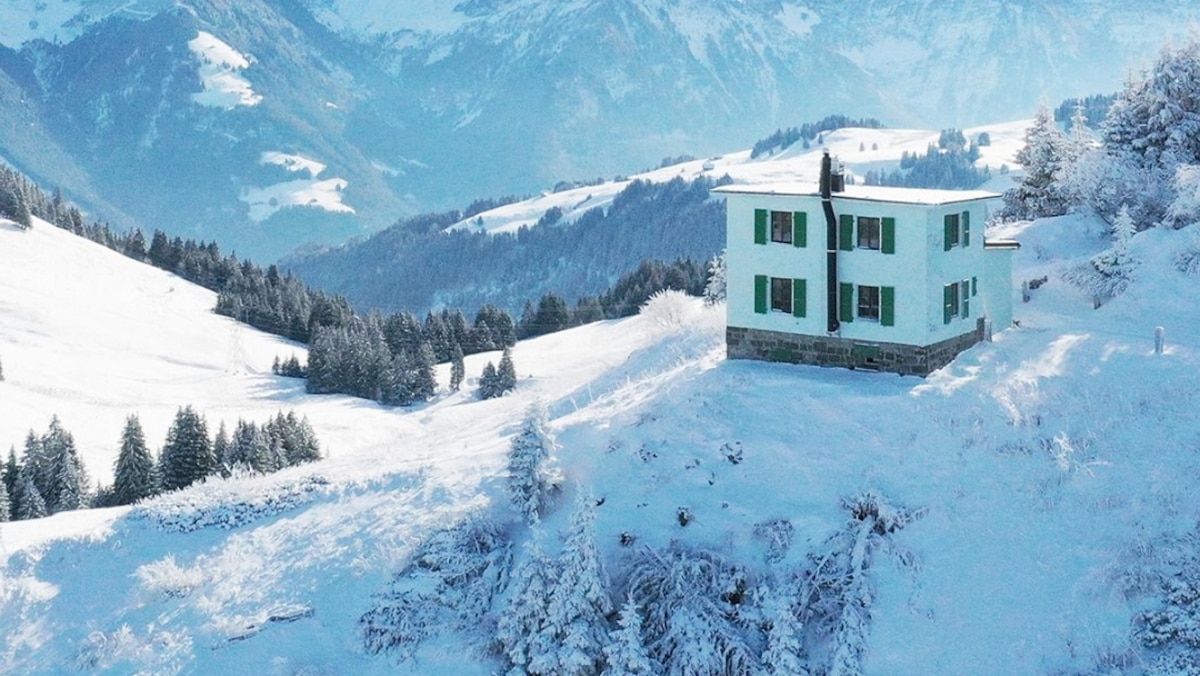
Built in 1928 above the Col des Portes de Culet — a 1,787-metre mountain pass — L’Ancienne Douane operated as a custom house until the late 1950s. It accommodated customs officers nicknamed gabelous, derived from the gabelle, the notorious salt tax introduced by French kings in the Middle Ages. Not that it’s possible to tell looking at it today, but the guard station was pivotal in stopping local mountain smugglers, who took advantage of the difficult-to-reach terrain to bootleg high-value contraband like tobacco, alcohol, gunpowder, coffee, chocolate, cheese and even cowbells for the black market. This cat-and-mouse game arose to bypass strict French import duties, and in response to wartime shortages and fluctuating prices between France and Switzerland. It might have been a simpler matter, if it weren’t for the harsh mountains and heavy snowfalls. The bandits took risks. They evaded and they hid, using modified skis lined with animal hides to muffle their tracks.
This Swiss border post is neither the highest nor the largest of the seven customs houses in the region, but it is one of the newest: left empty for years, it was renovated in 2020 with an eye on becoming a one-of-a-kind, six-bed, self-catering AirBnB. Skis off, I slip the key into the wooden door’s heavy lock and step across the stone threshold. Up here, it feels like being untethered from reality.
Inside, the warden has left the wood-burning stove in the common room lit. A scribbled note awaits me by the door: ‘Le dîner est dans le frigo’ — dinner is in the fridge. When I open it, after taking off my boots, I find cured Valaisan air-dried meats, Sbrinz cheese, bread, butter and beer from the local brewery. I pop a cap and warm myself by the fire.
L’Ancienne Douane counts as budget accommodation (80 CHF/£73 per night), and is surprisingly comfortable. My bedroom has a warm duvet and pillow, there are cosy house slippers, and the hot shower is real welcome. Just as I begin to turn in for the night, I come across a cupboard with emergency essentials: energy-boosting pasta, rice, Ovomaltine (Ovaltine) and, for those in genuine need of salvation, a bottle of champagne. Outside, the mountains shift from dark grey to black, softly disappearing below a mantle of stars. Then the Dents du Midi, my only companion for the night, vanish altogether.
Pulling back the shutters, set to explore the the next morning, I see L’Ancienne Douane the way it’s meant to be seen — enveloped in eiderdown-soft snow that glints in the rising sun. Then another ski guide arrives on the first lift of the day from Châtel in France, and I invite him in for café au lait — a strange thing to do while perched at 1,820 metres, with clouds rolling in below us.
“I’ve been teaching and guiding here since I was 25, but I’ve never been inside,” says ESF instructor David Brisseau, now more than twice that age and pacing like a keen estate agent. I tell him the smuggling history is new to me and he replies by telling me about the old customs house in Châtel. When the last customs officers moved out in 2009, it was converted into a museum of local bootlegging. “Now you’re the master of the house,” he jokes. “I promise, I smuggle nothing!”
After coffee, we ski. I stop halfway down the piste to admire the mountains and soon fall behind. L’Ancienne Douane now looks like a Tardis landed accidentally on the col. When I catch up with David, we’ve arrived in France — already en route to our second border post.
As far as ski days go, it’s hard to imagine many more beautiful than our journey down to Châtel, then up to Pré la Joux, with its views of Mont de Grange, the highest peak in the Abondance valley. Chairlifts soar to the top of cols, and, in reducing light and a creeping blizzard, we move in snakes and ladders style to Avoriaz, France’s 1960s avant-garde resort.

The slopes in Morzine are powdery and easily accessible via cable car lifts.
©DLM
Priests and Professional Smugglers
After arriving in the car-free village, we’re met by Chrys Felisaz, who takes the baton as my final Portes du Soleil guide. By way of introduction, the former French alpine ski champion leads me onto the Fornet chairlift and up across a ridge to within touching distance of the Col de Cou pass at 1,920 metres.
This winter, the historic crossing point between Morzine in France and Champéry in Switzerland welcomes the Cabane du Col de Cou, another former customs post to reopen as a refuge for ski tourers. Larger than L’Ancienne Douane, the 40-bed hut is staffed and off-grid, with solar panels and an autonomous waste management system. “The Portes du Soleil gets crowded,” Chrys tells me, “but this is something different — and I can’t wait.”
As history can attest, there’s no arguing with the location’s setting. Over the centuries, a hospice, chapel and hospital have been erected on the saddle, and it speaks to a fierce instinct for survival in the wildest of places. Looking at the lonely refuge, I find it hard to believe that professional smugglers once struggled over the fearsome slopes in harsh weather while trying to avoid capture. During the World Wars, stories circulated that the most cunning used networks of accomplices, including farmers and even a priest who hid black-market goods in his church.
As the sun returns, the off-piste sings with light, and we drop onto an unpatrolled area below the Col de Cou. Into the twisting folds of the Vallée de la Manche, silent but for our skis sifting through powder, we whoop on the long, wild descent to the road below. Chrys flashes ahead in a sped-up ballet of red fabric, and after the crowded pistes of Avoriaz we have the valley to ourselves. Beneath a pearly sky, it’s like skiing on a polar ice cap.
That night, tired and having skinned up one last track, I find myself once again bedding down at a historic epicentre for Franco-Swiss smuggling. Refuge de la Golèse, set above Morzine, has a shared heritage with the other huts that straddle the border and I’m relieved to find it creaky and almost empty.
A misguided notion persists that vast ski areas like the Portes du Soleil have reached a limit for crowds. But these optimistic border-post huts are proof that escape is possible anywhere. Even in the middle of a busy, international-class resort, you can quickly disappear into a more elemental landscape and feel like you’ve stepped back in time.
Published in the Winter Sports guide, available with the December 2026 issue of National Geographic Traveller (UK).
To subscribe to National Geographic Traveller (UK) magazine click here (available in select countries only).