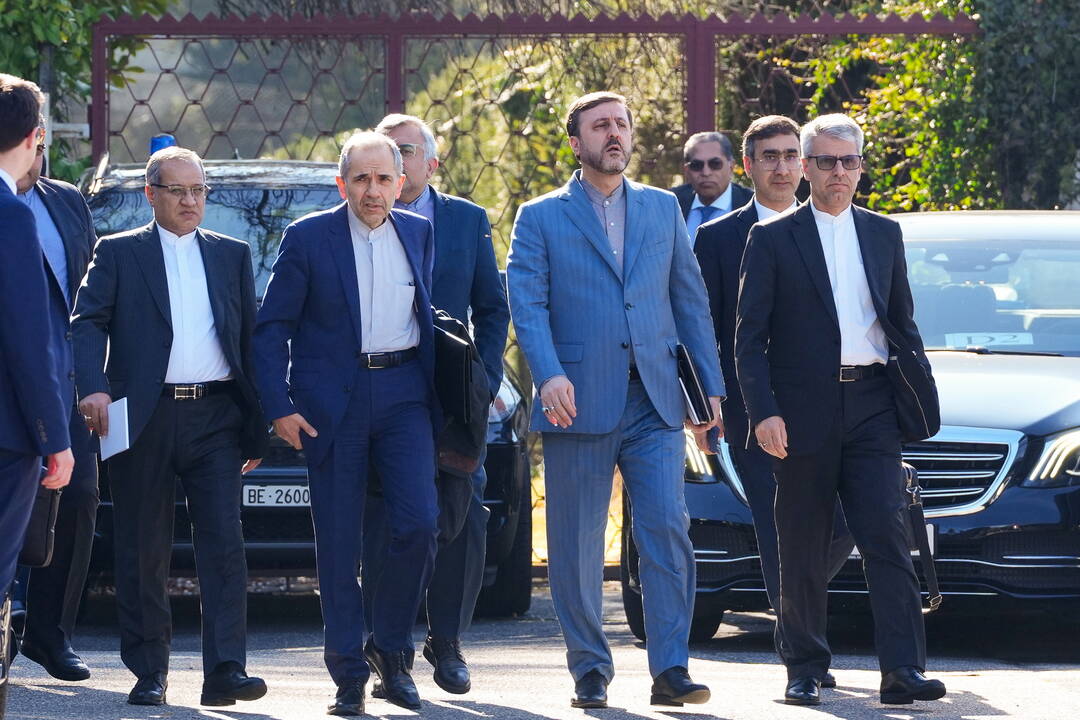
Indirect talks between the United States and Iran took place in Geneva on Thursday as the White House increased threats of military action. Technical talks are expected next week in Vienna.
Iran’s foreign minister, Abbas Araghchi, met in Cologny at the residence of Oman’s ambassador to the UN for indirect negotiations over the country’s nuclear programme with US special envoy Steve Witkoff and president Donald Trump’s son-in-law Jared Kushner.
Discussions wrapped up on Thursday evening, with the Omani foreign minister Badr Albusaidi, who acted as mediator between the two parties stating that “significant progress” had been made and technical talks are planned next week in the Austrian capital.
As boats crisscrossed Lake Geneva not far from the venue in the upscale neighbourhood, the setting of the talks could not be more in contrast to the military sabre-rattling in the Middle East, where the White House has mounted its biggest military buildup since the 2003 Iraq war in efforts to pressure Tehran to accept tough demands.
The negotiations are centred on Iran’s nuclear capabilities, with the US insisting on zero enrichment, no nuclear weapons, and that it dismantle its nuclear sites. Iran has maintained its right to enrich uranium and that its nuclear programme is for peaceful purposes.

Residence of Oman’s ambassador to the United Nations in Geneva, in Cologny, Switzerland, 25 February 2026. (Geneva Solutions/Paula Dupraz-Dobias)
‘Positive’ results ahead of break
After roughly four hours of discussions that began Thursday morning, Albusaidi wrote on X that “creative and positive ideas” had been exchanged between the parties before they paused for a break. Witkoff and Kushner departed Cologny for a scheduled meeting at the Four Seasons Hotel in the city centre with Ukrainian officials.
On the Iranian side, officials appeared positive. Ali Shamkhani, a close advisor to Iran’s supreme leader Ayatollah Ali Khamenei, said that an “immediate agreement was within reach”. Meanwhile, an individual identifying himself with the Iranian press told Geneva Solutions that the “atmosphere was much better” than at last week’s talks in Geneva, which ended after three hours.
A spokesperson for Iran’s foreign ministry told Iranian state television that Tehran was “ready to continue talks for as long as possible.”
Read more: Iran-US talks: Tehran hopes for a ‘lasting solution’, but remains prepared to defend itself
Talks resumed in the evening after Iranian and American negotiators returned to the Omani residence, and lasted for an additional two hours.
Rafael Grossi, International Atomic Energy Agency director general, was also actively involved in discussions. In his role, he could ensure that an Iranian offer to verify uranium enrichment corresponds with the organisation’s requirements. Ahead of talks on Wednesday, he warned that a failure to reach an agreement may lead to the use of force.
The IAEA’s board of governors are set to meet in Vienna next Monday, presenting a potential platform for the negotiating parties to present any results.
US pressure
While US officials did not communicate on Thursday about the talks, the White House upped its pressure on Tehran ahead of the meeting. On Tuesday, in his State of the Union speech, Trump said that Iran continues to seek to develop a nuclear weapon and ballistic missiles capable of reaching the US. He threatened to take military action against Iran if a deal was not reached. US forces currently in the region include two aircraft carriers, attack planes and multiple destroyers.
Secretary of state Marco Rubio had said that he wanted talks to include limiting ballistic missiles and Iran’s proxy militias in the region. Iran, for its part, has in recent days carried out military exercises in coastal areas.
The US treasury department also imposed new sanctions on Wednesday, including on Iran’s “shadow fleet” of ships, referring to oil tankers that smuggle oil for countries under strict US sanctions.