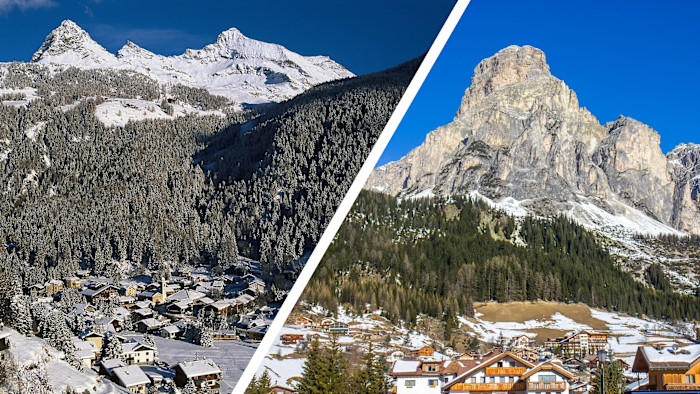
Once considered a poor relation to France and Switzerland in terms of skiing, Italy is now a buzzword in mountain sports circles. Both Savills and Knight Frank have witnessed increasing numbers of Alpine property buyers pointing their skis in its direction; not least because it’s often better value. In Cortina d’Ampezzo, Italy’s chicest resort, and host to the 2026 Winter Olympic Games, asking prices are up 10 per cent year on year, yet are still 30 to 40 per cent less than in St Moritz in Switzerland, according to Knight Frank’s most recent ski report.
Buyers aren’t only focusing on Cortina, though. Two other destinations in their sightlines are the Sellaronda, a circular ski route in the Dolomites connecting four picturesque valleys (Cortina d’Ampezzo is also linked indirectly), and the Monterosa ski area, 500km away on the Italian side of Mont Blanc near the French and Swiss borders, stretching across the Aosta Valley to Piedmont. Villages such as Selva di Val Gardena and San Cassiano in Sellaronda, and Champoluc in Monterosa are particularly beautiful and unspoilt.
 Alta Badia in Sellaronda has easy, quiet slopes and fast lifts © Simone Padovani/Getty Images
Data from Christie’s International Real Estate suggests that prices for ski property have climbed by about 17 per cent in Sellaronda and about 8 per cent in Monterosa in the past two years. Traditionally these areas have been popular with European buyers based within driving distance: the Dolomites are just three to four hours by car from southern Germany and accessible from Venice, while Monterosa is just over two hours from Milan and Turin, and an easy journey from Lausanne and Geneva in Switzerland. Increasingly, though, British and American buyers are cottoning on to both the comparatively affordable prices and Italy’s favourable tax regimes, such as the flat-tax scheme (€200,000 a year) and the “impatriati” or “brain-gain” worker regime, says Kate Everett‑Allen, head of European residential research at Knight Frank.

Separated by rugged mountains, the two areas look and feel very different. Sellaronda, which is in the South Tyrol, one of Italy’s wealthiest regions, has strong cultural links to Austria, reflected in the cuisine and architecture; German is an official language, along with Ladin and Italian. Luxury boutiques and a new Aman hotel in the village of San Cassiano, and the Michelin-starred La Stüa de Michil in Corvara are indicative of the wealthy northern European clientele, explains Hana Cmakalova of property agents Domus Global.
That said, it’s still possible to eat and drink at reasonable prices, adds Tom Collett, founder and director of Collett’s Mountain Holidays, who is a specialist in the Dolomites market. “Some of the hotels and private properties are exquisite, on a level with the best in Europe, but it’s still possible to buy a pizza for €10 and have a mezzo di rosso for next to nothing.”
 Gressoney-Saint-Jean in Monterosa is known for its off-piste skiing up to 3,275 metres © Simone Crespiatico/Alamy
Monterosa, meanwhile, is distinctly Italian in feel, with French and Swiss Alpine influences. “It’s Italy’s version of the Trois Vallées — high-altitude skiing with lots of off-piste, yet the villages are undeveloped with no big tour operators or apartment blocks,” says Simon Brown, owner and founder of Ski Champoluc, a small tour operator in the area. “Alagna in particular feels as if you’re stepping back in time 100 years.” His clients appreciate the “honest” local restaurants and hotels. “A glass of wine is €4, coffee is €1 and you can still get lunch on the slopes for €10,” he says. “You can’t really get a bad pizza in Italy.”
Alagna offers the best value: prices are about €3,500 per sq metre — a snip compared with Zermatt, 12 miles away, where prices start at €9,500 per sq metre
Both areas offer extensive piste networks enabling skiers to click into their bindings in the morning and ski different slopes all day. They also have extensive snow-making provisions — in Sellaronda 95 per cent of the piste network has snow canons, ensuring good conditions whatever the weather. “You end up skiing for many miles, stopping for lunch along the way; the ski schools take children until 3pm to ensure their parents have time to get back,” says Collett.
Sellaronda is the gentler of the two ski areas, though. Collett likens the 40km Sellaronda loop to the M25; it can be skied in both directions and has multiple junctions into the 500km Dolomiti Superski network, connecting the South Tyrolean valleys of Val Gardena, Alta Badia, Arabba and Val di Fassa. “It’s a family-friendly ski area with easy, quiet slopes and fast lifts,” Cmakalova says. “You don’t have to walk more than two steps before you’re on a magic carpet.” This year a €215mn infrastructure upgrade is under way, which will include a new fast cable car in Val di Fassa and new heated, weather-protected chair lifts in the villages of La Villa, Corvara and Arabba.
 La Villa, a village in the Badia valley, Sellaronda © iStock/Getty Images
Extreme skiers wanting moguls and gnarly off-piste might feel short-changed, though — the locals are protective of the natural environment, Collett warns. “Most of the red runs in the Dolomites would be blues in France, and the blacks would be reds,” he says. In summer, the villages are increasingly lively, with visitors choosing the mountains over the Mediterranean, adds Cmakalova: “It’s 25 degrees and sunny and you can go hiking, paragliding or cycling.”
Collett regards Arabba as the unsung gem: a quiet village with exceptional skiing
The Monterosa Freeride Paradise ski area, spanning the villages of Gressoney and Champoluc in the Aosta Valley and Alagna Valsesia in Piedmont, offers friendly ski schools and a wide range of motorway pistes, but the area is best known for its off-piste skiing up to 3,275 metres. Alagna Valsesia in particular is famous for its heli-skiing and ski-mountaineering, Cmakalova says.
While currently a smaller ski area than Sellaronda, Monterosa has plans for a cable car linking Alagna Valsesia to Zermatt in Switzerland — joining five valleys via 75 ski lifts to create one of the largest ski areas in the world: about 530km of marked pistes. The project is still in the planning phase but Brown believes that it would be transformative both for the ski area and the second-home market.
Property prices in Monterosa are often more than 50 per cent below those in Sellaronda, according to Christie’s International Real Estate’s figures. The majority of buyers are Italian, although Brown says a number of his British holidaymaker clients have bought properties in Champoluc. “You can pick up an apartment for €200,000,” Cmakalova confirms.
Alagna offers the best value: prices are about €3,500 per sq metre, compared to about €4,700 per sq metre in Gressoney and €4,800 to €6,000 per sq metre in Champoluc — a snip compared with Zermatt, 12 miles away as the crow flies, where prices start at €9,500 per sq metre, according to Christie’s International Real Estate. A number of small-scale luxury developments have proved successful, however, including a development of bespoke ski-in/ski-out chalets above Champoluc, which sold out last year through Savills with prices for three-bedroom properties starting at €1.3mn. Planning rules are strict, to protect against over-development, but as Cmakalova points out, there will probably be more small-scale developments of this type.
 Alagna in Monterosa, where prices are low and ‘It feels like you’re stepping back 100 years’, according to Simon Brown of Ski Champoluc © Jozef Sedmak/Alamy
Planning is equally stringent in the Dolomites, which is a Unesco World Heritage Site; the villages around Sellaronda have retained their authentic charm — there are no high-rise apartment blocks or large-scale developments. While property prices are lower than in resorts such as Courchevel, buyers still find them punchy. Planning regulations and the fact Italian families tend to pass property down through the generations ensures a chronic lack of stock, which keeps prices high. A decent studio apartment rarely costs less than €500,000, Cmakalova says, while chalets tend to sell for between €3mn and €6mn. The highest prices are found in Corvara (€13,000 per sq metre, up from about €10,000 in 2020) and Selva di Val Gardena (€12,000 per sq metre), closely followed by the village of Badia (€10,500 per sq metre), according to Christie’s.
 Champoluc in Monterosa is particularly beautiful and unspoilt © Vittorio Valletta/Alamy
The village of Arabba is the most affordable of the Sellaronda circuit, with asking prices between €3,000 and €5,000 per sq metre. Collett regards Arabba as the unsung gem: a quiet village with exceptional skiing as it links not only to Sellaronda but also to the Marmolada glacier, the highest mountain in the Dolomites. “Arabba is at 1,600 metres and most of the skiing is north-facing, thus conditions last four weeks longer than in Corvara,” he says. Christie’s International Real Estate forecasts 3 to 5 per cent annual growth across Sellaronda over the next five years; Maria Lena Brunner of Benedetti Luxury Properties in South Tyrol, an affiliate of Christie’s, also regards Arabba as a particularly interesting investment opportunity.
For every buyer who relishes the affordability and investment potential of Monterosa, there’ll be another who wouldn’t look anywhere other than Sellaronda, she says. “There are properties in Monterosa that haven’t had a euro spent on them in 20 years,” she continues. “Some buyers love a challenge but our international clients often find this hard to get their head around — they prefer to go to the other side of the Italian Alps and pay more.”
On the market © Alex Moling
Alta Badia, Sellaronda
A peacefully located detached chalet on Pic Ju, metres from a ski slope, with views of the Marmolada from its private garden and terraces. The living room features a traditional Tyrolean stube and there are three bedrooms plus an office. €1.45mn, savills.com

Val di Fassa, Sellaronda
An apartment with direct access to the Sellaronda. There are two bedrooms, two bathrooms, a balcony and a garage parking space. The town of Canazei is surrounded by the Marmolada, Sella and Sassolungo mountains. €1.25mn, Domus-global.com

Champoluc, Monterosa
A newly renovated chalet with open-plan kitchen, living area with fireplace and three spacious bedrooms. There is also a sauna and a large garden and panoramic views. Price on application, lionard.com
Find out about our latest stories first — follow @ft_houseandhome on Instagram