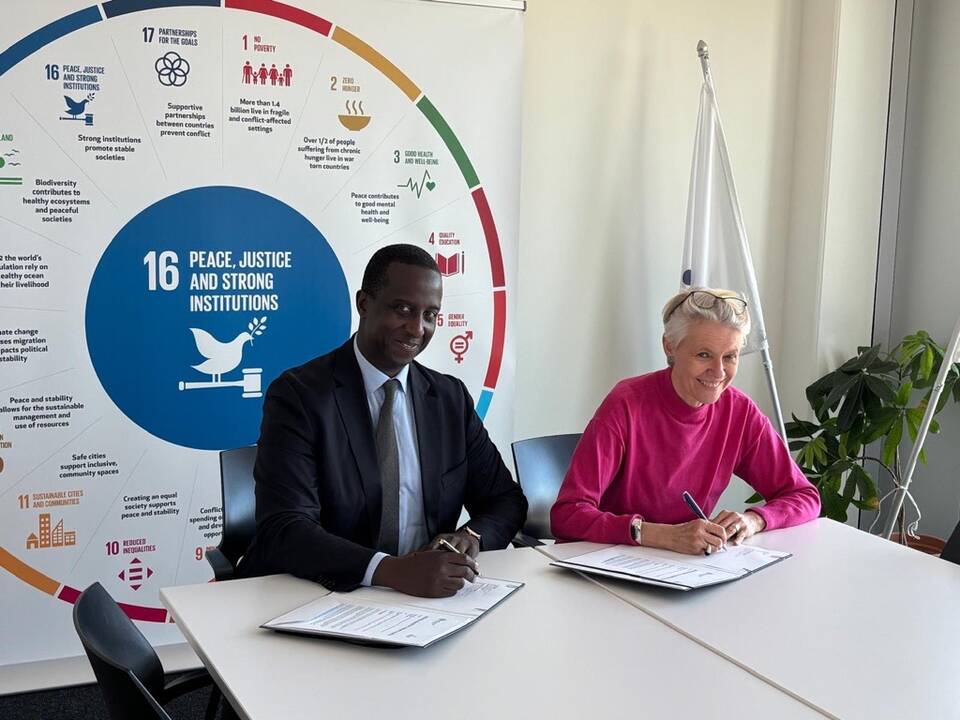
Two prominent peacebuilding organisations in Geneva will be working closely under the same roof in a bid to do more with less as the funding landscape increasingly shrinks.
The Kofi Annan Foundation and Interpeace announced on Tuesday that they will be merging some operations and moving in together as part of a strategic alliance to reduce costs as funding for humanitarian and peacebuilding work becomes increasingly scarce.
The transition will be bankrolled by the Foundation for the Adaptation of International Geneva (FAGI), set up last year by the canton and the Hans Wilsdorf Foundation to help Geneva’s organisations weather abrupt US aid cuts, compounded by the retreat of other western donors.
The two peacebuilding organisations will share a CHF 1.6 million grant spread over four years, Kofi Annan’s executive director Corinne Momal-Vanian told Geneva Solutions.
“At a time when violent conflicts are resurging, multilateral cooperation mechanisms are weakening, and funding for peacebuilding is declining, this initiative aims to combine Interpeace’s expertise in community-level peacebuilding and early warning with the Kofi Annan Foundation’s strengths in anticipatory analysis, high-level political engagement and advocacy,” she said.
The organisations plan to collaborate on youth and security, violence prevention, food security in conflict zones, and mental health support for war-affected populations.
Move planned for autumn
The plan includes moving their headquarters under one roof. Kofi Annan Foundation, whose offices are currently located in the Varambé neighbourhood near the United Nations premises, will be moving in the early autumn into Interpeace’s offices in the Maison de la Paix, Momal-Vanian said. The Kofi Annan Foundation employs 10 staff members full-time in Geneva. Interpeace, a larger organisation with operations abroad, has about 85 employees in Geneva and elsewhere.
The two organisations will remain separate entities with distinct governance structures, but could come to share certain back-office functions. “We have committed to achieving 10-20 per cent savings in administrative support costs within four years. These savings will come partly from reduced rent, and co-location will also allow us to assess whether certain support functions could be shared,” said Momal-Vanian.
She added that they hope to develop joint proposals in the future that could potentially lead to new hires and “reinforce Geneva’s role as a hub for international peace efforts”. She said they did not foresee any immediate reduction in staffing levels.
Supporting international Geneva
The collaboration is the latest of several projects to be granted funding by the FAGI Foundation. By the end of January, a total of CHF13.5 had been awarded to nine projects – five submitted by international organisations, three by NGOs, and two by academic institutions.
The foundation plans to disburse a total of CHF50m over a five-year period. The complete list of projects will only be released with the foundation’s annual report later this year. In an interview with RTS last month, Martine Brunschwig Graf, president of the foundation, said it had received over 50 applications since its launch in the autumn.
Additional reporting by Kasmira Jefford