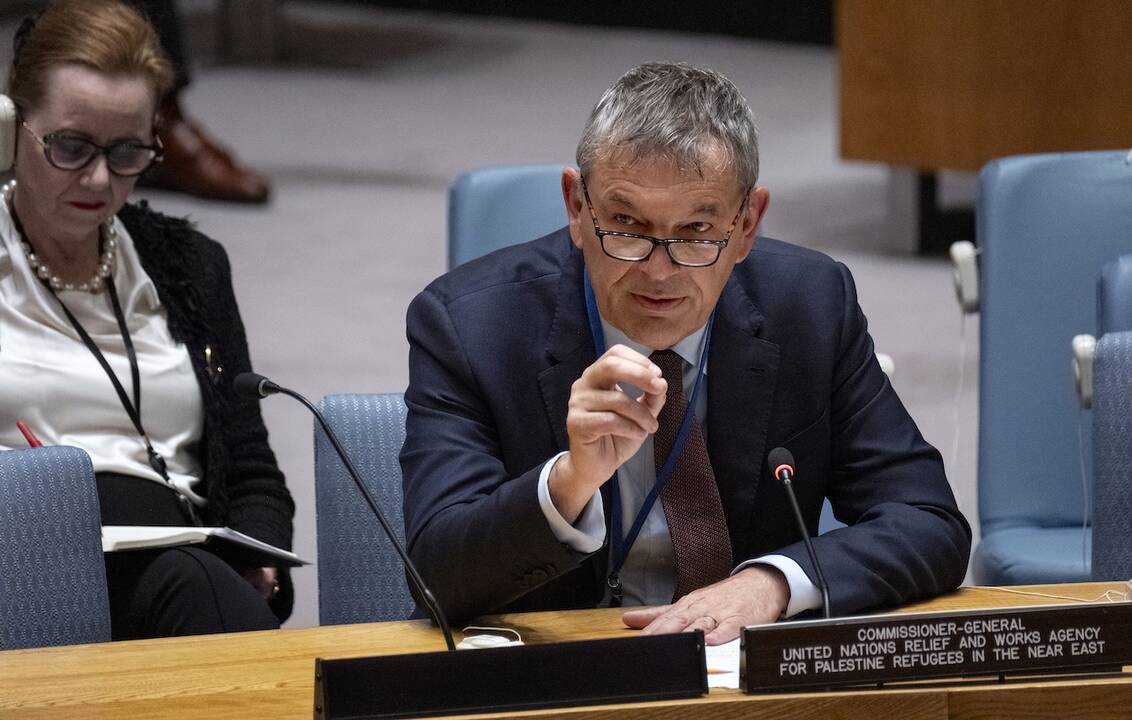
Warning of the risks of a collapse of the UN Palestinian refugee agency, its outgoing chief, Philippe Lazzarini, says the organisation needs to be part of a political solution for the population that it has long provided services to.
In his last press conference before stepping down, UNRWA’s commissioner general, Philippe Lazzarini, told Geneva Solutions that the agency should be involved in the Gaza peace plan by “building a future Palestinian institution” that could be part of a political process, while supporting Palestinian refugees with critical services.
Speaking in Geneva, he warned that amid efforts by the Israeli government to discredit the organisation as well as attacks by authorities on its installations, the killing of nearly 400 employees and major funding cuts, UNRWA faces near collapse. In early 2025, Israel imposed a ban that effectively blocked UNRWA’s work in Gaza and the West Bank. Without additional funding, further “painful” measures will be required in 2026, the Swiss official added. His tenure, which ends after six years, comes amid a fragile ceasefire that entered into force after two years of intense fighting between Israel and Hamas. The organisation has already had to slash 20 per cent of local staff positions.
Since the 7 October attacks, Israel has made allegations against UNRWA that several of its employees in Gaza had participated in them and that the agency was systematically infiltrated by militants, which the agency had denied. In January 2025, the United States cut funding to the agency as a result of those allegations.
Read more: In survival mode, UNRWA awaits outcome of leadership change
UNRWA was established by the UN in 1949 as a stop-gap measure, intended to operate only until a political solution was found for Palestinian refugees displaced following the creation of Israel.
Lazzarini said that he had requested UN member states to allow the agency to “retrieve its temporary nature to be part of the solution within a political process”, as the political solution had never materialised. He now hoped that the political process could resume.
Part of US-driven peace plan
UNRWA should be viewed as an “asset” in implementing last year’s UN Security Council resolution supporting US president Donald Trump’s Gaza peace plan, Lazzarini argued. The initiative, envisages Gaza being governed by a yet-to-be-appointed “technocratic apolitical Palestinian committee”, responsible for running public services. It also assigns a central role in the enclave’s reconstruction to Trump’s Board of Peace.
The resolution, which was welcomed by the Palestinian Authority and Israel, does not mention UNRWA. It was condemned at the time by human rights organisations, which said it legitimised indefinite Israeli control of the Strip, given the government’s membership on the board gives it oversight of reconstruction plans and its future governance.
Lazzarini explained that Palestinians’ future authority should ultimately take over from UNRWA.. But for that to happen, “we need a genuine political process and…genuine commitment,” he added.
‘A ceasefire only by name’
When asked about the future of the organisation, Lazzarini said that it will depend on the implementation of the Gaza peace plan and how any governance transition unfolds. “We have to enter into a transitional mindset to ensure we have a soft landing, and to have that, it means having a proper future recipient,” he said.
With funding for UNRWA’s services for Palestinians, such as clean water, health and education, only expected to last till September, any variations of financial flows, often shaped by domestic politics in donor countries, will also be decisive.
Meanwhile, delays in the implementation of the peace plan are only causing more “misery” for the people in Gaza. Families are still living amid the rubble of their homes and waiting hours for water, said Lazzarini, adding that they were living a “ceasefire only by name” – more than 650 people have been killed since its start in October.
Hostilities, while less intense, continue as talks to disarm are stalled as Washington focuses on its war with Iran. Under the peace plan, an international stabilisation force would also replace occupying Israeli forces as Hamas fighters lay down their arms. Last week, a Bulgarian diplomat, Nickolay Mladenov, presented a detailed plan for decommissioning Hamas weapons at the Security Council. A number of countries, including Kosovo, Kazakhstan and Indonesia, have indicated their willingness to contribute troops to the mission.