With nearly a quarter of its land contaminated, Ukraine is the world’s most mine-affected country, due to their widespread use by Moscow. Last summer, Kyiv signalled its intention to suspend its participation from the Ottawa Convention banning their use and production.
Since the start of Russia’s full-scale invasion, Ukraine has become a country littered with mines, dispersed over roughly 133,300 square kilometres. Deployed by hand or via drones, Moscow has used at least 13 types of landmines, including some dating back to the Soviet Union, threatening the lives of millions of Ukrainians, hindering rescue operations, and preventing farmland from being cultivated. Over a thousand civilians have been injured and 405 people have been killed by them.
In July last year, Ukraine announced its intention to temporarily suspend its participation in the Ottawa Convention that bans anti-personnel mines, making it the first state to reject its duties under this important instrument of humanitarian law, during conflict. The move prompted objections from several countries, including Switzerland.
Read more: Ukraine decision to put mine ban treaty on hold draws backlash at Geneva meeting
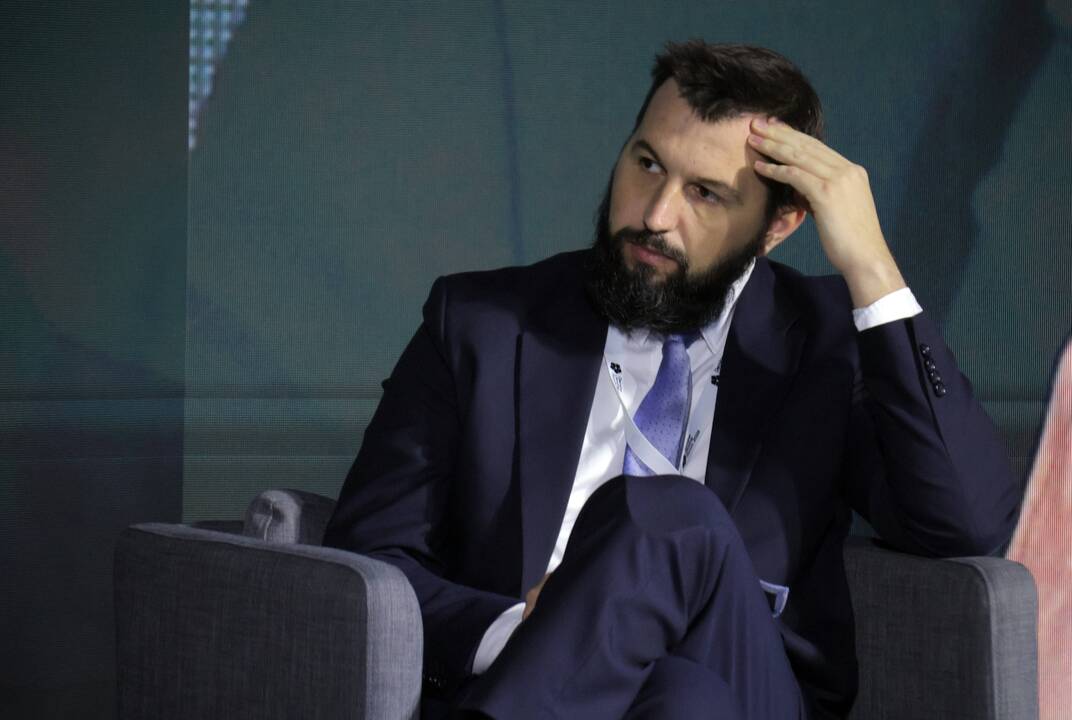
“We must find the right words to explain what led to this decision and what we envisage going forward,” Ihor Bezkaravainyi told Le Temps. The Ukrainian deputy minister of economy, who lost part of his left leg to a Russian mine during fighting in Donbas, was in Geneva for a workshop aimed at coordinating international efforts on humanitarian demining in Ukraine. Meanwhile, on Wednesday, the 29th International Meeting of Mine Action Programme Directors and United Nations Advisers opens in Geneva.
Le Temps: How do you explain Ukraine’s decision to suspend the Ottawa Treaty?
Ihor Bezkaravainyi: It’s a bit difficult to explain, not because our position may lack transparency, but because it involves several technical and legal aspects. The main message remains the following: that Ukraine is not leaving the treaty, but we have decided to suspend or postpone its application. We are trying to find an appropriate solution. And if we are seeking to temporarily pause this treaty, it is because it does not function in the current context – namely Russia’s aggression against Ukraine.
Our approach is therefore to continue to respect international humanitarian law while seeking a solution. It is also a matter of consistency with the treaty: if circumstances force us to use landmines, it would be contradictory to remain bound by it.
Switzerland, as well as Norway, Austria and Colombia, have objected to this decision. How are you trying to convince them?
We must find the right words to explain what led to this decision and what we intend to do next. We want a common solution. I hope this will be possible, especially as some of our neighbours – the Baltic states and Poland – have simply chosen to withdraw from the treaty. On our side, we are trying to adopt a more nuanced, more legally ‘elegant’ approach, given that we cannot leave the treaty in the middle of a war. That is why we are relying, among other things, on the Vienna Convention on the Law of Treaties, to explore different legal mechanisms.
But doesn’t withdrawing from the convention play into Russia’s hands, as it seeks to undermine international law?
Once again, we are fighting on the side that respects this law. Today, we are simply trying to survive. When the war ends, we will draw lessons and try to understand how to better protect civilians in conflict, especially along the front line.
Turning back to the situation in Ukraine: do we know what proportion of the territory has been contaminated by mines and unexploded ordnance?
The situation is complex because many areas are affected. There are liberated territories, active combat zones, and occupied areas where we do not know exactly what is happening. To date, around 50 per cent of accessible areas have been surveyed and nearly 40,800 square kilometres have already been returned to use. Some areas have been fully inspected and declared safe. Others have been identified as dangerous and then cleared through humanitarian demining. Still others have been secured by operational units such as emergency services or the police.
Sometimes it occurs that an area already secured is re-contaminated by drones or missiles. The main impediment is that the war is still ongoing. But we cannot afford to wait, as the situation could last.
How do you define priority areas for demining?
Last year, we would have probably answered according to a classic approach: first priority infrastructure, then social infrastructure, then economic areas, and finally the rest. Today, we know this was a mistake. It is impossible to rank priorities so rigidly. For example, if we delay dealing with forests, which were at the bottom of the list, they risk disappearing due to fires, as firefighters cannot operate on contaminated land.
Using artificial intelligence and supercomputers, we have developed a new approach, tested last December, called GRIT (Ground Rehabilitation through Innovative Technology), based on data analysis. It allows us to create a kind of digital modelling of affected areas. We rely on four criteria: security, the economy, the environment, and social impact. Areas close to the front line, likely to be re-contaminated, are not prioritised. For the rest, we seek a balance between these different impacts.
Ukraine is the most contaminated country in the world. Do you share your expertise with other mine-impacted countries?
We have begun exchanges, notably with Syria. I was in Damascus a few weeks ago. But our model relies on existing solid state structures, which is not always the case in other countries, where capacities and equipment can vary greatly. Still, we remain open to cooperation and share our experience with partners. Interestingly, demining often serves as a starting point for other forms of cooperation, particularly with countries in the Global South.
What is the profile of mine victims in Ukraine today?
Farmers account for the majority of victims. We try to raise awareness, but it is not easy. While prevention works well with children, it is more complicated with farmers, who often underestimate the danger. Most accidents occur at the edges of fields, about fifty metres in. This is linked to military logic, as positions are often set up along field boundaries.
Beyond human casualties, what impact do mines have on Ukrainian soils?
In some parts of the front line that have not moved for years, the soil is completely destroyed. In these areas, contamination levels – either from explosives or the chemical substances they release – may be extremely high, to the point of becoming unmanageable. We could then end up with real scars on Ukraine’s territory, comparable to the contaminated ‘red zone’ in France after the First World War.
Does Ukraine also lay mines on parts of its territory to defend itself against Russia?
Yes, on the front line, we use anti-tank mines and various other types. Regarding anti-personnel mines, I cannot comment, as I do not have precise information on their use. The military does not communicate on this. They are used for defensive purposes. But in the future, because we know how to deal with them, they will likely be less problematic than new systems, such as fibre-optic drones or certain munitions, which will pose far more complex challenges.
This article was originally published in French in Le Temps. It has been adapted and translated into English by Geneva Solutions. Articles from third-party websites are not licensed under Creative Commons and cannot be republished without the media’s consent.