
A day before governments meet at the world’s first conference to end fossil fuels, activists and lawmakers gather to demand a greater say in decisions, as international climate negotiations remain stalled and risk sidelining action.
SANTA MARTA, Colombia — In a cool classroom at the University of Magdalena, one social movement group debates how to address the issue of companies buying up community land. “The laws are there,” one participant says. “The problem is that they’re simply not implemented.” In another group nearby, a young participant questions whether a fossil fuel treaty can succeed without reforming the financial architecture.
Those arguments are playing out in the buzzing coal port city, where campaigners and officials from over 60 governments have gathered for the world’s first conference on ending fossil fuels. Campaigners have been racing to finalise their proposals ahead of a high-level segment from Tuesday to Wednesday, and ensure their demands for a fair transition are reflected in any political outcome.
Read more: Nations committed to fossil fuel exit to gather in Santa Marta as new climate diplomacy takes shape
“The transition must be built from the bottom up,” Mauricio Cabrera Leal, Colombia’s vice-minister for the environment, reassures attendees.
By the afternoon, debates spill into the streets. Under the humid Caribbean heat, to the sound of beating drums and Latin American protest songs, campaigners march across Santa Marta, carrying banners calling for an end to fossil fuels and the economic system that sustains them while chanting slogans denouncing “imperialism” and extractive “neocolonialism”.
Breaking with traditional diplomacy
For many participants, the gathering reflects a growing frustration with traditional climate negotiations that have long sidelined those most affected. Alessandra Cardoso from the Brazilian NGO INESC, which monitors fossil fuel subsidies, says the space allows for more open exchanges than at UN climate talks. “The logic here is different from Cop, which is much more rigid,” she says, meeting at a cafe. “Here we have more room to build something.”
Cássio Carvalho, also from INSEC, pointed to what he describes as a first: workers from the oil, gas, and coal industry came together and presented their own concerns about how the transition stands to dispossess them. Communities now increasingly affected by the green transition must also be part of the debate, the experts say.
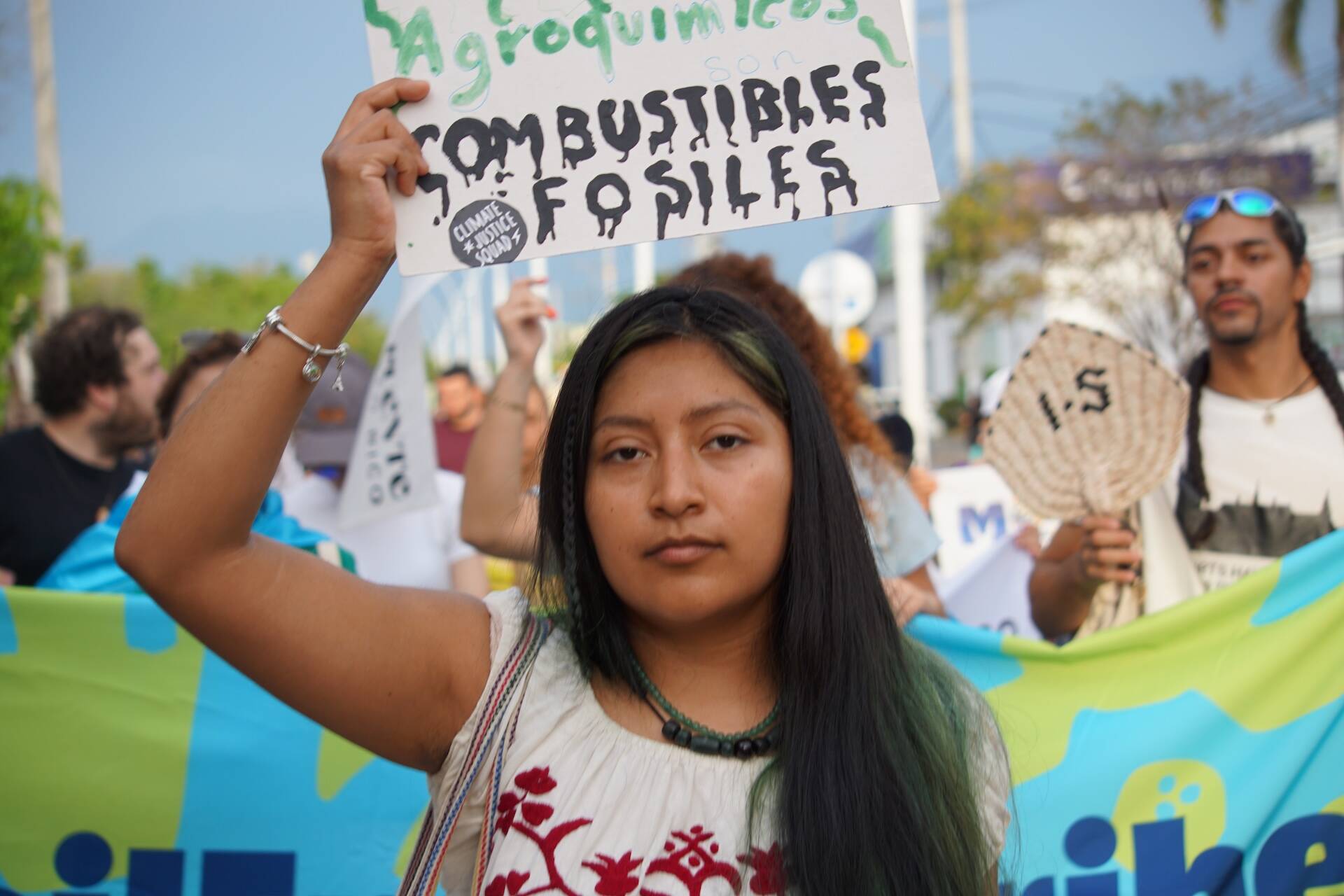
Ngiwa Indigenous activist Xananine Calvillo Ramirez at a protest in Santa Marta, Colombia, during the first Conference on the Transition away from Fossil Fuels, 27 April 2026. (Geneva Solutions/Michelle Langrand)
Lawmakers are also increasingly visible. Rosa Gálvez, an independent senator from Canada and a member of a global coalition of lawmakers for a fossil fuel-free future, says parliamentarians have long been sidelined from climate diplomacy. “Only until recently have members of parliament had a space at Cops,” she says, noting that lobbyists are often embedded in state delegations while parliamentarians are not.
Juan Carlos Losada, a Colombian MP, says that “these discussions have been vetoed in UN conferences for too long”. The Santa Marta meeting, he adds, signals the need for a “rebellious attitude”, highlighting Petro’s boldness in convening the conference in the aftermath of the Cop30 flop in Belém.
Read more: Fossil fuels fight engulfs Cop30 as vulnerable states warn adaptation can’t wait
Inclusion under scrutiny
The organisers have framed the conference as an effort to centre communities and move beyond the diplomatic stalemate. Colombia’s equality minister, Alfredo Acosta Zapata, underscores the importance of the approach. “If communities are not empowered, governments will not function,” he tells Geneva Solutions. “They must be the protagonists.”
Acosta Zapata, an Indigenous leader, points to the threats faced by Indigenous peoples for defending their territories and to the cost they will continue to bear if their concerns are not addressed.
While energy on the streets is high, expectations for the high-level segment are running low. “It reproduces the same exclusion as the UN conference,” says Xananine Calvillo Ramirez, an Indigenous activist from the Ngiwa territory in Mexico, as she marches along the protest. Of the more than 1,000 attendees at the civil society segment in Santa Marta, only a handful will be able to participate in the high-level session, with each sector from civil society — including unions, farmers and Indigenous people — only getting two slots. The conference is also held in a hotel in Pozos Colorados, on the outskirts of Santa Marta, making it harder for any planned demonstrations. A Brazilian campaigner calls out the “hypocrisy”.
Another campaigner, Sacni Acosta, from the Debt for Climate citizens’ movement, is also disappointed at how old habits have resurfaced. “Our proposals to eliminate debt were watered down by the Mexican government,” she says. As for the high-level event, she also finds it hard to be optimistic. “It’s hard to trust the governments that have lied to us for so long,” she adds.
The beginning of a conversation
Still, Acosta and the other campaigners agree that the conference is fundamental to kick-start a long-awaited conversation. Now, they hope it will lead to serious work to implement the proposals that emerge. “The end game cannot just be a second, third or fourth conference,” she says.
In Calvillo Ramirez’s view, “the worst that could happen is that nothing happens, that we continue with the status quo”. But perhaps Santa Marta has yet another card to play as the birthplace of Colombia’s most famous writer, Gabriel García Márquez, and of his fictional village, Macondo, where magic becomes real. “If the end of the fossil fuel era, including petrochemicals, can be dreamed into reality, it will be in Macondo, where the impossible is simply another form of truth,” says Andrés Del Castillo, senior attorney at environmental rights NGO Center for International Environmental Law.