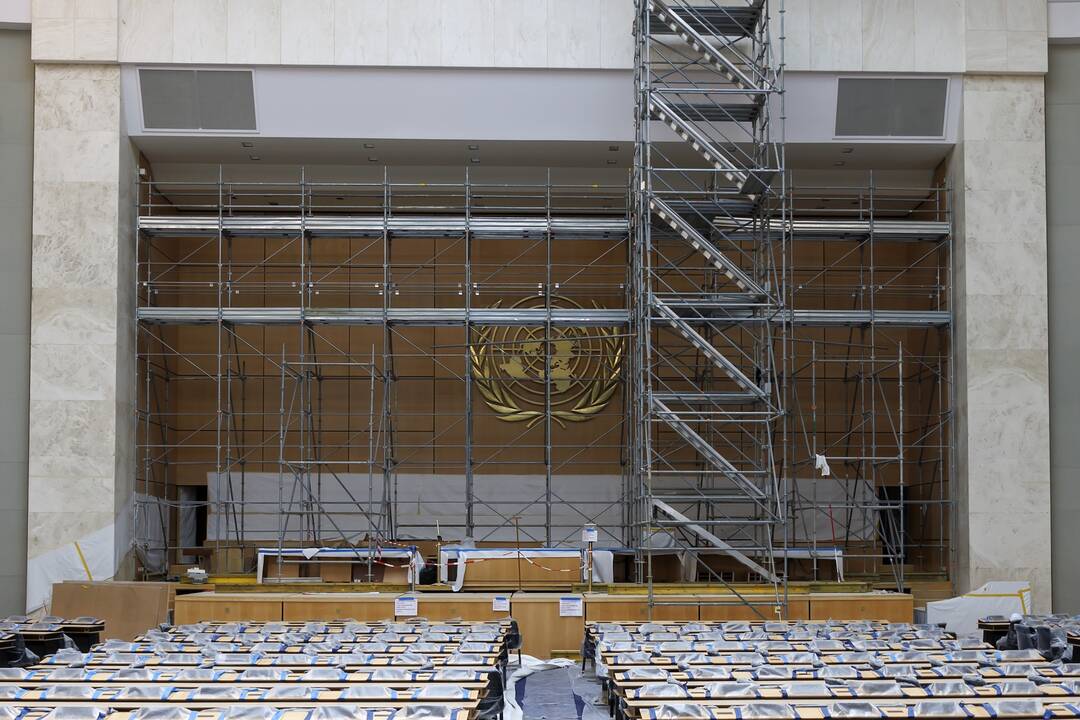
As Washington ramps up pressure on the UN, a US agency looking into the organisation’s renovation spending notes that while multiple UN bodies are focused on ensuring that plans stick to budget, the State Department lacks the capacity to keep a closer eye.
A United States federal watchdog has published a detailed probe into the United Nations’ building renovations, totalling an estimated $4bn over the past decade, and how the multilateral organisation keeps tabs on whether they stay within budget.
But it notes that with some projects, notably in Geneva, having run over budget, Washington, the UN’s biggest donor, is not doing enough of its own oversight.
The US Government Accountability Office (GAO), an independent nonpartisan congressional agency formed to help Washington find ways to save money, published an extensive report on Wednesday detailing timelines and spending for projects across the UN since 2014, including several in Geneva. The renovations are intended to update offices and bring them up to safety, environmental and usability standards.
Aside from the major upgrade at the UN headquarters in New York, which the GAO had projected in 2015 would run $379 million over budget, it noted that work at the Palais des Nations had also run above the originally approved amount. Funding to construct new office space in Geneva’s UN complex and renovate the historic buildings, under the Strategic Heritage Plan, was expected to run 10 per cent above its original $871.4m budget, due to Covid-19 and Ukraine-war induced inflation. In 2025, the UN’s budget body, the Fifth Committee – which includes all UN member states – adjusted the rebuild budget for Geneva accordingly to nearly $1bn.
Read more: Inside the UN’s maelstrom
According to the report, renovations at the headquarters of UN agencies in Geneva, including the International Organization for Migration, the International Telecommunications Union, the International Labour Organization and the World Health Organization, had remained on budget. A project at the ITU had been stalled due to initial construction bids coming in higher than expected, and had incurred an unrecoverable $20m cost for architectural and engineering services. The ITU Council then agreed on a new plan, for work intended to begin in 2028, that would stay within budget.
The GAO study focused on 11 capital projects completed or underway between 2014 and 2024. It comes as the US government has put the UN under enormous pressure to reduce costs and reform, while refusing to make mandatory payments to the organisation.
Lack of focus
The report detailed how several bodies at the UN coordinate, inform on and approve renovation projects at UN buildings. These include the General Assembly’s Fifth Committee, which considers and approves issues dealing with the UN budget, its Advisory Committee on Administrative and Budgetary Questions (ACABQ), the UN Board of Auditors, responsible for several reports on capital projects, and the Global Asset Management Policy Service, which has shared lessons learnt from the NY headquarters project and coordinates such projects.
Read more: As international Geneva’s offices empty out, could it ease the housing shortage?
In contrast, State Department officials could do better to strengthen US oversight of spending projects at the organisation, “and to be better positioned to identify potential cost overruns and address them before they occur”, the GAO says.
It notes that the department’s Bureau of International Organization Affairs “does not have guidance that defines how officials should fulfill their responsibility schedule, and does not have clear triggers, such as percentage over budget or times behind schedule, for when to take action.” Nor did officials in the international organisation section of the State Department dispose of any “clear steps for taking action, including guidance on who to contact and which communication method to use”.
For Charles Adams, a former US diplomat under Democratic President Barack Obama, the report’s recommendations to authorities in Washington come at a time when the “State Department hardly has any people left in it” following the departure of roughly 3,000 employees through firings and early-retirement deals since the return of president Donald Trump to the White House in 2025.
“It actually talks about how the UN is doing a pretty good job with its oversight,” he says.
Politics of spending
Responding to questions about the report, a State Department spokesperson told Geneva Solutions that the US was committed to a “back to basics” reform agenda at the UN that would include deeper cuts to what it sees as wasteful spending, and “concurs with the GAO’s recommendations to increase oversight of large-scale UN capital projects.”
Earlier this week, the online media platform Devex reported that, according to internal US documents, the Trump administration threatened to withhold hundreds of millions of dollars in contributions to the UN unless it agreed on further reforms. Over the past year, the organisation has been implementing its UN80 reform initiative, which has included a 15 per cent reduction in its administrative budget and approximately 3,000 job cuts.
In Geneva, the US mission has reiterated Washington’s messaging, pressuring the UN to review staff compensation and benefits.
The report comes as the Geneva Group, an informal yet influential coterie of top UN donor countries, recently met in its namesake city, in its last gathering ahead of not only this year’s consequential high-level meeting at the UNGA in September, but also next month’s G7 gathering in Evian. The US, which together with the United Kingdom, co-chairs the gatherings, no longer chairs with Switzerland, the “buildings” focal group within the Geneva Group, with France now taking that role.
With many other western donors also reducing contributions to the multilateral organisation, some believe that, in spite of any posturing by some to distance themselves from US pressure on the UN, it may serve them as well.
“Some large contributors in the Geneva Group will be happy to see the US make these threats because they wouldn’t mind cutting staff salaries and benefits,” UN budget expert Ronny Patz recently wrote.