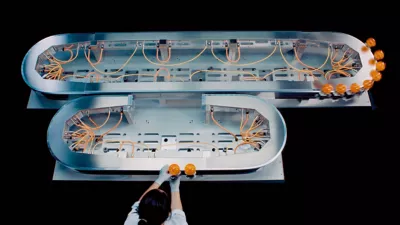
Unlocking adaptability with mechatronic transport
When people imagine a production line, the first thing that comes to mind is often a conveyor belt. Yet, because of the rigid sequence of processes they impose, these mechanical movers often limit flexibility.
Mechatronic systems, based on linear or planar motor technology, work much differently. Here, the motor itself essentially becomes the conveyor. In a linear motion system like ACOPOStrak, the active part of the motor – the stator – extends along the entire transport path in the form of a track. The passive part of the motor – the rotor – takes the form of shuttles that carry products along the track. This evolution elevates product transport into a new role. What before may have been considered auxiliary equipment – a means to an end – now becomes the intelligent, value-adding backbone of the entire operation. By eliminating mechanical power transmission, mechatronic systems avoid slippage and wear, enabling movements with both high dynamic forces and extremely repeatable precision. Whether the product is an electric vehicle battery cell, an insulin pen or a package of chips – such systems carry each item on a unique high-speed journey through production.
In these dynamic processes, shuttles must often switch from one track to another – whether to sort out defects, balance flow among parallel processing stations, or merge products from different lines to be packaged in custom sets. While other linear motion systems do this using mechanical rails or gates, B&R’s ACOPOStrak diverter technology »03 is fully contactless. In the absence of wear-prone moving parts, switching can occur at full production speed (up to 5 m/s) with no spacing needed between the 50-mm shuttles.
This patented technique is based on the principle of field weakening. In field-oriented control, the motor’s magnetic field comprises two perpendicular components: the d-axis (direct axis) produces the force that holds the shuttle on the track, while the q-axis (quadrature axis) produces the torque that propels the shuttle along the track. When a shuttle is moving between two opposing tracks, reducing its d-axis current weakens the magnetic field generated by the stator and allows the shuttle to switch sides.