
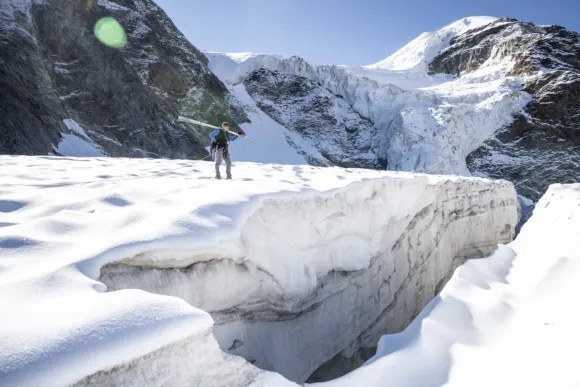
 Some Swiss glaciers are at risk of retreating due to a significant snow deficit this season. | Image: swissinfo.ch
As the effects of climate change continue to become increasingly visible and alarming across the globe, glaciers in Switzerland are going into the melt season with a terrible starting position.
The Swiss Glacier Monitoring Network (GLAMOS) is reporting an average snow deficit of 25%, compared to averages from 2010-2020, partly due to a warm and dry month of April this season. Specifically, the regions of Upper Valais, Ticino, and Graubünden are seeing a drastic deficit heading into the summer melt months. Consequently, the protective snow layer is depleting so rapidly, it could be a matter of just weeks before debris and bare ice are exposed, leading to an inevitable accelerated glacier melt and retreat.
A snow deficit signifies that the amount of snow which accumulated on the glacier during the winter will not be enough to sustain the glacial mass through the summer melt season. More snow coverage going into the warmer months implies there is potential for glacial accumulation, or growth. On the other hand, a 25% deficit this season — or 75% of average snow cover — unfortunately will likely result in a negative mass balance, or retreating. When the snow is melted away quickly, debris and darker ice on the glacier are exposed, reducing the albedo effect. Because of this, the glacier’s surface can absorb more sunlight and therefore it gets warmer, faster, causing melting to speed-up significantly.
 The popular summer ski area Saas-Fee, in Valais, Switzerland, pictured here in the middle to the left of the prominent rock-band, showing a 17 year difference in glacial retreating not too far below. | Image: Swissglaciers.org
“The outlook for this summer is bad,” glaciologist Matthias Huss told the Keystone‑SDA news agency. In the last two decades, just four winters recorded less snow than this winter. Of those, 2022 and 2023 had similar snow deficits as this winter, and substantial glacier loss occurred over both of those summers. That is not a good sign of what could happen this year.
Several ski areas such as Saas-Fee, Zermatt, and Glacier 3000 all provide summer skiing located on Swiss glaciers at risk of being directly affected by this snow deficit. Whether that means operating with more limited terrain, or earlier season closures all together, the likelihood is much greater this year thanks to the deficit. All three of these high-altitude, glacial ski destinations host a slew of national ski teams, professional racers, and those seeking pre-season training on the slopes; so that could be detrimental in many ways, if not this season then sometime in the near future.
Switzerland is already amongst the top 10 countries worldwide that has warmed the most in the last 10 years. Now, the adverse effects of their warming climate is taking a direct toll on the glaciers in multiple regions. With this season’s spring data findings from GLAMOS, it appears that many of the 25 glaciers studied will see at least some — and perhaps considerable — negative mass balance this summer.
Now, as three out of the last five years have all seen large snow deficits, we’ll have to wait and watch what another summer does and if the harrowing predictions hold true.
 These two pictures show just a 6 year difference from 2018 to 2024 on the Rhone Glacier in Valais, Switzerland. | Image: Swissglaciers.org