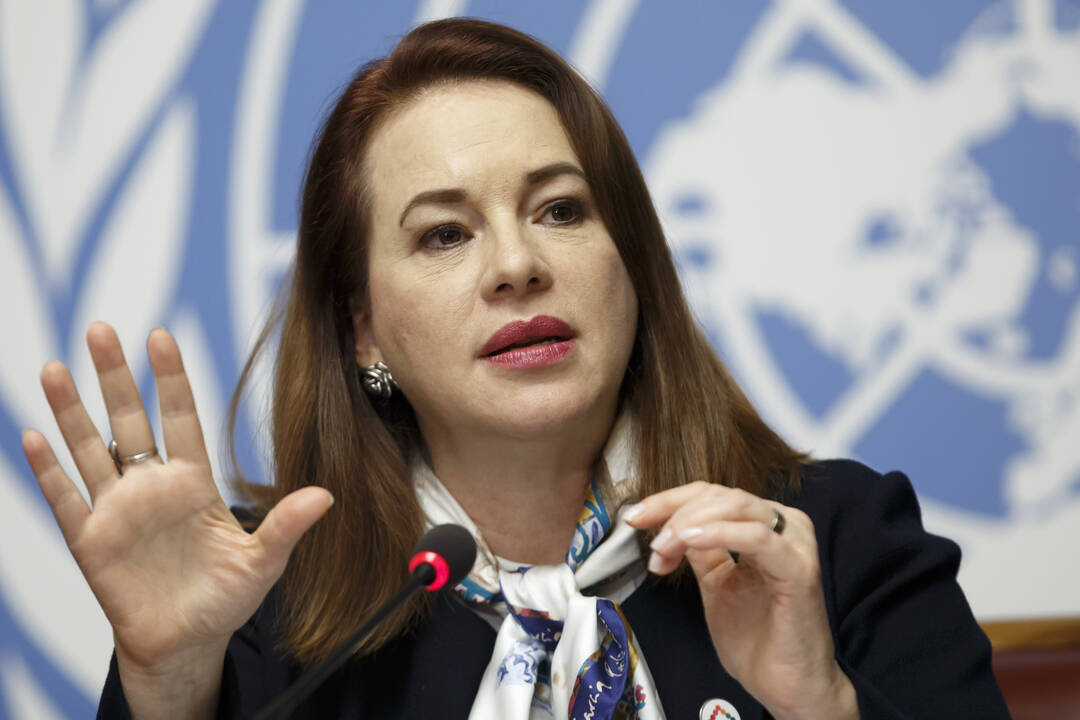
María Fernanda Espinosa has emerged as the fifth contender for the world’s top diplomatic job – and to be the first woman in the role.
Antigua and Barbuda has officially nominated María Fernanda Espinosa to be the next secretary general of the United Nations, making the Ecuadorian diplomat and former politician the fifth candidate to join the race.
The Caribbean country submitted her credentials to the respective presidents of the General Assembly and the Security Council, a UN spokesperson in New York confirmed on Tuesday.
She joins four other candidates competing to succeed António Guterres in January 2027, including two other women – Michelle Bachelet of Chile and Costa Rica’s Rebeca Grynspan – as well as Macky Sall from Senegal and Rafael Grossi of Argentina.
Espinosa is the third candidate to be backed by a country other than their own: Bachelet is supported by Brazil and Mexico after her country’s new hard-right leader, José Antonio Kast, withdrew its backing for the former socialist president in March. Former Senegalese president Sall’s nomination was submitted by Burundi.
Ecuador, which is run by conservative president Daniel Noboa, who recently secured his second term, has not yet commented publicly on her nomination.
From politician to diplomat
Under the country’s former long-time leftist leader, Rafael Correa, Espinosa twice served as minister of foreign affairs and trade – in 2007-2008 and 2017-2018 – and held roles as cultural minister and minister of defence.
She was president of the UN General Assembly from 2018-2019 – only the fourth woman to hold the position and the first from Latin America – where she made striving for gender parity a priority.
Before then, Espinosa was posted to Geneva, where she served as Ecuador’s permanent representative to the UN and other organisations between 2014 and 2017. During that time, she became a well-known figure among the NGO community for her work chairing an open-ended intergovernmental working group drafting a legally binding treaty to hold transnational corporations accountable to international human rights law.
Observers Geneva Solutions spoke to said they were not surprised that Espinosa was entering the fray to lead the embattled organisation. Described as an active and high-profile diplomat who wears a number of different hats, she has been vocal throughout her career on issues ranging from gender equality to climate security.
With small island developing states like Antigua and Barbuda comprising a significant number of votes at the General Assembly – 39 UN member states and 18 associate members – one rights advocate in Geneva described it as a “clever move”.
Read also: Running for the UN’s top job: a process riddled with pitfalls
Ben Donaldson, an adviser to 1 for 8 Billion, a nongovernmental coalition focused on the secretary general selection process, said: “We are delighted to see further substantial candidates enter the selection process to become the next secretary general. It is also encouraging to see the first nomination by a Caribbean state, and another example of a candidate nominated by a state of which they are not a citizen – helping to chip away at perceptions of patronage.”
A published poet and a scholar with a background in social sciences and Amazonian conservation studies, Espinosa has also held roles with prominent environmental organisations, including as regional director at the International Union for the Conservation of Nature.
Before announcing her candidacy, she was serving as executive director of GWL Voices, a group advocating for women’s leadership in multilateralism and the organiser of a public debate between the candidates running for the secretary general role, to be held on 9 June in Geneva.
Honest broker
In a letter formally presenting her candidacy to member states and made public last night, Antigua and Barbuda’s prime minister Gaston Browne said Espinosa possessed “the experience, judgment, independence, credibility and legitimacy” required to lead the organisation with “balance, integrity, strategic vision and, crucially, impact.”
The Ecuadorian outlined, in her vision statement also published yesterday, a transformation plan based on five pillars where she said the next UN leader could act “most effectively within her remit to restore UN credibility”. These include energy and digital transformation, closing the delivery gap, and resourcing results on addition to the UN’s existing peace and security, and development pillars – but omitting human rights.
Espinosa said the next secretary general should be an “honest broker”, and “equally attentive to the priorities of north and south, east and west”.