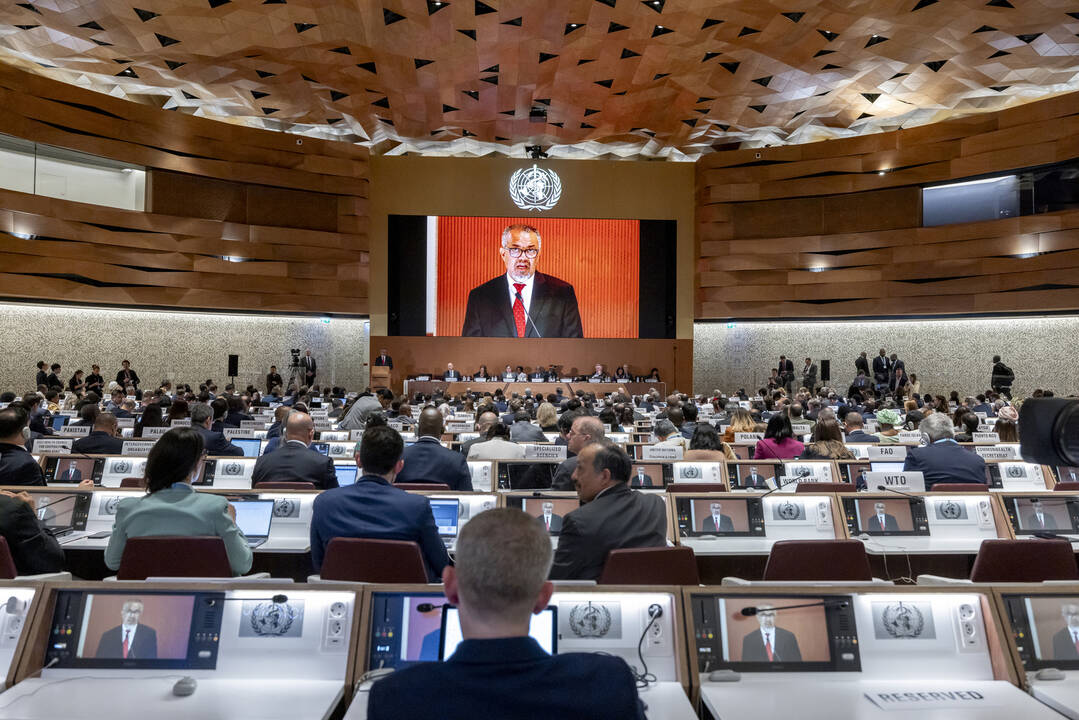
Tedros Adhanom Ghebreyesus’s successor will need a strong strategy and their political wits about them to address member state defections, shaky financial prospects and an expanding to-do list of global health issues, writes Priti Patnaik, founder of Geneva Health Files.
The World Health Organization has sounded the call that will see a slew of nominations from potential candidates to be the next leader of the organisation. A communication to this effect was sent out last month by the current director general, Tedros Adhanom Ghebreyesus, and recently-published guidelines for the election process will be reviewed at the World Health Assembly, the organisation’s highest decision-making body, next week.
There have been many names already doing the rounds – German politician Helge Braun and WHO Americas regional director Jarbas Barbosa, reportedly, among them. But it is still early in the process, and it would be wise to wait and see which candidates will eventually have the backing of their countries.
The election process comes at a time of falling financial support from member states. This might also translate into a lacklustre eagerness from countries to put forth their candidates. To be sure, the process can be painstaking because it will mean expending both additional financial resources and political capital. Countries will need to kick in an entire machinery for the campaign that will begin this year and culminate in the selection of the new head in May 2027.
Beyond the process itself, only those countries that have a specific vision for global health, and for the WHO, are likely to join the race to nominate the next leader. More than a few countries have their hands full at home, either due to widening security agendas or a plain disinterest in international organisations.
Unprecedented and complex geopolitical dynamics present both challenges and opportunities for interested candidates.
The tightrope on financing
A key challenge that will welcome the new leader is an altered landscape in global health and the WHO’s role in this architecture. She or he will be faced with an ongoing financial crunch, sparked by historic cuts of aid. Further, the new director general will be met with a restructured organisation with some of its key functions spliced and diced across different member states, such as Germany and France, which house the WHO Hub for Pandemic and Epidemic Intelligence and the WHO Academy, respectively.
The WHO’s workforce globally is projected to shrink by more than 20 per cent by July 2026. And yet, the new leader will have to deliver on ever-expanding mandates while staying on course for securing the core fundamentals in global health, including its convening power, setting of standards and norms, issuing guidelines and prequalification of medical products, among other areas
On financing alone, Tedros’s successor will need to make tough decisions on both efficiencies and the sources of funding. The pressure of relying on the private sector and private actors, without meaningful and adequate voluntary, unearmarked contributions from countries, is only growing.
The need for a political vision
Traditional WHO watchers believe that the problem is not the lack of finances, but the lack of political vision for the institution. Financing pressures are typically cyclical for a range of reasons, but the distinguishing feature is the political leadership that steers an organisation through uncertainty, they say.
The need for political deftness is crucial, given that the WHO may be facing its toughest test yet: the highly political and sensitive topic of its membership. Experts lament countries choosing their membership to the institution at will. Recent moves by both the US and Argentina to withdraw from the WHO raise a number of questions, not only on what this means for international health cooperation, but also on the legality of these procedures.
The central coordinating role of the WHO has always been emphasised. But what does that mean in practice, particularly in the context of a changing global health landscape as a result of funding cuts and a redrawing of domestic priorities in many donor countries? Fundamental questions are being raised for the sake of efficiency and cutting down on duplication, including mergers of institutions. The new leader must articulate her or his vision on navigating deep transitions in the field.
Despite the challenges awaiting the next director general, it is also a role with tremendous possibilities, from furthering the agenda on gender equality, to leadership in response during conflicts, to anticipating challenges and opportunities in artificial intelligence, to its work on pandemic prevention, preparedness and response.
The institution deserves a humane, dynamic and courageous leader in these turbulent times, taking the baton from Tedros, who has governed during a pandemic, and in the backdrop of splintering international solidarity.
Increasingly, global health is a sphere where foreign policy unfolds. As the only member state-led institution in global health, it acts as a key interface for 190+ countries. Any new leader will have significant power in bringing regions together and in dealing with private actors.
A changing international order provides opportunities for political institutions such as the WHO. Health, after all, is political. But given that health is also intrinsically linked to other sectors, including trade, security and the environment, a leader who assesses these linkages holistically will steer the institution through these modern-day realities.
The question now will be, will member states elect the best woman or man for the job, or will they make the most convenient political choice?
Few people, if any, seriously believe that the WHO will be rescued by a shining white knight or a diva with a magic wand. A secret ballot next May will determine the new leader. People’s health globally will be shaped by who comes next. Whoever assumes this responsibility will have to make tough but wise choices, and quickly. But that is what we expect from good leaders.
Priti Patnaik is the founder and publisher of Geneva Health Files, a reader-funded, interdisciplinary and investigative global health journalistic initiative.
Geneva Solutions publishes opinions and columns proposed by or requested from external contributors and experts. These texts reflect the point of view of their authors and do not represent the position of the media.