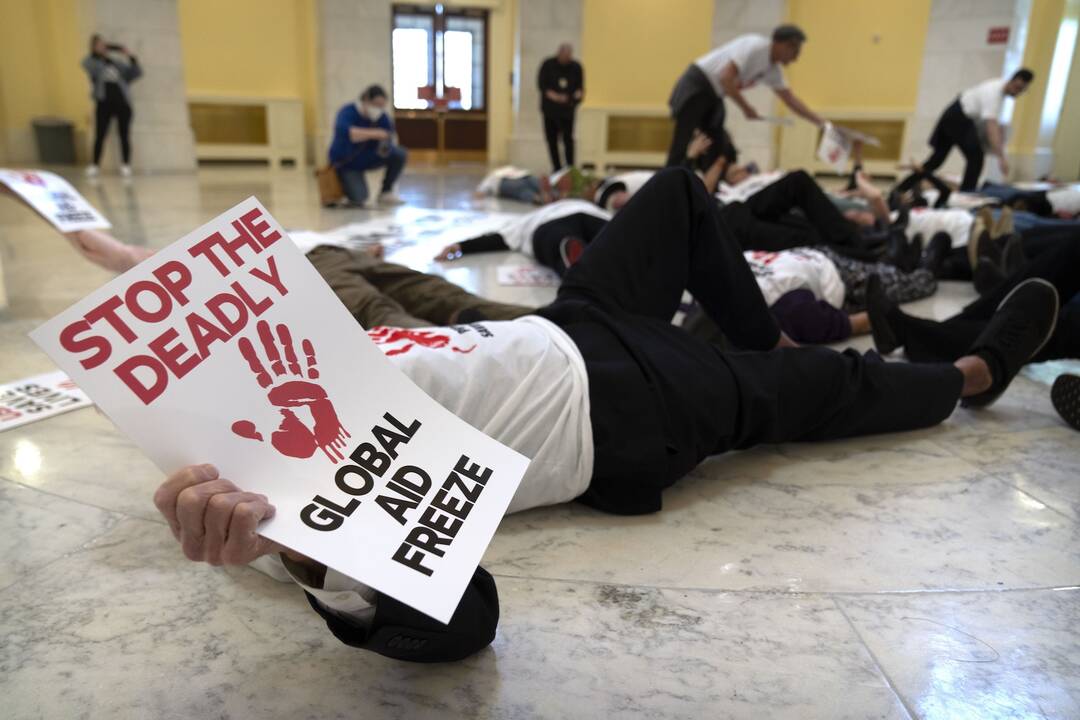
New restrictions on US foreign assistance go far beyond anything seen before, and may leave Geneva’s multilateral institutions scrambling to comply, Hannah Reinl of International Gender Champions writes.
On 26 February 2026, a new United States foreign assistance policy entered into force that places significant pressure on the multilateral system. Known as Promoting Human Flourishing in Foreign Assistance (PHFFA), it combines three separate policy strands targeting abortion access, diversity, equity and inclusion (DEI) programming and what the Trump administration terms “gender ideology”.
At first glance, PHFFA appears to extend the Mexico City Policy – more commonly known as the Global Gag Rule – under which Republican administrations have historically restricted funding to NGOs that provide or refer for abortion services. But PHFFA reaches considerably further. Although the full implications are still unfolding, enough is known to raise serious concerns about the future of gender equality within the multilateral system – and the system itself.
A sweeping reach
PHFFA is both broad in scope and far-reaching in consequence. Whereas the Mexico City Policy only targeted foreign NGOs and had so far been limited to US aid for family planning and health, the new policy extends to voluntary contributions to multilateral organisations, foreign governments and US-headquartered NGOs. It is said to apply to nearly $40 billion in US nonmilitary foreign assistance across some 160 countries, with multilateral organisations accounting for 40 per cent of that aid.
The policy introduces substantive restrictions, prohibiting the provision of or advocacy for abortion and gender-affirming care, DEI programming and conceptual frameworks that treat sex and gender as distinct categories. Critically, these restrictions don’t just apply to US-funded activities and could shape broader organisational operations, including those financed through other sources. For multilateral organisations, which commonly rely on pooled, multi-donor funding and integrated delivery models, this poses a serious challenge.
Waivers exist on paper but offer little reassurance in practice. They are fully discretionary and require organisations to demonstrate, among other conditions, that an activity is critical to US foreign policy interests. During Donald Trump’s first term, only two organisations sought waivers under the Mexico City Policy, and neither request was approved.
Non-compliance carries significant penalties, including funding withdrawal and repayment of amounts already disbursed. Meeting the policy requirements is itself costly: organisations must physically and financially separate services, enhance due diligence on downstream partners, and maintain ongoing compliance monitoring. The administrative burden this creates sits awkwardly alongside US calls for greater efficiency and reduced overhead at the United Nations.
Deliberate uncertainty
At the same time, key definitions remain vague, leaving wide discretion to US agencies, embassies and contracting authorities. How consistently the rules will be applied across countries and funding streams, or how enforcement will work in practice, remains unknown. That uncertainty appears intentional.
By keeping the rules unclear, PHFFA creates strong incentives for organisations to overcomply, pulling back from gender or DEI-related work that is not explicitly prohibited. If the past year is any guide, the impact of PHFFA may be felt not only through direct funding cuts but also through the climate of caution it creates. While some organisations, such as the UN Population Fund, have seen all US funding halted from the outset, others have sought to avoid similar consequences through anticipatory compliance. Even before PHFFA formally entered into force, gender-related terms quietly disappeared from organisations’ websites, programmes and budget discussions.
Against this backdrop, UN aid chief Tom Fletcher’s recent statement that he would refuse US funding if PHFFA conditions were attached stands out as a rare act of institutional resistance. But it also exposes the limits of UN leadership in the absence of clear backing from other member states, especially in a strained funding landscape where the US’s donor influence remains significant despite recent cutbacks.
Read more: A year after its launch, aid experts ask: humanitarian reset or rollback?
Need for a coordinated response
What matters now is not waiting for clarity that may never come but deciding how to act without it. That means member states and organisations should align on red lines, share risk assessments and coordinate responses to protect core mandates and values.
PHFFA sets a precedent where the conditions imposed by a single donor can shape how all resources within an organisation are used. This is not simply a shift in US policy; it is a challenge to the norms and operational frameworks underpinning international cooperation. How Geneva’s institutions and member states respond will be a litmus test not only to their commitment to gender equality, but also to the resilience of the multilateral system itself.
Hannah Reinl works as project manager at the International Gender Champions, a network of 300 international decision-makers determined to break down gender barriers. She writes on leadership, gender equality, and international policy and is the host of the International Gender Champions podcast.
Geneva Solutions publishes opinions and columns proposed by or requested from external contributors and experts. These texts reflect the point of view of their authors and do not represent the position of the media.