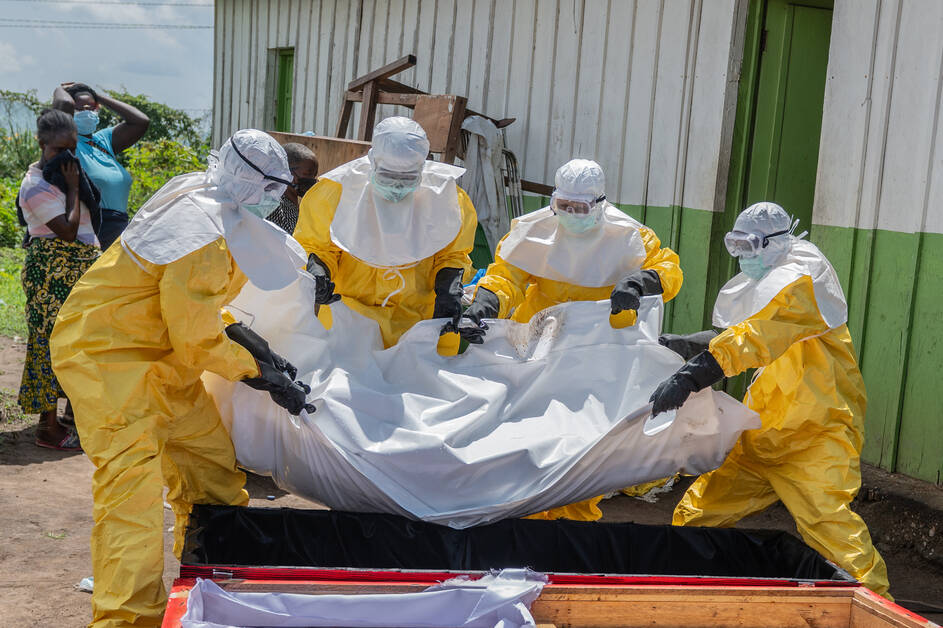
Two possible vaccine candidates against the Bundibugyo virus species are being developed, but neither has gone through clinical trials yet, experts at the health organisation said.
The first potential vaccine against the deadly strain behind the latest Ebola outbreak in central Africa is unlikely to be available before six to nine months, experts at the World Health Organization (WHO) said Wednesday, as the number of suspected cases and deaths has continued to rise.
The WHO on Tuesday urgently convened its emergency committee, made up of international experts who provide its chief with technical advice and recommendations, in a race against the clock to contain the spread of the deadly disease for which there is no approved vaccine.
Vasee Moorthy, who leads the global health body’s research and development blueprint, told reporters in Geneva that the most promising candidate against the Bundibugyo virus was a vaccine equivalent to the one developed for the Zaire strain, which caused the largest Ebola outbreak in 2014.
“There are no doses of this which are currently available for clinical trial, so this needs to be prioritised as the most promising Bundibugyo candidate vaccine,” he said.
Another one is being developed by researchers at the Oxford Institute and the Serum Institute of India, using the same technology that was used for AstraZeneca’s Covid-19 vaccine. However, Moorthy said there was “no animal data” to support it, and that doses may only be available for clinical trials in two to three months.
His comments came as the WHO said the number of suspected cases in the Democratic Republic of Congo and Uganda had climbed to 600, with 139 people suspected to have died from the disease, first announced by health officials on 15 May.
Rise in infections expected
So far, 51 cases have been confirmed in the DRC’s northern provinces of Ituri – where the virus was first reported – and North Kivu, including in the cities of Bunia and Goma, though the scale of the epidemic is expected to be much larger.
Speaking at the press briefing, WHO director general Tedros Adhanom Ghebreyesus said: “We expect those numbers to keep increasing, given the amount of time the virus was circulating before the outbreak was detected.”
Health experts of the WHO’s emergency committee backed Tedros’s decision to declare a public health emergency of international concern (PHEIC) at their first meeting on Tuesday – two days after the WHO boss took the historic step of making the call without waiting for their recommendation.
“The current situation and criteria for a public health emergency of international concern have been met, and we agree that the current situation does not satisfy the criteria for a pandemic emergency,” Lucille Blumberg, chair of the WHO emergency committee, said.
Scaling up the health response
The UN agency said it was deploying more staff and assisting local health authorities in ramping up its response on the ground. “We have deployed people, supplies, equipment and funds,” said Tedros. The WHO has approved an extra $3.4 million from its Contingency Fund for Emergencies, bringing the total to $3.9m.
Dr Anaïs Legand, the WHO’s technical officer on viral haemorrhagic fevers, said that while no approved vaccines or therapeutics were available, the priority right now was “to ensure cases could be detected early and patients cared for” by setting up optimised treatment centres in affected areas – a task that has been made more complicated due to the ongoing armed conflict in the DRC.
Fighting has escalated significantly over the past two months, with over 100,000 people newly displaced. Ituri, where the majority of deaths have been reported, is a mining province bordering Uganda and South Sudan, with heavy movement of people for trade and work, increasing chances of the disease spreading.