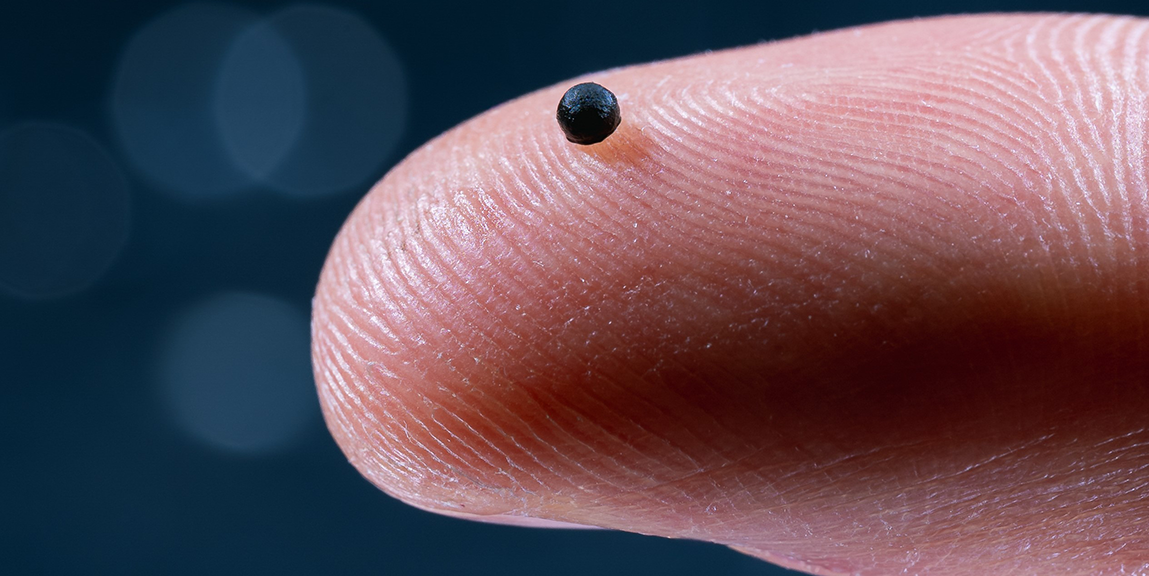
The microrobot also needs a contrast agent to enable doctors to track via X-ray how it is moving through the vessels. The researchers focused on tantalum nanoparticles, which are commonly used in medicine but are more challenging to control due to their greater density and weight. “Combining magnetic functionality, imaging visibility and precise control in a single microrobot required perfect synergy between materials science and robotics engineering, which has taken us many years to successfully achieve,” says ETH Professor Bradley Nelson, who has been researching microrobots for decades. Professor Salvador Pané, a chemist at the Institute of Robotics and Intelligent Systems, and his team developed precision iron oxide nanoparticles that enable this delicate balancing act.
Special catheter releases drug-loaded capsule
The microrobots also contain the active ingredient they need to deliver. The researchers successfully loaded the microrobots with common drugs for a variety of applications – in this case a thrombus-dissolving agent, an antibiotic or tumour medication. These drugs were released by a high-frequency magnetic field that heats the magnetic nanoparticles, dissolving the gel shell and the microrobot.
The researchers used a two-step strategy to bring the microrobot close
to its target: first, they injected the microrobot into the blood or
cerebrospinal fluid via a catheter. They went on to use an
electromagnetic navigation system to guide the magnetic microrobot to
the target location. The catheter’s design is based on a commercially
available model with an internal guidewire connected to a flexible
polymer gripper. When pushed beyond the external guide, the polymer
gripper opens and releases the microrobot.