
“You can only really have one or maybe two art fairs a year where you bring your best work.” Pace CEO Marc Glimcher said at Art Basel Paris on Tuesday, during Avant Première, the fair’s exclusive new VVIP day. “Why? Because there isn’t that much of it.”
Art Basel in Switzerland has always been the key fair on the calendar, but Glimcher is curious to see if Paris will become just as important. “Maybe not replace Basel—but, hey, that may well be the case,” he told me during Frieze London last week.
He brought two major early 20th-century pieces to the fair this year: a 1907 Pablo Picasso drawing (a study for his famed Demoiselles d’Avignon, once owned by Gertrude Stein) and a newly attributed Amedeo Modigliani painting from 1918. The Modigliani was “nearly sold” when I spoke with Glimcher in London last week. Pace confirmed that it sold to a private European institution for just under $10 million on Tuesday.
This past June, Art Basel was a debacle (a “de-Basel”), Glimcher told me in London. He sends his best material to “where the collectors for those works will go,” he said. This year, evidently, they are in Paris, especially the big American collectors who skipped Switzerland.

Amedeo Modigliani, Jeune fille aux macarons (Young Woman with Hair in Side Buns), 1918. © Maurice Aeschimann Genève. Courtesy of Pace Gallery.
Early sales on Tuesday provided a much-needed boost for the market, which has been slogging its way through a multi-year slump. Pace also sold a $4.5 million painting by Agnes Martin, whose work is featured in the “Minimal” exhibition at the Bourse de Commerce across town. Hauser and Wirth touted the sale of a $23 million Gerhard Richter abstraction from 1987; Lévy Gorvy Dayan had another, from 1988, on its stand for $25.5 million. Richter is the subject of a major retrospective at the Fondation Louis Vuitton, and the aisles are loaded with his works.
David Zwirner reported that more than eight works sold for over $1 million by the end of Tuesday, including—you guessed it—a $3.5 million Richter painting. Zwirner also moved 12 large-scale print editions of clouds by the artist for $400,000 each ($4.8 million in total) and a $7.5 million Ruth Asawa sculpture, as well as a Bridget Riley painting for $2.2 million; Riley has a solo show at the Musée d’Orsay.
Pace was not alone in bringing its strongest Modern and contemporary material to the second edition of the fair, but there is also a bounty of older works, which are part of an ongoing conversation around how contemporary art is valued and sold, especially in a downturned market. Taken together, the 206 booths at the fair, which runs through Sunday, suggest that the market is recovering and that Paris is continuing to rise as a global power center.
The Paris Push
France has always been able to boast encyclopedic museums and a rich place in art history, but its market for contemporary material has also exploded in recent years. Many factors are working in its favor. Brexit bureaucracy made the U.K. less appealing to the trade, and the 2024 Olympics bolstered its image, but the core of its appeal is its diverse infrastructure for both art and luxury businesses.
“The major luxury groups are based here, controlling not only the French historical brands but also most of the Italian ones,” said Marc Spiegler, the former global head of Art Basel. “Of course they want to make an impact next to HQ.” Private museums buoyed by those firms—the Fondation Louis Vuitton, François Pinault’s Bourse de Commerce, and the Fondation Cartier, which opened its new Jean Nouvel-designed building on Monday—have laid the groundwork for a thriving scene.

Main facade of the new headquarters of the Fondation Cartier on the Place du Palais-Royal in Paris on Wednesday. Photo: Riccardo Milani/Hans Lucas/AFP via Getty Images.
The art market is now looking to the Gulf region as the next horizon—Art Basel plans to debut its Qatar edition in February—but Europe will remain a very important region for the foreseeable future, Spiegler said. Besides Paris, “there are no serious other contenders on the continent,” he added.
In the lead-up to the launch of Art Basel Paris last year (which replaced the smaller Paris+), major international dealers opened new spaces, joining established French outfits. Meanwhile, the secondary market has grown, even as global auction sales have fallen. Although France trails far behind the U.S., the U.K., and China in its share of the auction market, it was the only one of the four to see an increase in auction sales in the first half of 2025, of around 4 percent, according to Artnet data.
Another important facet of the French auction scene? While Christie’s and Sotheby’s are increasingly holding more sales in Paris, their international duopoly doesn’t have the same vice grip on Paris as it does in other major art hubs, thanks to French firms like Drouot and Artcurial, which still command big French consignments.
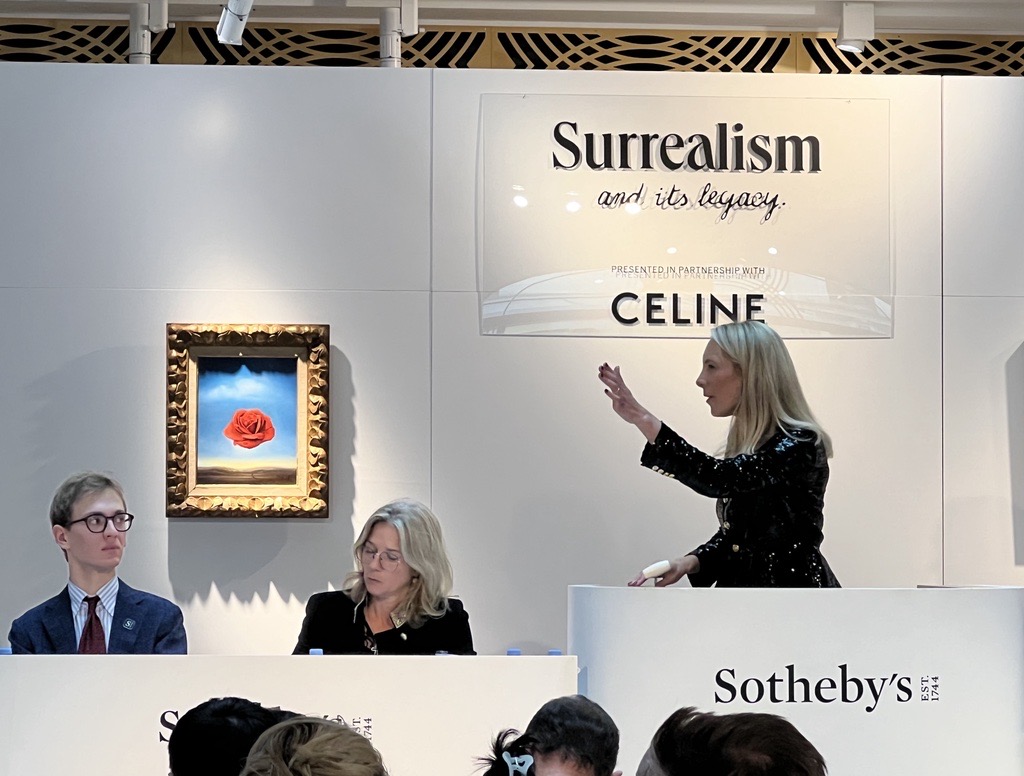
Sotheby’s “Surrealism” auction in Paris on October 18, 2024. Photo: Katya Kazakina.
“There’s a good balance in Paris,” said Brussels-based advisor Ellen de Schepper, referring to the strength of French auction houses and the growing contemporary art field. Generally speaking, sales may unfold at a slightly slower pace than in other major hubs, she said, but that tempo has benefits. It means acquisitions are more thoughtful and that there is greater stability in the secondary market, even when demand is soft.
Art Basel Paris now grounds the city’s biggest week for art business, but to succeed in the long term, it needs to have more of a “narrative,” said India Phillips, the London-based managing director of Bonhams‘ European, Middle East, and Africa department. Phillips was in town to meet clients, after helping facilitate the loan of a Riley work to the Orsay. “I think people want to see a real differentiator between this fair and others,” she said, and to do that, there needs to be works on offer that simply can’t be found anywhere else.
Secondary Market on Display
For some dealers, that means rare historical material, even if it predates the 1900 cutoff that the fair usually enforces. For instance, at Acquavella’s booth, an 1877 Edgar Degas painting and Paul Gauguin’s Fruits on a Table (1889) hang opposite early 20th-century works by Max Ernst and Henri Matisse.
At Gagosian’s stand, crowds formed around The Virgin and Christ Child, with Saints Elizabeth and John the Baptist, a masterful painting by Rubens dating to around 1611–14 that sold for $7.1 million at Sotheby’s in 2020. (The gallery declined to comment on its price.) Not on view at the booth during Avant Première but included in its preview materials was Degas’s La Toilette (1897), a pastel last sold publicly at Sotheby’s New York for $1.9 million in 2002 (or about $3.4 million today), according to the Artnet Price Database.

A Degas at Acquavella. Courtesy of Art Basel Paris.
The infiltration of time-tested names with established price points comes as no surprise amid a crisis in art pricing, as my colleague Naomi Rea pointed out around Art Basel earlier this year. “Price inflation for living artists has been a bugbear for years,” she wrote, and the declining auction prices for many contemporary works has seen speculators take flight from the art market.
“Currently, there is a disconnect between primary market pricing and auctions,” said Suzanne Modica of the New York-based advisory firm Modica Carr. This allows collectors to acquire work by significant artists, “sometimes at price points that are lower than the young artists in their collection.”
Glimcher also agreed there had been a “loss of confidence” that has prompted a so-called “flight to quality.”
A K-Shaped Recovery?
This is a double-edged sword of sorts. The effect somewhat resembles a K-shaped recovery in macroeconomics, in which one sector bounces back, while another continues to suffer the effects of a recession. On the one hand, the phenomenon has left living artists—especially younger ones—in the lurch as their former buyers seek the safety of proven names. But it has also spurred demand for overlooked historical figures.
Consider, the early 20th-century British Surrealist Ithell Colquhoun, whose Song of Songs (1933) is freshly off the walls of Tate Britain, where a retrospective of her work closed on Sunday, and now on offer for $400,000 at Lévy Gorvy Dayan’s booth. That price is well above the $311,191 auction record set for the artist at Bonhams in 2022 (that figure was more than 2,000 percent over the estimate, according to Artnet’s data).

Ithell Colquhoun’s Song of Songs (1933) at Lévy Gorvy Dayan’s booth at Art Basel Paris. Photo: Margaret Carrigan.
Upstairs at the fair, in the Premise section, which is dedicated to art historical presentations, Paris dealer Pauline Pavec is presenting works by Marie Bracquemond, one of the four grandes dames of Impressionism; painted before 1900, the works are priced between €39,000 and €52,000 ($45,000 to $60,000). One sold to a museum within the first hours of Avant Première.
“What makes this moment so exciting is that it is the first time an international art fair presents a solo show of an Impressionist woman artist,” said Pavec. “At a time when the art world is urgently reassessing its narratives through the lens of long-marginalized figures, Bracquemond’s rediscovery feels not only necessary but groundbreaking.”

Marie Bracquemond, Afternoon tea (ca. 1880) in the collection of the Musée des Beaux-Arts de la ville de Paris. Photo: Fine Art Images/ Heritage Images via Getty Images.
While works by the artist have come to auction intermittently over the decades, 2024 was a watershed year for her: A record 162 pieces went under the hammer, and all of them sold, according to the Artnet Price Database. Many of those lots were in a landmark sale at Artcurial devoted to the collection of Bracquemond and her husband Félix, which was offered by their heirs.
Pavec, whose gallery handles Modern and contemporary art, is working directly with the Bracquemond estate, and many of the works on view at her booth have never been seen publicly.
Spinning a New Story
While Modica, the New York advisor, said that most of her clients started out collecting contemporary art, many are seeking more historical material. They find that it makes for “compelling dialogues with the younger artists in their collection,” she said. However, one client went the opposite way and started their collecting activities with Bonnard and Vuillard, then gradually became comfortable with more abstract compositions or conceptual practices, including works by South Korean Dansaekhwa artists.

Art Basel Paris’s Avant Première 2025. Photo: Margaret Carrigan.
These kinds of connections are, in part, what a lot of dealers are banking on at Art Basel Paris. New York-based advisor Erica Samuels said that there is a bit of “aesthetic whiplash” at this year’s fair, where historical pairings with contemporary artists highlighted surface-level visual similarities. She pointed to the Degas in Gagosian’s preview PDF and its compositional synergies with works by John Currin that are also on offer. It’s a sort of “if you like that, then you will also like this” kind of logic that algorithms also regularly employ.
But there’s a deeper value proposition being made by drawing both a visual and narrative thread between artists and eras, one that reinforces the value of contemporary art in a moment when its value is being questioned.

William Kentridge, Morandi sculpture set (2025). © William Kentridge. Courtesy of the artist and Hauser & Wirth. Photo: Nicolas Brasseur.
Art dealers have always been “focused on storytelling,” said Hauser and Wirth’s president, Marc Payot, pointing to Giorgio Morandi‘s 1935 Natura morta (Still Life) painting on view at the gallery’s booth. It chimed with William Kentridge’s Morandi sculpture set (2025), which sold for $550,000. “It helps a lot with contextualizing historical works in contemporary discourse and also the other way around, by positioning contemporary art within the historical canon,” Payot said.
The story is changing, along with the art world’s power centers. If the dominant narrative of the last two decades has been about art as a financial investment, it is now about its status as a temporal investment. Who’s in it for the long haul and what can withstand the test of time?