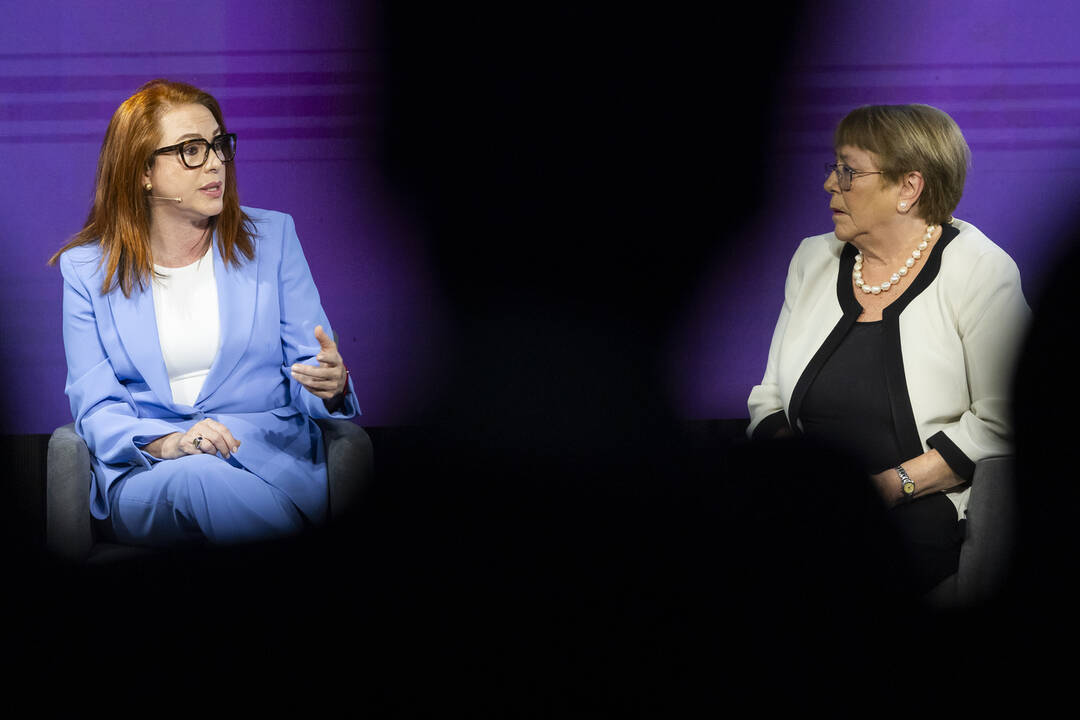
As three candidates to become the next UN leader took to the stage in Geneva on Tuesday to set out their priorities for the world’s top multilateral body, they also nodded to the city’s diplomatic role.
For one hour on Tuesday, Geneva took centre stage in the race to select the next secretary general of the United Nations. The Maison de la Paix – a stone’s throw away from the UN’s European headquarters – was buzzing as over 500 people packed into the main auditorium to watch three of the five candidates explain why they should be picked to lead the ailing multilateral body in desperate need of a revival.
The event made the case for Geneva as a key convening hub. “It’s not an accident that we are meeting in this city,” María Fernanda Espinosa, former Ecuadorian foreign minister and the newest candidate to join the race, later told reporters. “Geneva is the laboratory of international law…it is the true school for multilateralism if you want to be a diplomat,” she said, also crediting the city’s mediation role as a neutral convener.
But once the audience disperses and the cameras stop rolling, where does Geneva as a diplomatic hub fit into their broader strategic vision for the future of the UN? According to Daniel Safran-Hon, an independent researcher who has served in several positions in the executive office of the secretary general: “Geneva remains a rare space where sensitive conversations can continue. Yet its role as a hub for UN diplomacy has declined.”
This has happened for multiple reasons, he notes in a recent opinion piece for Geneva Solutions. “Key among them is the declining diplomatic relevance of the UN itself. Another is the absence of any vision from the secretary general for what the UN in Geneva should do.”
Amid shrinking global aid budgets and a UN forced to make cuts or move jobs to less expensive cities, international Geneva has been experiencing a crisis of its own. Here also Espinosa, who served as Ecuadorian ambassador in Geneva for four years and knows the city well, steps in: “Yes, Geneva is not cheap. That’s the reality. But we can negotiate and discuss. I’m sure the Swiss government would be ready and eager to regain the weight of Geneva as a hub of multilateralism,” she told Geneva Solutions.
Hub to one of the UN’s three pillars
One who appears to understand Geneva’s relevance well is Michelle Bachelet. The former high commissioner for human rights has made human rights central to her campaign. The human rights pillar, a core part of Geneva’s international system, is among the hardest hit by funding cuts from the US and other donors and UN reform efforts. Responding to a question by Geneva Solutions about the chronic funding issues the UN human rights office she used to lead now faces, Bachet said: “I will do my best to reinforce and support the whole structure of human rights,” she said. “I’m not a magician, and I don’t do miracles. But I can be very persistent.”
But the human rights pillar is not only under pressure over simple accounting issues. The United States congress has opposed Bachelet, who also served as head of UN Women, due to her position on women’s reproductive rights, potentially earning her a veto from the US and other conservative states like Russia at the Security Council. Still, the two-time Chilean left-wing president refused to back down, making it clear that this was a risk worth facing for standing up to UN principles: “If somebody vetoes me because I believe in democracy, because I believe in multilateralism, because I believe in women’s rights and human rights, I will be honoured.”
Rebeca Grynspan, the Costa Rican former vice president who currently leads the Geneva-based UN trade and development agency, Unctad, also has deep ties to the multilateral city. She stressed the need to “push back on the politicisation of the principles of human rights and international humanitarian law”. It remains to be seen how she plans to protect this other foundational part of the humanitarian city.
Additional reporting by Michelle Langrand