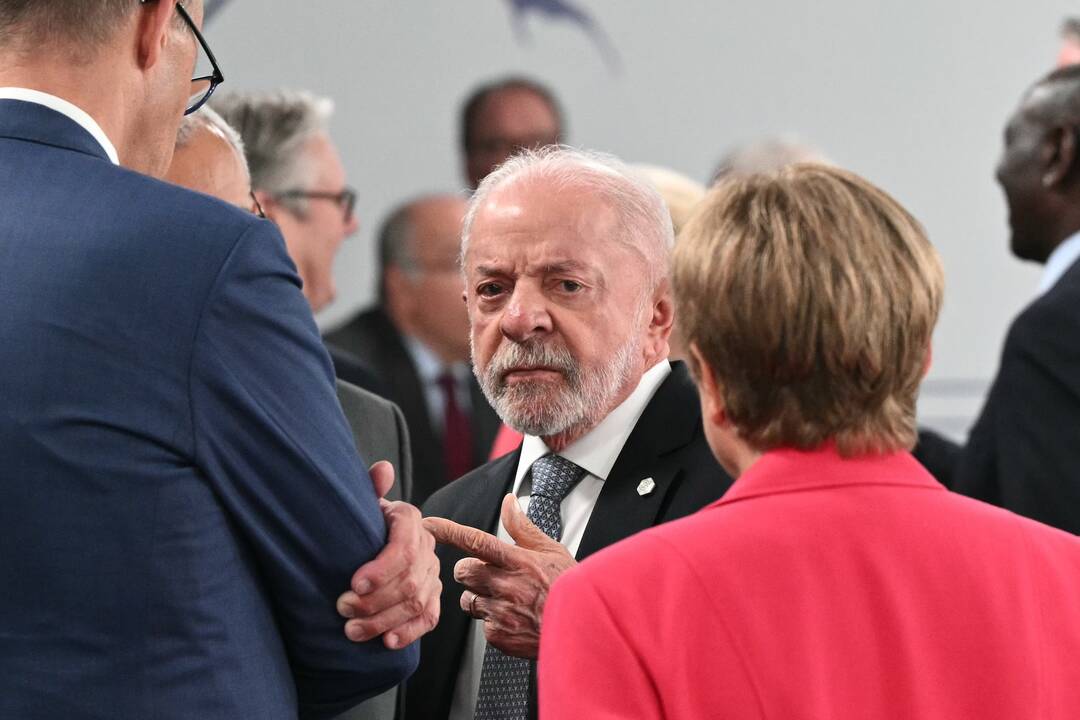
The leaders of Brazil, India and Kenya met with the G7 in Evian as the western bloc seeks to counter China’s sprawling economic influence and presents its new narrative on development aid.
Three heavyweights from the global south joined the G7 summit in Evian this week – Brazil’s president Luis Inácio da Silva, India’s prime minister Narendra Modi and Kenyan president William Ruto. The trio were invited alongside the leaders of South Korea and Egypt to discuss shifting from traditional aid to investment, but also critical minerals and economic imbalances.
The western-led meeting comes as the developing world reels from the economic fallout of the blockade of the strait of Hormuz, compounded by a record year of plummeting aid levels.
While French president Emmanuel Macron has been careful not to antagonise Donald Trump, the invitees proved less accommodating. The countries also play a crucial role in the G7 nations’ objectives – chiefly countering China’s sprawling Belt and Road Initiative.
Lula, who arrived on Monday, was met by a cheerful Macron. The Brazilian leader’s political clout and growing economic status have made him a sought-after ally – it’s his 10th G7 summit. He’s known to clash with Trump, who has actively backed Jair Bolsonaro’s son in the upcoming elections, and he didn’t shy away from offering some veiled criticism at the summit.
Speaking on Tuesday, Lula said the fight against transnational crime and drug trafficking must respect national sovereignty, hinting at the US administration’s attacks in the Caribbean and the recent designation of two Brazilian criminal gangs as terrorist groups.
“Lula was one of the leaders who waited until the last moment to change his mind to accept the invitation,” says John Kirton, director of the G7 Research Group.
Documents reveal split
Perhaps where the divergences were most visible was in the documents stemming from the meeting. Brazil’s signature was conspicuously absent from a declaration published on Tuesday on the G7 leaders’ response to the Ebola outbreak currently raging in the Democratic Republic of Congo. Reportedly, the document failed to mention the World Health Organization, which the US has repeatedly belittled and even exited. Lula joined WHO chief Tedros Adhanom Ghebreyesus, ahead of the summit, in calling for the G7 to push to finalise negotiations on the pandemic agreement’s annex that recently failed to meet a May deadline.
Another declaration on international cooperation also lacked Brazil’s support. The document calls out the traditional development aid system for perpetuating dependency and using resources poorly, and instead proposes bolstering countries’ abilities to “self-finance” their development – a stark departure from the historic consensus on wealthy nations’ responsibility towards their poorer counterparts for achieving the Sustainable Development Goals.
Modi’s relevance
But the headliner, according to Kirton, was Modi. “Modi is essential for Evian’s overall success. He’s the leader with the most experience; he’s from the most populous country. It’s still a genuinely developing country, and he’s shown how you can lead on AI, for example through its digital public health infrastructure,” says Kirton.
Commenting on X, Modi backed the G7’s call for partnerships instead of aid but said trust needed to be rebuilt presumably between north and south, also urging for support for developing countries having to absorb the shocks of conflicts. But India will also have a keen interest in the G7’s objective to counter China’s economic expansion.
“If China can’t sell its subsidised stuff into Europe, they’re going to dump it into other developing countries, including India, killing its chances of developing its own standard secondary manufacturing sector,” Kirto says, citing India’s booming solar energy sector.
African agency
As for Ruto, his invitation stemmed from a summit held by African heads of state in May in Nairobi. It corresponds with Macron’s efforts to reinvent French relations with African nations and dispel accusations of colonialism.
African countries have largely embraced the shift in narrative from traditional aid to mutual partnerships, with Ruto backing the declaration on international cooperation – unlike his Indian and Brazilian counterparts.
“The narrative shift today acknowledges, in a way, what has been happening over the past two or three decades – that countries in the global north do not come to Africa purely out of altruism to help, but also to pursue their own interests,” says Delidji Eric Degila, professor of international relations at the Graduate Institute and legal adviser to the African Group in Geneva.
“Still, African countries should stay vigilant about how these partnerships are developed because there is a tendency for the terms to be imposed on them,” he adds.
But the arrival of bigger players like China, India and the Gulf states has opened up the possibilities for the continent, putting them in a better position to negotiate. One of the G7’s goals is to set up economic corridors to connect developing nations with the G7, especially when it comes to critical minerals.
Kenya is a case in point. Its deposits of niobium and other valuable minerals essential for electric vehicles and advanced tech have drawn attention from both the US and China. One of the main demands from resource-rich developing countries has been for more of the supply chain value to be based in their territory, something the G7 has committed to.