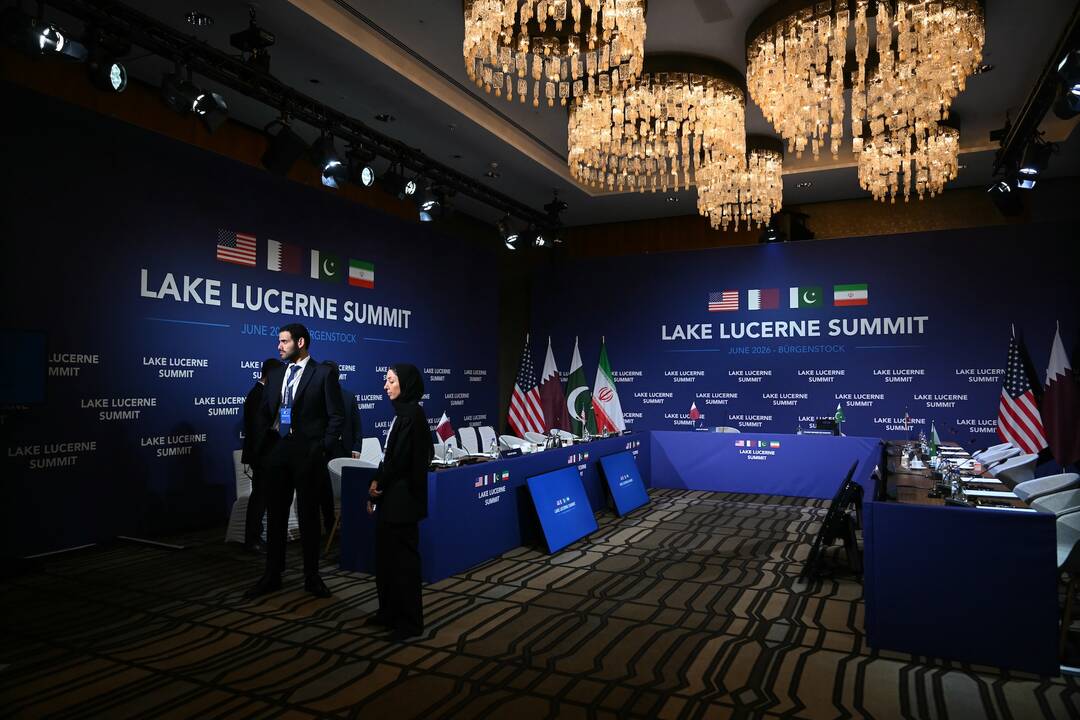
Iran’s ambassador in Geneva confirmed that the initial conditions for a peace process agreed with the US had been met. But there is little doubt that much can still go wrong in talks, with both parties disagreeing on what was agreed to regarding UN nuclear inspections.
After last week’s geopolitical theatre at the G7 in Evian, where US President Donald Trump and a memorandum of understanding with Iran took centre stage, it appeared for a moment that further talks between Washington and Tehran had hit the rocks. But after Qatar vacated a secluded Emirati-owned resort in central Switzerland to nudge talks forward, high-level officials from both sides returned to the table.
On Monday, the two adversaries reached a breakthrough, moving negotiations into their second stage and agreeing on mechanisms that would allow the strategic Strait of Hormuz to remain open and to deconflict, or remove the risk of confrontation.
Iran’s ambassador to the United Nations in Geneva, Ali Bahreini, told a press briefing with the Association of Accredited Correspondents at the UN on Tuesday that “good progress” has been achieved in talks. He confirmed that the Strait of Hormuz was now “completely” open, US waivers were issued for the sale of Iranian oil – including for bank transactions and transport – and the defreezing of $12 billion in Iranian assets had begun.
Read more: Iran wants to charge ‘fees’ on Hormuz passage. What impacts could that have?
In talks since the weekend at the Bürgenstock hotel complex, negotiators agreed on setting up working groups to focus on removing sanctions on Iran and its nuclear activities.
“Everything is interconnected,” Bahreini said about the various issues involved in the current negotiations, coming 11 years after an initial deal on Iran’s nuclear energy, known as the Joint Comprehensive Plan of Action (JCPOA), was signed with the US, before being cancelled by US president Donald Trump during his first term in office.
“You cannot resolve one part of the issues and leave other parts. They should all be resolved simultaneously,” the Iranian diplomat said.
When asked how long he expected negotiations to last, he said he could not provide an estimate, but stressed that the talks were more complicated than the JCPAO. “Definitely, it will take time in order to go through all the issues, resolve the issues and conclude arrangements.”
Lebanon menace
Ali Vaez, Iran project director at the International Crisis Group and an expert on nuclear non-proliferation, echoed scepticism about the rushed time frame. “It’s almost impossible to reach a comprehensive agreement in 60 days,” he told Geneva Solutions.
He warned that while the MoU aimed to lay the foundations for serious negotiations, “there was no guarantee they would get there”. He said that negotiators had prioritised two of the most important issues – ending hostilities and opening the Strait of Hormuz – while deferring other substantial issues to be resolved over the next two months.
Among the greatest challenges to successful talks is the ongoing conflict in Lebanon, where Israeli interests run counter to those of negotiators. “As long as Israel occupies southern Lebanon, there is always the risk and the possibility that there will be more tit-for-tat confrontations between Israel and Hezbollah,” Vaez said.
Trump, he said, has yet to exert leverage on Israeli prime minister Benjamin Netanyahu by limiting US military assistance to Israel, and with legislative elections in Israel this year, the Jewish head of state may worry about the end of his career if the public perceives him as losing the war with Iran.
But before heading back to Washington, US Vice President JD Vance focused on other threats in Lebanon, suggesting that Iran may have lost its leverage over Hezbollah as it trades fire with Israel.
Answering a question from Geneva Solutions, Bahreini objected, saying that while the organisation was an ally, Hezbollah was an independent entity which “does not receive any instructions from Iran, and Iran does not send any instructions to Hezbollah”.
The diplomat said it was the US’s responsibility to fulfil that part of the MoU. He stressed, however: “Iran’s red line is any attack against Lebanon, because…we received the assurance that there would be no attack against any place in Lebanon.”
Misinterpreting 14 points
Vaez said that misinterpretations of how the one-and-a-half-page MoU is implemented may also affect negotiations between the US and Iran on a broader agreement.
Bahreini denied that Iran had agreed to allow nuclear inspectors from the International Atomic Energy Agency (IAEA), saying this would be part of discussions in the next stage, after other key elements, including sanctions waivers and the unfreezing of Iranian assets, are achieved. He said Iran’s team had not met with IAEA chief Rafael Grossi in Bürgenstock. Last week, the Argentine welcomed the memorandum of understanding between the US and Iran.
Trump responded later on Tuesday in a social media post, insisting that Tehran had “fully and completely agreed to (the) highest level Nuclear inspections (hic).”
The Iranian ambassador also rejected statements made by Vance that unfrozen Iranian assets would be used to purchase US soy and wheat products. “Iran is the only country that will decide what to do with its assets.”