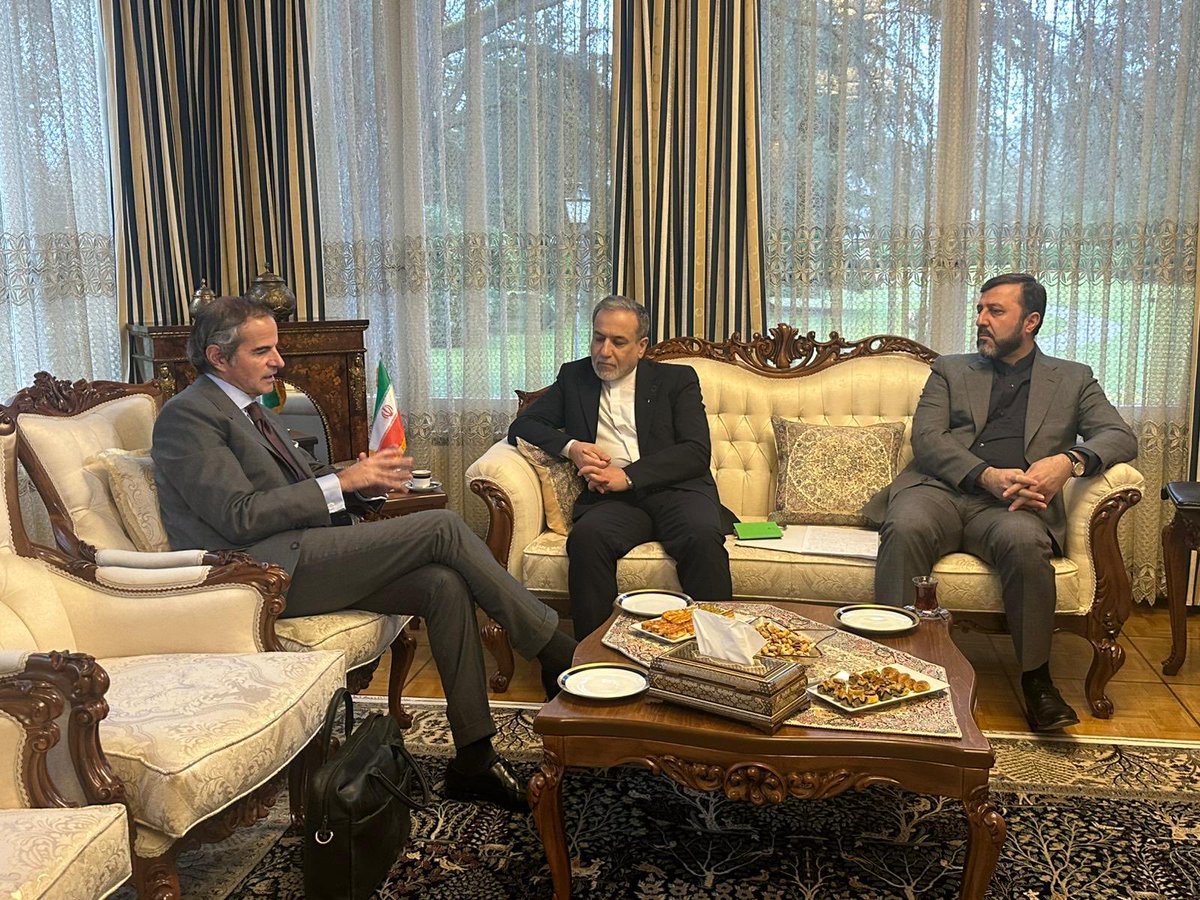
 Iranian Foreign Minister Abbas Araghchi with Rafael Grossi, director-general of the International Atomic Energy Agency
Geneva- Iran’s top diplomat met with the head of the UN nuclear watchdog agency on Monday, ahead of a second round of negotiations with the United States over Tehran’s nuclear programme.
Iranian Foreign Minister Abbas Araghchi met with Rafael Grossi, director-general of the International Atomic Energy Agency, and said he would also meet with Foreign Minister Badr al-Busaidi of Oman, which is hosting the US-Iran talks in Geneva on Tuesday.
“I am in Geneva with real ideas to achieve a fair and equitable deal,” Araghchi wrote on X. “What is not on the table: submission before threats.”
The IAEA chief added that the meeting was held “in preparation for important negotiations scheduled for tomorrow in Geneva.”
The Monday meeting came as Iran and the United States are to hold a second round of indirect talks on the Islamic Republic’s peaceful nuclear program on Tuesday. Oman is expected to continue its intermediary role.
Iranian and American delegations, led by Araghchi and US Special Envoy Steve Witkoff, resumed nuclear talks in Muscat on February 6, months after Israel’s aggression of June 2025.
Iran’s main demand in Muscat remains the effective and verifiable lifting of economic sanctions. Officials in Tehran have repeatedly stated that any agreement without tangible economic benefit would be meaningless in practice.
The negotiations will take place as US President Donald Trump has deployed military forces to the region, heightening concerns about possible new military action. US officials said on February 12 that the Pentagon was sending an additional aircraft carrier to the region, adding thousands more troops along with fighter aircraft and guided-missile destroyers.
In late January, Trump spoke of “another beautiful armada” of warships heading toward Iran and claimed that failure to reach a deal would bring consequences “far worse” than the June strikes on Iranian nuclear facilities.
Anti-war organizations, however, caution that another confrontation would be disastrous, pointing to the 12-day war in June 2025 as a stark example.
Iran’s drills take place against the US military buildup
Just before the talks, Iran announced its naval forces started the drill early Monday morning in the waterways that are crucial international trade routes through which 20 per cent of the world’s oil passes.
Separately, EOS Risk Group said sailors passing through the region received by radio a warning that the northern lane of the Strait of Hormuz, in Iranian territorial waters, likely would see a live-fire drill Tuesday.
The Naval forces of Islamic Revolution Guards Corps (IRGC) have started military drills off the country’s southern coast, practicing smart control of the strategic Strait of Hormuz, Press TV reported.
The combined live-fire intensive drills, named “Smart Control of the Hormuz Strait,” began on Monday and are directly supervised by the IRGC Chief Commander Major General Mohammad Pakpour.
The drills aim to test the readiness of the IRGC Navy’s operational units and review support programs and scenarios in the face of “possible security and military threats” in the strategic Strait of Hormuz.
Smart utilization of Iran’s geopolitical advantages in the Persian Gulf and the Sea of Oman is another main objective of the military exercise.This is the second time in recent weeks sailors have received warning about an Iranian live fire drill.
During the previous exercise, announced at the end of January, the US military’s Central Command issued warning to Iran. While acknowledging Iran’s “right to operate professionally in international airspace and waters,” it warned against interfering or threatening American warships or passing commercial vessels.
On February 4, tensions between the Iranian and US navies rose further after a US Navy fighter jet shot down an Iranian drone that was approaching the aircraft carrier USS Abraham Lincoln in the Arabian Sea. Iran also harassed a US-flagged and US-crewed merchant vessel that was sailing in the Strait of Hormuz, the US military reported.