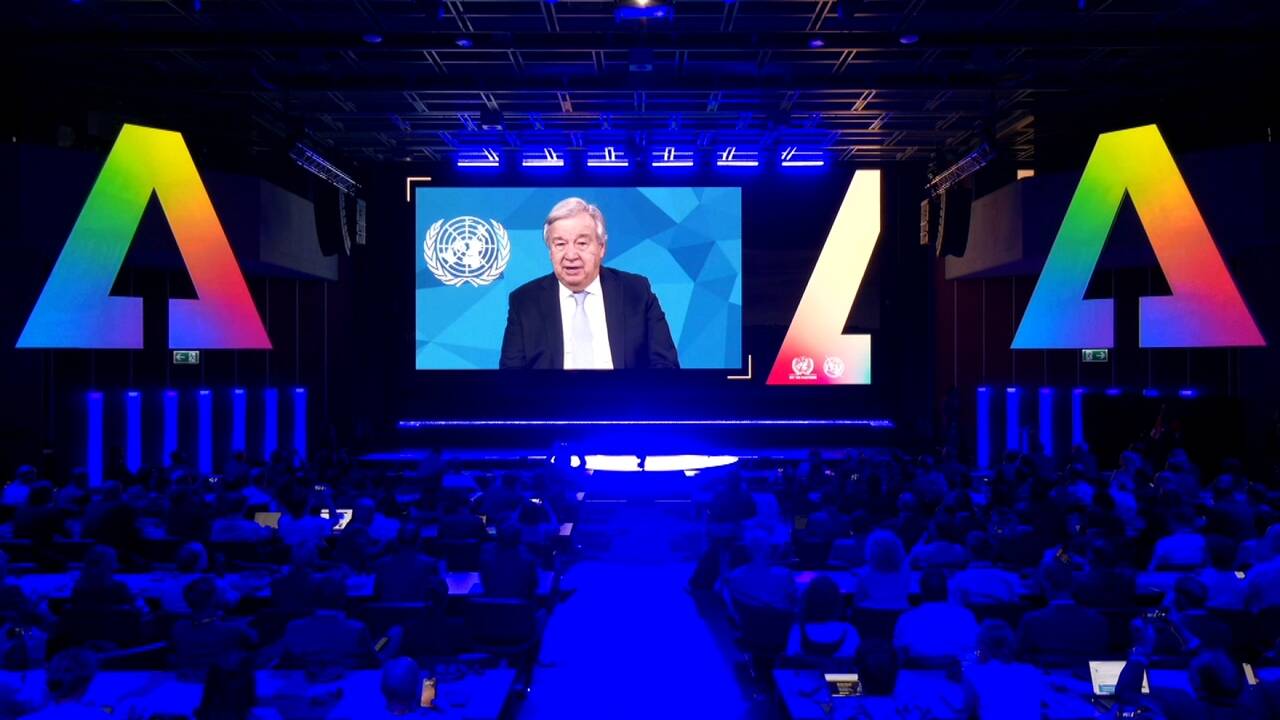
Amid broader international efforts to govern artificial intelligence, the United Nations is holding a Global Dialogue this week in Geneva, arguing it will give all countries a seat at the table.
Artificial intelligence is the buzz of the week in Geneva, with more than 2,600 people, including ministers, big tech executives, academics and experts, participating over the next two days in a UN conference billed as the first inclusive global dialogue on governing AI.
Hot on the heels of the meeting, on the same site at the Palexpo arena, technology companies will showcase the spectacular feats these new systems are capable of in everything from health to agriculture at the annual AI for Good Summit organised by the UN’s International Telecommunications Union.
But the dizzying array of innovations on show this week also underscores why the UN, countries and civil society are clamouring for better oversight.
While these new technological tools have transforming capabilities, they also carry risks, and many industry experts are deeply worried about how they could be exploited. A report released last week by 40 leading independent scientific experts ahead of the dialogue warns that AI capabilities are outpacing both scientific understanding and governments’ ability to adapt to them. The same tools that can help revolutionise society can also be deliberately misused to commit cyber attacks, spread malicious content, influence elections or design bioweapons.
On top of this, AI agents that perform tasks for humans, often in a fraction of the time, are becoming so sophisticated that there’s no guarantee that they won’t try to overrule instructions, or that humans will stay in charge, the co-authors of the report, Yoshua Bengio, considered one of the godfathers of AI, and Maria Ressa, the Nobel-Peace Prize-winning journalist, said in their opening statement.
In the race for dominance, power over these new tools is being concentrated in the hands of a few private actors and governments, which risks leaving huge swathes of the world behind or dependent on models they have little input in.
“The more AI advances without shared rules, the less say governments and people will have in the outcome,” António Guterres, the UN secretary general, told journalists at the launch of the preliminary report last Wednesday. He urged governments to take action as they prepare to engage in discussions this week.
Guterres’ final legacy
So far, there’s been little global coordination on how to manage AI’s runaway success, and Guterres has been pushing, over his second term, to position the UN as the institution best placed to play this convening role. Amid the financial crisis and geopolitical fractures weighing on the multilateral body, the outgoing UN chief wants to ensure the UN takes a leading role in helping govern a technology that will shape humanity’s future – one of the final pieces of his legacy he hopes to leave behind.
In September 2021, his office published Our Common Agenda, which argued that emerging technologies needed stronger governance. His answer was the Global Digital Compact, a framework for digital cooperation and AI governance, adopted by member states in September 2024 at the Summit of the Future. A year later, the UN General Assembly established the Scientific Panel on AI, tasked with equipping governments with the evidence they needed to act, and the Global Dialogue on AI Governance.
The two-day meeting in Geneva, which will be followed by a second dialogue in New York in 2027, appears almost modest after a roster of high-profile gatherings from the UK’s 2023 Safety Summit to Seoul, Paris and New Delhi’s Impact Summit to G20 and G7 talks.
But these processes remain fragmented, and observers say none so far have given all countries an equal seat at the table. According to UN Trade and Development, 118 countries, predominantly in the global south, are not engaged in major AI governance discussions.
Danish, a programme officer at the South Centre, a Geneva-based think tank backed by developing countries, and the author of several papers on AI policy, said: “Because it focuses on the lowest common denominator, the UN has the ability to build coherence and complementarity between these different processes, which is currently missing.”
So far, Danish believes the institution under Guterres has been consistent in its approach. “Since the beginning, it has focused on getting the cooperation needed so that AI is safe, trustworthy, and contributes to peace, and sustainable development,” he told Geneva Solutions.
‘Not just another technology meeting’
Still, coming off the back of high-level meetings like recent G7 summit in Évian – where questions of AI and tech sovereignty dominated the agenda and tech titans, including OpenAI founder Sam Altman, rubbed shoulders with global leaders –, it’s fair to ask what appetite there will be for stakeholders to engage meaningfully in the UN’s conversation.
Speaking at an online press conference on Thursday, Egriselda López, El Salvador’s ambassador to the UN in New York and co-chair of the dialogue, stressed: “This is not another meeting about technology. It is definitely the beginning of a global process to answer the most important questions of our time.”
Rein Tammsaar, Estonia’s ambassador to the UN in New York and also co-chair, said they received over 4,500 written submissions from member states, big tech and civil society, showing an overwhelmingly positive response. The Trump administration – which has retreated from many UN processes – will also send a delegation, he confirmed.
The dialogue will explore thematic issues around AI including societal, economic and linguistic opportunities, capacity-building, safety and trust, and the protection of human rights.
The tortoise advantage
Often criticised for its institutional lethargy and slow diplomatic processes, some observers have questioned whether the UN can react quickly enough to respond to such a fast-moving field like AI. But Jovan Kurbalija, director of the DiploFoundation, argues that in this scenario, its slow-moving approach might serve as a strategic advantage. “Like Aesop’s tortoise, that might just be its greatest strength.”
Amid the hype around AI, doomsday headlines and massive international pressure, he says, some regions like the European Union rushed to regulate only to pack-pedal on key parts of their legislation. “Premature rules were drafted before anyone truly grasped AI’s societal impact.”
The UN, by contrast, Kurbalija adds, may not represent the most exciting process but it is moving forward in a substantive and inclusive way that “will help focus attention on where it belongs: how this technology impacts our jobs, our rights and our communities”.
Voicing the needs of the global south
For Danish, active participation of the global south will be the key litmus test for the success of the dialogue. Though more than one billion people now use AI weekly, access and usage vary widely, with poor countries lagging behind wealthy nations.
But the problem goes beyond access. The US and China alone account for 90 per cent of the world’s computing power, meaning most countries are dependent on systems they cannot build, inspect or fully adapt to their local context.
On top of this, current AI systems reflect a fraction of the world’s linguistic and cultural diversity. “If you’re a least developed country, you really don’t have a voice in how this technology is being developed. But these are the countries that will be impacted the most in terms of labour, data use or just energy requirements,” Danish adds.
The creation of an AI fund, as proposed in the Global Digital Compact, would be the best solution to address the infrastructure shortfall, he notes. In New Delhi, Guterres raised the notion again – calling for a $3bn target – less than one per cent of a single global tech company’s annual revenue – to help developing countries catch up on skills, data and affordable computing power.
Appetite for such a fund in the current geopolitical backdrop, amid a retreat in international aid and increased defence spending, is unlikely, Danish admits, but he hopes the topic will at least begin gathering pace at the dialogue.
For Kurbalija, education and jobs should be the top priority. “The UN dialogue can play a useful role in calming down the hype around AI’s existential threats, recalibrating risks and having an evidence-based discussion on existing and immediate problems, for example in education, work and the quality of information.”