
There is a particular form of exhaustion unique to Art Basel. Not physical exhaustion, though there is plenty of that — the endless circuits through Messeplatz, the strategic lunges toward collector breakfasts, the late-night migrations from riverside terraces to hotel bars. No, the exhaustion is existential. It is the fatigue of witnessing a machine that has become so sophisticated at reproducing itself that it occasionally mistakes repetition for relevance — and yet, every June, like clockwork, Art Basel arrives.

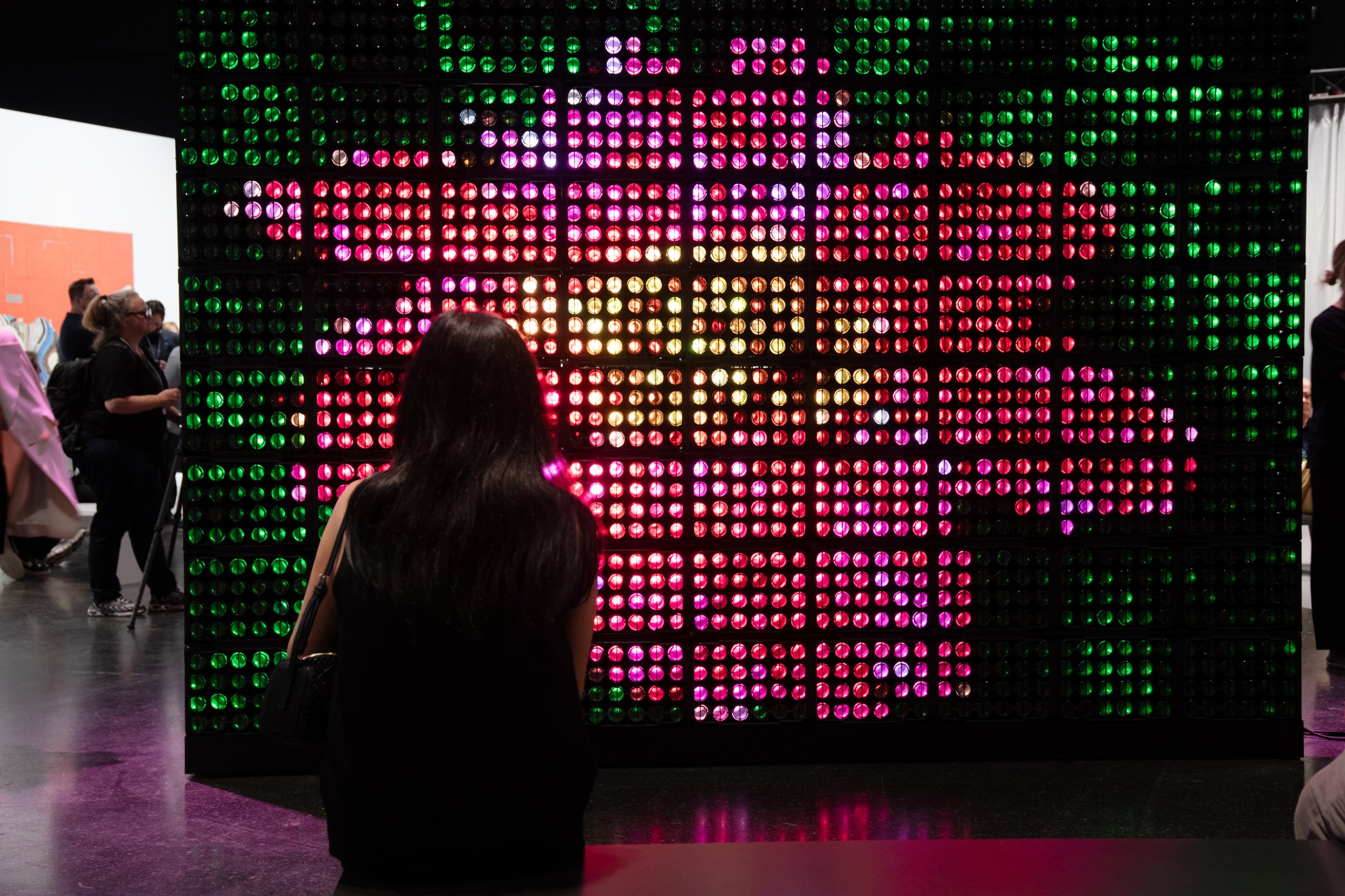
Art Basel 2026, Tarq. Courtesy of Art Basel
This year, hovering over the fairgrounds like a benevolent specter in bespoke tailoring was the ghost of Marc Spiegler — not literally, of course, though he was plenty there, but intellectually. In a recent New York Times opinion piece, the former global director of Art Basel argued that the art world may finally need fewer fairs and more relationships, less expansion and more community, less frantic globalization and more local identity.
The argument has the peculiar quality of a man standing before a cathedral he helped build, gently suggesting that everyone spend less time in church.
The argument has the peculiar quality of a man standing before a cathedral he helped build, gently suggesting that everyone spend less time in church. As summarized in subsequent coverage, Spiegler proposed a future grounded in direct relationships, local ecosystems, and sustainable cultural communities rather than endless fair-hopping.
The Architect’s Doubt
While one is tempted to applaud, one is also tempted to laugh. For if Art Basel is now being diagnosed as a symptom, Marc Spiegler spent a decade perfecting the disease. Overseeing the fair’s expansion to Miami and later Hong Kong (now, under new director Noah Horowitz, fed into the Murdoch family pipeline of the MCH Group), Doha, and who knows where next, North Korea perhaps?

Art Basel 2026, Goshka Macuga, Kate MacGarry, Galerie Rüdiger Schöttle, in collaboration with Vistamare. Courtesy of Art Basel
Contradictions that are literally visible everywhere. Inside Messeplatz at Basel, dealers spoke reverently about slowing down while simultaneously conducting sales at the speed of high-frequency trading. Outside, the city itself offered a compelling rebuttal to the fair’s own logic. Self-reported sales figures, pre-sale hype, and a new Basel editions model, designed to ensure works are not pre-sold and actually available on fair day. This, coupled with the recent demise of Jerry Gogosian, a chronicler of these absurdities, put a serious damper on this year’s Art Basel for me.
Because Basel, the actual city, not the corporate organism sharing its name, remains one of the great cultural miracles of Europe.
Unlike the sprawling fair-week nightmares that transform entire metropolises into logistical hostage situations, Basel retains the coherence of urban planning. Messeplatz functions not merely as a convention center but as a civic anchor. One walks. One encounters things. The city has scale. The river remains visible. Distances are humane. The architecture refuses spectacle for spectacle’s sake.
Unlike the sprawling fair-week nightmares that transform entire metropolises into logistical hostage situations, Basel retains the coherence of urban planning.
Art Basel 2026, Esther Schipper & Andrew Kreps Gallery, Hito Steyerl. Courtesy of Art Basel
Most importantly, Basel possesses something increasingly rare in contemporary art: memory. Its relationship with museums is not decorative but foundational. The Kunstmuseum, Fondation Beyeler, Museum Tinguely, and countless smaller institutions do not exist as auxiliary programming for a fair. The fair exists partly because these institutions have already made Basel a cultural destination.
This year, nowhere was that more evident than at Fondation Beyeler, where Pierre Huyghe once again demonstrated why he remains among the few artists capable of producing genuine wonder without resorting to technological gimmickry. The Beyeler exhibition offered the sort of experience increasingly absent from commercial fairs: duration, ambiguity, and the possibility that meaning might emerge slowly rather than arrive prepackaged in a PDF.

Art Basel 2026, Site-specific commission across Münsterplatz by Ibrahim Mahama. Courtesy of Art Basel
Basel, Not Art Basel
Meanwhile, inside the fair, the market performed its annual ritual of cautious optimism. Reports suggested strong sales, selective collectors, and a mood considerably more restrained than the speculative delirium of recent years. Everyone appeared relieved that civilization had not ended. Dealers celebrated seven-figure transactions with the nervous gratitude of survivors emerging from a bunker.
Yet the most interesting energy was often elsewhere.
That can be said for younger initiatives and alternative models emerging around the fair week. Zero10, among others, represents an encouraging willingness to experiment with formats that do not begin and end with booth economics. Whether these ventures ultimately endure is less important than the fact that they exist. Their presence introduces oxygen into a system that frequently mistakes prestige for vitality.

Art Basel 2026, Ben Brown Fine Arts. Courtesy of Art Basel
This is, perhaps, the true lesson of Basel —the city thrives not because Art Basel dominates it but because Art Basel must compete with it.
This is, perhaps, the true lesson of Basel —the city thrives not because Art Basel dominates it but because Art Basel must compete with it. Collectors arrive for the fair and discover a cultural ecosystem. Curators come for openings and stay for museums. Artists wander from institutional exhibitions to independent projects to improbable dinners along the Rhine. Commerce remains central, but it is not singular.
Contrast this with so many contemporary fair cities that become temporary stages for transactional performance. Basel stubbornly remains a place.
Of course, commerce eventually reasserts itself. It always does.

Art Basel 2026, eastcontemporary, Aziza Kadyri. Courtesy of Art Basel
The Economy of Attention
By midnight, one inevitably finds oneself at the Trois Rois, where the annual theater of luxury enters its most operatic phase. Here, among champagne flutes and strategic introductions, one encounters the familiar fair-week cast: collectors, advisors, artists, journalists, oligarchs, pseudo-oligarchs, actual royalty, self-declared royalty, and several individuals whose professional functions remain pretentiously mysterious.
Niclas Castello is one of these figures. A contemporary artist, he now circulates through this ecosystem like a rumor that refuses to die, a permanent fixture in the same way Ye and Bianca Censori now orbit Art Basel as moving installations rather than mere VIP guests. His 24‑karat gold cube, briefly parked in Central Park under armed guard and priced by weight like bullion, has already entered art-world lore as a portable ATM of attention — an object lesson in how capital and spectacle can be fused into a single, photogenic commodity. The piece, conceived as a 400‑pound “socle du monde” for this cycle of financialized culture and used to launch a namesake cryptocurrency, functioned less as sculpture than as a recurring reminder that contemporary art has always run a dual‑track system: circus and catechism, showroom and sanctuary, bank vault and belief structure.

Art Basel 2026, PKM Gallery. Courtesy of Art Basel
In the same register, Kanye and Bianca’s Basel appearances — frozen in place for a resurrected Mannequin Challenge one night, circulating the fair in naked proximity to cringe the next — operate as mobile billboards for the fact that every ecosystem breeds its own peacocks, bodies, and objects calibrated to feed a continuous scroll of images. The market’s demand for glamour is not new, nor is its willingness to collateralize scandal; what changes from Castello’s cube to Bianca’s wardrobe is only the translucency, while the underlying protocol — attention minted into value — remains structurally identical.
The market’s demand for glamour is not new, nor is its willingness to collateralize scandal; what changes from Castello’s cube to Bianca’s wardrobe is only the translucency, while the underlying protocol — attention minted into value — remains structurally identical.
Long Live Art Basel
The irony, of course, is that these absurdities remain deeply entertaining. And since transitioning into my new role as an art fixer and press relations goon, I honestly stopped hating the game and just started accepting it for what it is. My clients, among them art foundations and artists (including the aforementioned Castello), help me make sense of the world. I want to get rich just as much as anyone else. With the obvious caveat that I myself am a product of what I critique. Soulless.
Perhaps this is why Art Basel endures despite its contradictions.
And so the fair proceeds. Dealers complain and renew their booths. Collectors lament prices and continue buying. Curators denounce the spectacle and accept invitations. Art critics advocate slowing down while rushing to the next press trip. Everyone invokes community while checking sales reports, Instagram followers, and proximity to clout.
This is where Spiegler’s argument becomes both persuasive and impossible. He’s right — the art world likely does need fewer fairs and deeper relationships. It needs stronger local communities, healthier ecosystems, and less dependence on perpetual expansion. The diagnosis is convincing.

Art Basel 2026, Gagosian. Courtesy of Art Basel
The problem is that Art Basel itself remains the greatest argument against the prescription.
Because despite everything — despite the exhaustion, the contradictions, the market theatrics, the strategic networking disguised as friendship, the friendship disguised as networking, the endless panels, breakfasts, lunches, dinners, cocktails, previews, and after-parties — Basel still produces something approaching cultural intensity. A destiny of arrivals and departures, an art scene brimming with equal parts classy and crappy.
Not because of the fair model alone.
Because of the city.
Because of the museums.
Because of the dopamine rush from movement.
Because of permanence.
Because of independent projects.
Because of events like Basel Social Club.
Because of alternative ventures like Zero 10.
Because Messeplatz remains connected to an urban fabric rather than isolated from it.
Because preservation and experimentation can coexist.
Because memory survives.
And because for a brief moment once a year, a debilitating event arrives, the art world gathers in a place that reminds it what a cultural ecosystem can look like when commerce is embedded within civic life rather than replacing it.
Art Basel may be an exercise in futility. But art itself remains an exercise in being human. Long live Art + Basel, to hell with everything else.