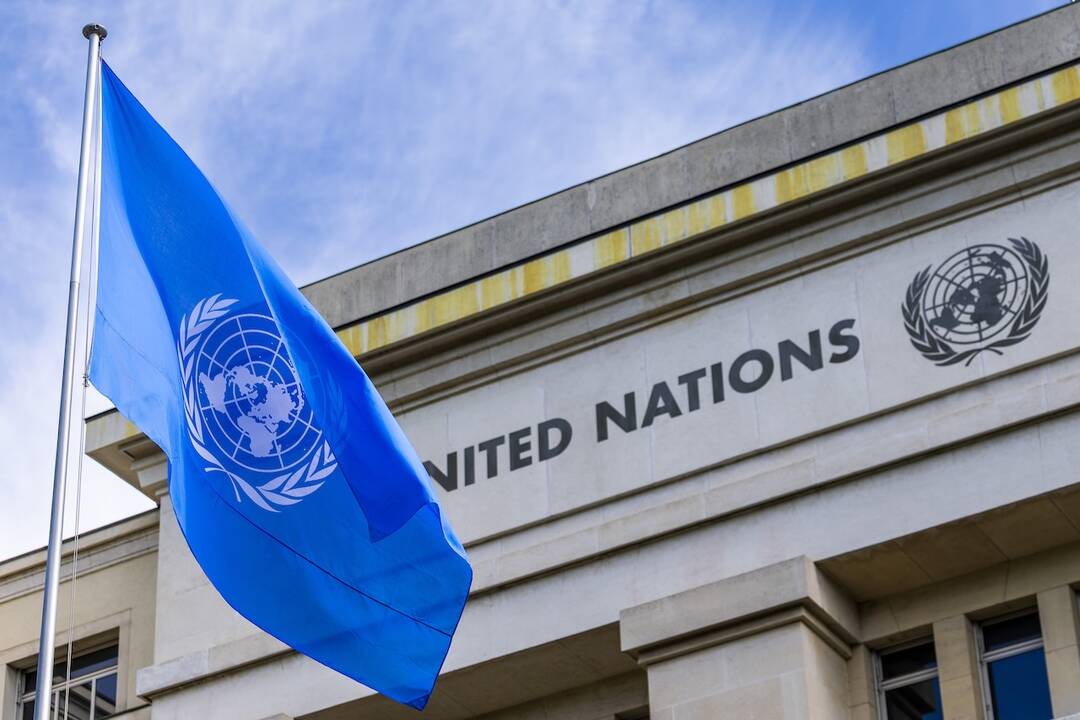
Guy Ryder, who is leading UN chief António Guterres’s reform push, says controversial merger proposals were to assess the merits of fusing organisations, not to force decisions on member states.
With just two months left to come up with the United Nations’ biggest structural shakeup, Guy Ryder, chairman of the UN80 reform task force, announced that no further budget cuts will be made while difficult discussions on agency mergers proceed.
“It has been a reform effort to respond to the entirety of the circumstances operating on the UN system, be they financial, be they political,” Ryder said at a press briefing, referring to the major cuts in aid funding, particularly by the UN’s biggest contributor, the United States. The former head of the International Labour Organization said that after the secretariat’s 9.2 per cent budget cut this year – coming on top of a seven per cent reduction in 2025 – no further cuts are foreseen.
Ryder was in Geneva on Tuesday to update member states on the process that had been launched in 2025 by UN secretary general António Guterres.
The UN80 initiative focuses on three main areas: reducing spending at the UN’s secretariat, rationalising mandates given to the organisation by its member states, and slimming down agencies, either by shrinking them or by fusing some of them.
Match-making strains
Among the proposals on the table is combining the UN Development Programme (UNDP) and the UN Office for Project Services (UNOPS), which Guterres has said would “create a stronger engine for sustainable development, with greater reach and scale”.
Devex, however, recently reported that the heads of the two agencies were not having it and clashed at a meeting in April over their respective visions for a future merger. UNDP chief Alexander De Croo proposed a scheme to absorb the smaller agency while streamlining operations. This was viewed as a hostile takeover by his UNOPS counterpart, Jorge Moreira da Silva, who countered that a new agency should be created in which UNOPS could help raise more funding for the UN.
Ryder insisted that both organisations had spoken in favour of a merger.. “It’s just the conditions upon which the geometry of going from two to one takes place, which still divides the two entities,” he said.
Another coupling proposed by Guterres – between the UN Population Fund (UNFPA) and UN Women – has faced opposition from civil society groups, which fear it may dilute the UN’s mandate to protect women’s rights. Meanwhile, a group of countries, including Brazil, Canada and Belgium, has requested alternatives to the merger.
Under his UN80 initiative, Guterres has also proposed “sunsetting” the Geneva-based organisation, which US cuts have hit hard, and folding it into other organisations such as the World Health Organisation. But UNAids’s board has rejected the proposal, saying that it would do serious damage to the fight against HIV/Aids at a time the disease is facing a comeback.
Read more: Sunset or new dawn? UNAids fights for survival
Ryder maintained that Guterres had not pushed for mergers but rather to “make an assessment of whether these would bring benefits or not” and would not force any decisions on member states. The secretary general, however, was determined to “front load” as much of the UN80 plan as possible before the high-level opening of the UN General Assembly in September.
Responding to questions from Geneva Solutions about possible mergers, the former head of the International Labour Organization avowed: “One thing I’ve learned in UN80 is any structural change is particularly difficult in this circumstance.”
No US interference
Responding to a question from Geneva Solutions, Ryder denied that the US, responsible for 22 per cent of the UN regular budget, had exerted any pressure on those involved in advancing the reform proposals, including a merger of UNFPA and UN Women.
Women have been disproportionately affected by US aid cuts, since the Trump administration dissolved USAid. According to a 2025 UN Women report, the cuts had affected 90 per cent of women-led and women’s rights organisations it surveyed. US relief cuts to Afghanistan have also intensified the crisis for women and girls in the country.
“US representatives in New York are very engaged in the UN80 process and have been generally quite encouraging,” Ryder added. “But they want to go further in ways which are not entirely precise at this moment.”