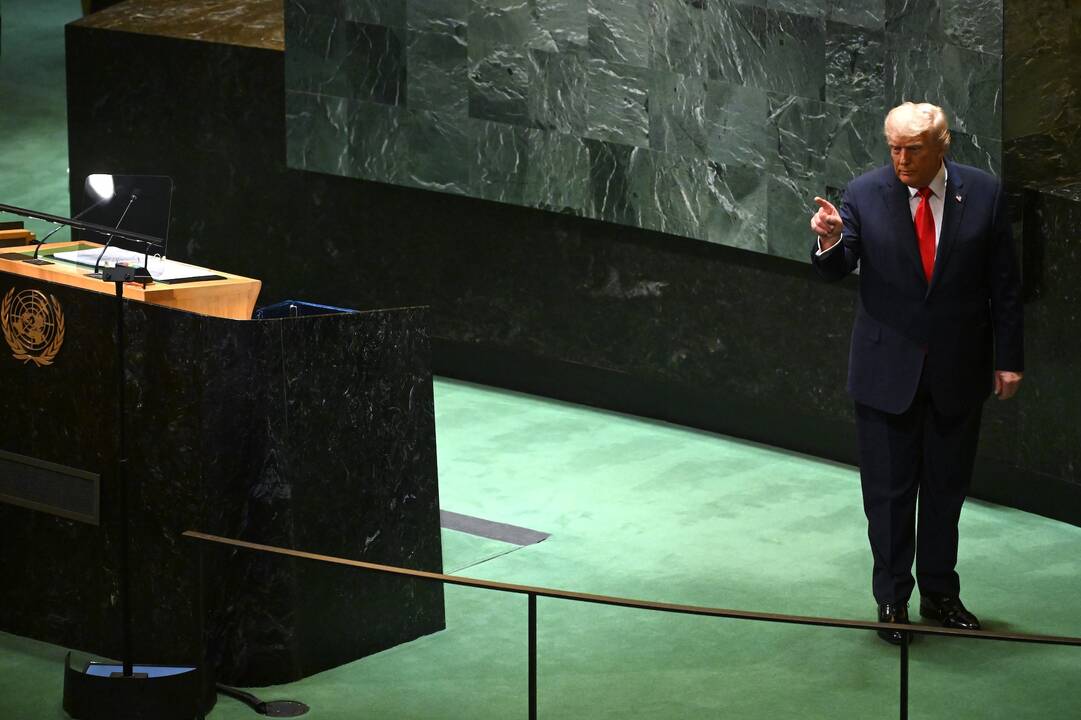
An overnight announcement by president Donald Trump to exit 66 international organisations – including Unctad and the IPCC in Geneva – may signal the US administration’s further diversion from multilateralism, but may be more symbolic than a funding catastrophe.
As the snow fell on Geneva yesterday, another chill could be felt coming from across the Atlantic, bringing a further freeze by the United States of international cooperation and multilateral relations. On Wednesday evening, the Trump administration signed a sweeping executive order withdrawing from dozens of international organisations and UN agencies, including over 10 with offices in and around Geneva.
The move was perhaps not surprising after a trend that began exactly a year ago with Washington’s announced withdrawal from the World Health Organization, and has since followed with exits from other significant UN organisations, including its culture and education agency, Unesco, and the Human Rights Council. But the level of detail and sheer number of institutions singled out – 66 in total – has given observers reason to pause. “The major thing here is that Trump is going after any kind of erosion of American sovereignty,” says Swiss-US political analyst Daniel Warner.
Geneva dealt a blow
The order, which comes after secretary of state Marco Rubio’s review of all international organisations, severs support for 31 UN agencies, offices and councils, as well as another 31 non-UN organisations focused on issues from trade and development, to climate, to education and human rights.
Geneva-based organisations affected include UN Trade and Development (Unctad) and the International Trade Centre – both key in providing technical assistance to developing nations – and the Intergovernmental Panel on Climate Change (IPCC).
“The US has prioritised rejecting bodies that focus on development, environmental issues and gender issues,” Richard Gowan, programme director at International Crisis Group, tells Geneva Solutions. “Basically, the current US administration thinks these are ‘woke’ issues, so it is no shock these bodies are the main targets.”
In a statement issued on Wednesday, Rubio gave a litany of reasons for leaving these institutions, saying the Trump administration found them to be “mismanaged, unnecessary, wasteful, poorly run, captured by the interests of actors advancing their own agendas contrary to our own, or a threat to our nation’s sovereignty”.
He also suggested that sending staff to these organisations – “the blood, sweat, and treasure of the American people” – was not worth the time and effort. The comments don’t bode well for Geneva, which is still awaiting the appointment of a US ambassador to the UN and other institutions, a year after Trump took office. So far, there have been no indications of a nominee for the post, which Warner said could be interpreted as a purposeful move “to show there is little interest”.
Early signals
Eugene Chen, a non-resident adviser at the International Peace Institute, notes that while the number of institutions and conventions is eye-catching, the only UN system organisation that the US will actually be withdrawing from following the order is the UN Framework Convention on Climate Change, the body that oversees the annual conferences, after Trump already announcing its exit from the Paris treaty last January. “
“The Trump administration has not signaled that it is considering withdrawing from the UN itself; it simply announced that the United States will no longer participate in or fund the specific parts of the UN listed in the memorandum,” he said in an online post.
Unctad, meanwhile, had not received funding from the US since 2018 – during the first Trump presidency – when the agency granted Palestine membership.
Other Geneva-based organisations tagged for the US exit are UN Water, the UN Institute for Training and Research (Unitar), a technical agency, the International Law Commission, in charge of codifying international law, and Education Cannot Wait, a global fund supporting education in emergencies. The International Union for the Conservation of Nature, a network of governments and NGOs based in Gland, has also been struck off.
The UN Office in Geneva did not immediately comment on the developments ahead of statements expected from New York headquarters later on Thursday.
Staff jitters
Ian Richards, head of the UN staff association, says that following job cuts announced in recent months, “staff continue to be very worried” following the US announcement. “There’s a worry that there will be even more cuts. Are we in some kind of vicious cycle?”
Nonetheless, he questioned the extent of the withdrawals’ impact. Some entities are funded by the UN regular budget, which is approved as a whole in New York. Others, such as the New York-based UN Population Fund and UN Women, as well as any climate-related programmes, reliant on voluntary contributions, had already been hit by US funding cuts since last year. “Practically for staff, I don’t think there would be much change,” Richards says.
More importantly, however, is the question of whether the US would reassess its contributions in 2026 following the massive cuts that the global body has been introducing under the UN80 reform initiative. “If they don’t contribute in 2026, then there may have to be further cuts,” he says, noting that the US always makes its membership contributions in October in alignment with Washington’s fiscal calendar.
Not on the list
In spite of the length and detail provided in the list of agencies that Washington deems unworthy of US support, other international organisations have remained in its good graces.
In Geneva, the US has signalled support, at least for now, for the International Telecommunications Union, responsible for shaping global tech standards and headed by US nominee Doreen Bogdan-Martin. And in October, the US paid $25 million in overdue fees to the World Trade Organization, in spite of its diametrically opposed vision of trade policy.
The UN’s drug and crime agency in Vienna (UNODC), where a majority of funding comes from voluntary contributions, last year received additional funding from the US, following its cooperation with American law enforcement agencies to tackle the fentanyl crisis.
Hit for multilateralism
Warner warns of what the announcements mean for international Geneva if left undefended. “There’s no Mr. or Mrs. international Geneva. There’s no leading figure representing the morality and the idea behind international cooperation.”
“And even in Switzerland, we don’t see the Swiss foreign ministry or certain other leaders stepping forward and defending international Geneva and defending the UN,” he adds.