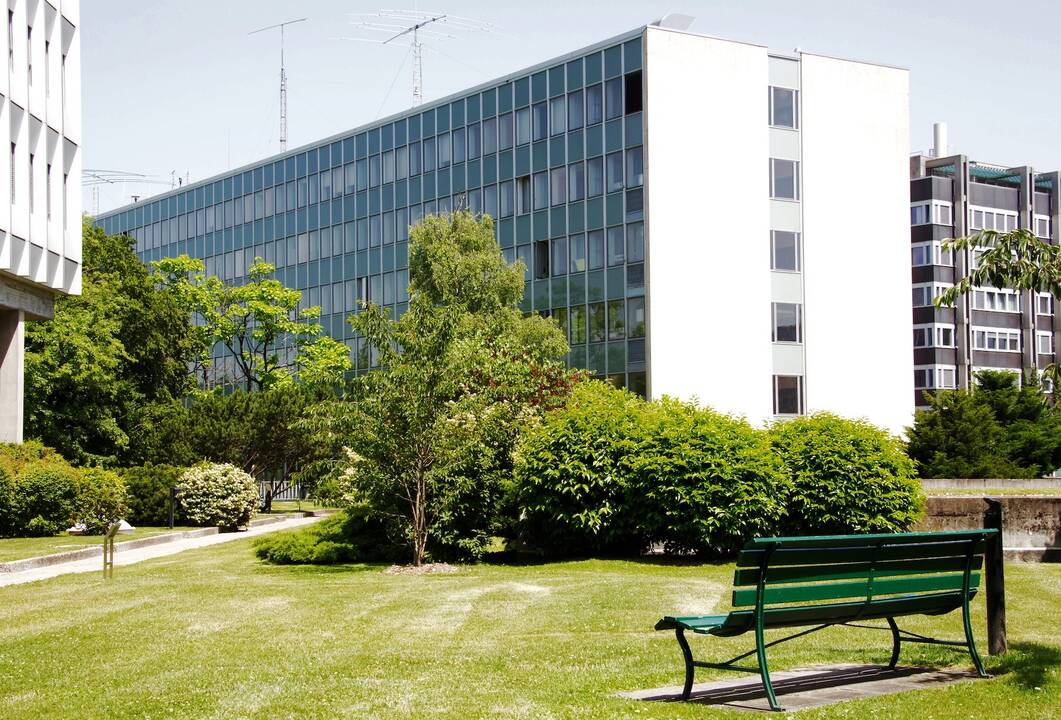
The UN tech agency is finally set to renew its outdated headquarters, but funding gaps and logistical hurdles still loom.
After nearly a decade of planning, redesigns and budgetary setbacks, the International Telecommunication Union (ITU) says its long-delayed plan to rebuild part of its Geneva headquarters is finally moving forward. Member states received an update on the new building project in April during a council meeting, according to the ITU, which told Geneva Solutions by email that the project “was on budget, on schedule and on scope”.
The decision comes as a boost for international Geneva at a time when several agencies are downsizing their presence in the diplomatic hub.
But the project is not out of the woods yet. The UN tech agency must keep construction costs within a CHF172.69 million ceiling while preserving donor commitments after the withdrawal of a major sponsor, and develop a logistical plan to continue hosting dozens of meetings a year during demolition and construction work on its campus near Place des Nations.
A fresh start
The ITU has been trying to replace part of its Geneva headquarters campus since 2016, when states approved a roadmap for restructuring the campus and replacing the ageing Varembé building – the oldest part of the complex, which no longer meets modern safety and energy standards.
A 2018 design by Geneva architect Christian Dupraz was abandoned after construction bids came in over budget and attempts to downsize proved impossible. The setback was a blow not only for the ITU but also for international Geneva. The agency had originally hoped to complete its new headquarters by 2026.
In June last year, the project was given a new lease of life when the ITU appointed IB+3XN, a new consortium of Swiss and Danish architects, to come up with a new, less grandiose design in line with budget realities.
“We are currently developing the architectural concept and design with both internal stakeholders and member states, including the host country,” the ITU said. For now, the final appearance of the future headquarters remains under wraps. The UN agency said details would be shared publicly once finalised in 2027.
Funding questions
The building is being largely funded by loans from Switzerland and the Canton of Geneva – CHF95.6m from the federal government and CHF42.4m from the Canton of Geneva, repayable over 50 years. A spokesperson from the Swiss diplomatic mission in Geneva confirmed that both have agreed to reallocate the remaining funds from the original loans to the revised project.
Though focused on the Varembé building, the makeover has triggered a rethink of the ITU’s whole Geneva campus. One of the most significant changes concerns the future of the Tower building. Earlier versions of the redevelopment strategy envisioned selling the landmark structure to help finance the project. That option is no longer on the table after independent studies ruled out the sale due to legal, market and operational hurdles.
Read also: ITU rethinks plans for new Geneva headquarters
Notably, the building will be needed to accommodate staff and operations during the construction period. But that means the ITU now expects to retain all three campus buildings, including the costs of a ten-year maintenance programme for the Tower complex, followed by a full renovation.
Still, the ITU says the budget envelope “remains unchanged”.
But questions remain around how other parts of the renovation are being financed. The ITU maintains that the redevelopment remains fully funded despite the withdrawal of a CHF5m sponsorship from the United Arab Emirates, which had supported the original design. The contribution was returned in November 2025. According to ITU documents, the loss can be absorbed through existing contingency reserves without affecting the project’s scope or delivery.
Other sponsors remain on board, including Saudi Arabia, Kuwait and Intersputnik, the intergovernmental organisation, alongside donations from the Czech Republic, Nigeria and Ghana.
Operational conundrum
But the biggest challenge may come once construction begins in 2028, with the works expected to run until 2031. The ITU is actively exploring on-site mitigation measures to ensure minimal disruption to its operations and events.
The ITU, which oversees telecommunications standards, radio spectrum management and satellite coordination, normally hosts between 60 and 65 meetings a year and finding alternative venues in Geneva may prove difficult. The Geneva International Conference Centre, traditionally the ITU’s main overflow venue, which sits next to the ITU complex, will itself be undergoing renovation and faces periods of limited availability.
Other options include the exhibition venue Palexpo, or even the World Health Organization, the International Labour Organization and the United Nations Office at Geneva, which have recently freed up office space following job cuts. But these are only partial solutions.
To help the ITU during this transition period, Switzerland has granted ITU a two-year waiver on repayments of eligible real-estate loans, generating CHF2.78m in savings for a business continuity fund dedicated to supporting meetings during the construction period. Along with earlier allocations, the fund currently stands at around CHF3.17m.
The ITU has also examined more radical options, including setting up an ITU meetings hub abroad during the construction period. Earlier discussions involved the UAE and Kenya, but the organisation now says no decision has been made.
This comes as budget constraints have prompted other organisations to reassess their presence in one of the world’s most expensive cities. But that solution comes with its own host of challenges. A telecommunication forum organised by the ITU in the Bahamas was recently postponed after too few delegates and companies registered, according to sources, raising concerns that moving operations to hard-to-reach areas would make participation more difficult, especially for small middle-income countries.