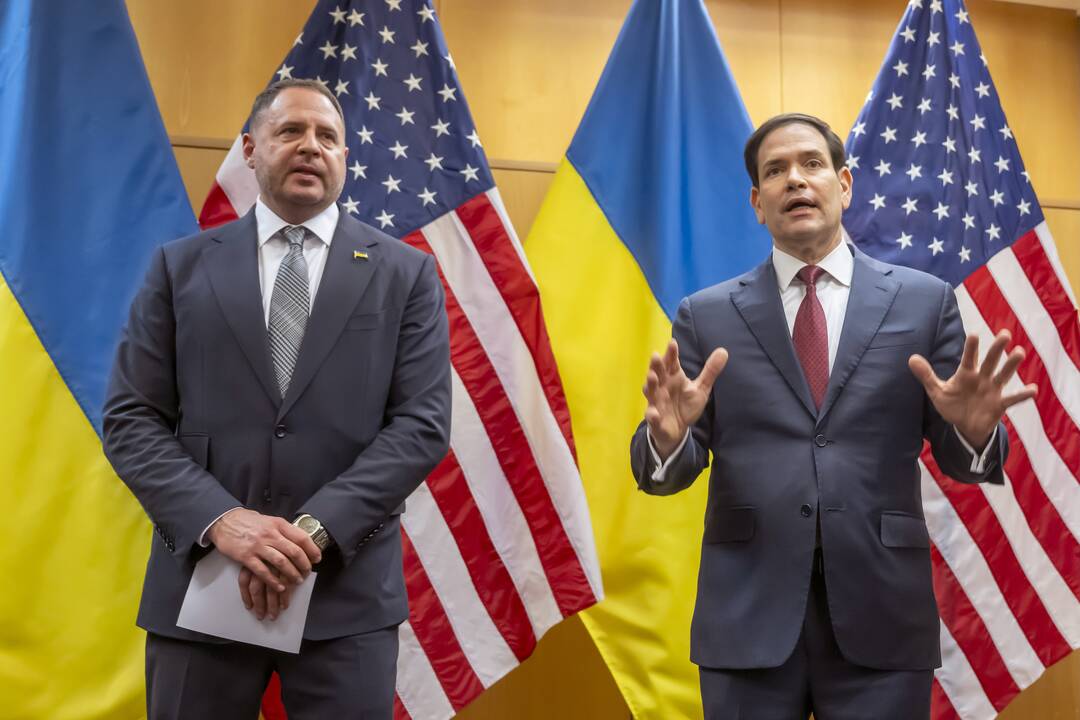
By hosting talks on Sunday between Ukrainian, US and European officials over a prospective peace plan for Ukraine – one partly sketched by the Russian Kirill Dmitriev – Switzerland treads a fine line between pushing for peace and defending the international legal order it so often champions.
A stone-faced politician suddenly charges across the lobby of Geneva’s Intercontinental Hotel. The man, surrounded by bodyguards and an equally taciturn entourage, is Marco Rubio, officially in town to discuss peace with Ukraine.
Geneva is no stranger to hosting diplomatic talks. But these resemble something closer to a standoff – Ukraine and Europe pushing back against Washington. To end the war with Russia, the Trump administration is demanding that Kyiv surrender sovereignty over certain territories, halve its armed forces and drop its ambition of joining NATO.
It’s a return to Europe’s darkest hours, warns David Harland, director of Geneva’s Centre for Humanitarian Dialogue. “The US-Russian proposal is something Europe hasn’t seen since Munich in 1938 and Molotov-Ribbentrop in 1939. Europe is paying the price for 30 years of neglecting its military power,” he told Le Temps.
After their meeting, both Rubio and Andriy Yermak, head of Ukraine’s presidential administration, told reporters the session had been “productive”. Rubio went further, touting the talks as “probably the most productive” to date, adding that point-by-point changes to Donald Trump’s peace plan are now being negotiated.
The Russian architect behind the ‘American’ plan
The stakes could hardly be higher. Yet on Sunday evening, little leaked from the discreet meetings inside the Intercontinental or around the US and French missions. The opacity was all the more striking given that Trump had just hinted he was open to revising parts of the plan and that the 27 November deadline for Ukraine to accept it could shift. Talks kicked off late and were expected to run well into the night.
This carefully managed tension contrasted sharply with the evident delight of one man hundreds of kilometres away in Moscow. Kirill Dmitriev, the head of the Russian Direct Investment Fund (RDIF), revelled in the “hysterical reactions” the supposedly “American” plan was causing across Europe. This was unsurprising as he appears to have helped design it. Multiple sources suggest as much.
US lawmakers have been saying it openly. At the Halifax International Security Forum, Republican senator Mike Rounds and independent Angus King said Rubio had told them privately that the US peace plan was in fact a Russian one, which Washington had agreed to relay to Kyiv. King described it as a “wish list of the Russians”, “not the administration’s plan”. Rounds added that the English document “looked more like it was written in Russian to begin with” – a claim reinforced by linguists who spotted tell-tale signs of an AI-translation.
Asked by Le Temps about the plan’s origins, Russia’s consul-general in Geneva initially claimed the plan came from Trump and Putin’s Alaska summit. “They came up with this solution,” he said. He then clarified that “the project presented today is our new version”.
According to Reuters, it was drafted in late October in Miami during a meeting between Trump’s special envoy Steve Witkoff, his son-in-law Jared Kushner and Russian businessman Kirill Dmitriev – despite Dmitriev being under US sanctions. “Russia’s positions are finally being taken seriously,” Dmitriev boasted on his return, overshadowing veteran foreign minister Sergei Lavrov, said to be “out of favour” since the indefinite postponement of the planned Trump-Putin summit in Budapest.
A man with ‘physical access to the boss’
Dmitriev’s clout is not new, but it has grown since Trump’s re-election. He is credited in Moscow with steering Russia’s approach to negotiating with the White House strictly on the basis of commercial interests. He endlessly touts the benefits of rekindling US–Russian business ties – hence the plan’s unusually generous perks offered to Trump as a would-be peacemaker. In the same vein, Dmitriev has floated, in all seriousness, the idea of a rail tunnel under the Bering Strait linking Russia and the United States. “He’s extremely ambitious, always chasing something that will make him famous,” a close associate told the exiled Russian outlet Meduza.
Born in Kyiv during the Soviet era, Dmitriev is a discreet operator who spent much of his career in American firms. He appears to be well-trusted within the Kremlin – helped by the fact that his wife, Natalia, went to school with Putin’s daughter Katerina Tikhonova. He is reportedly close to one of Putin’s sons-in-law, according to independent media, and holds a rare privilege within Russia’s elite: he has, quite literally, “physical access to the boss”.
Moving forward at any cost
Meanwhile, Putin continues to push on every front. On Thursday, he wore military fatigues for the fourth time since the invasion began to announce the fall of Kupiansk, a town in the Kharkiv region that has seen months of brutal fighting. Several Ukrainian battalions are said to be encircled. The Russian defence ministry also claims progress on another major axis in the Donbas, towards the strategic city of Pokrovsk in the Donetsk region. Ukraine disputes these claims, and even hardline pro-war Russian analysts have cast doubt on them.
But the message is clear: Russia intends to keep advancing. As Putin put it on Friday, “If Ukraine doesn’t want to discuss Trump’s proposals, then Kyiv and the European warmongers must understand that the events of Kupiansk will inevitably be repeated on other key sectors of the front. Maybe not as quickly as we’d like, but inevitably. And overall, that suits us.”
Over the weekend, Dmitriev took to X in English to argue that the plan’s purpose was to spare Ukraine “the loss of even more territory and lives”. Yet even one of the Kremlin’s spin doctors, Andrei Lukyanov, acknowledges that it effectively sounds the death knell for the “old world” of rules and international obligations.
‘There’s what Switzerland does, and what Geneva does’
As for Switzerland, doesn’t hosting talks over a peace plan that fundamentally contradicts the very principles of international law the country has long championed pose a dilemma? When asked by Le Temps, foreign ministry spokesman Nicolas Bideau gave a pragmatic reply: “Switzerland is acting as an impartial intermediary. We serve the parties that need us and our impartiality to move towards a just and lasting peace.” He pointed to the Burgenstock and Lugano conferences. “In this war, Switzerland has taken the initiative on two fronts: reconstruction and facilitation,” he said, initiatives, he added, “made easier by our presence on the UN Security Council, which gave us a particular position on peace-promotion issues.”
In practice, hosting talks that favour Moscow may also help foreign minister Ignazio Cassis with his own diplomatic travel plans. Switzerland will chair the Organization for Security and Co-operation in Europe starting on 1 January 2026, and Cassis hopes to visit Kyiv, Tbilisi and Moscow early next year – but Russia has yet to respond.
According to Russia’s consul-general in Geneva, Igor Popov, Bern has work to do if it wants to shake Moscow’s view that Switzerland became a hostile state when it aligned itself with EU sanctions. “Our official position is that Switzerland is no longer a neutral country. But Geneva maintains its tradition as a place where international agreements are made,” Popov said, recalling the Putin–Biden summit of June 2021. “There’s what Switzerland does, and there’s what Geneva does,” he concluded.
This article was originally published in French in Le Temps. It has been adapted and translated into English by Geneva Solutions. Articles from third-party websites are not licensed under Creative Commons and cannot be republished without the media’s consent.