DTRA maps indicate zero airborne lead detection following Wednesday’s controlled detonation.
 MIDDLETOWN, Iowa —
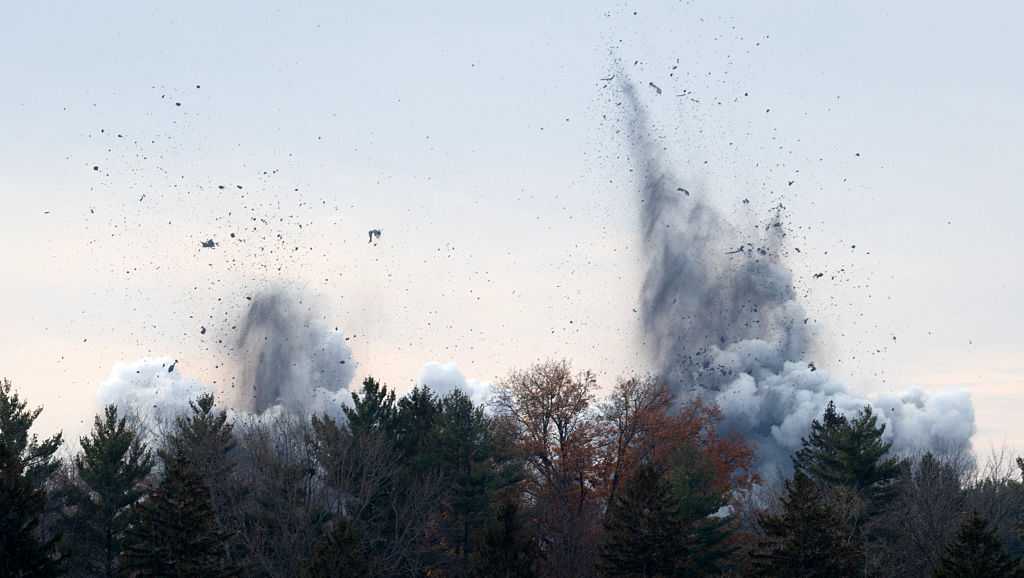
The Army detonated 68 barrels of unstable lead azide in Iowa on Wednesday at 9 a.m. It’s the entire U.S. stockpile of the unstable and dangerous chemical.
The detonation sent a plume of dust into the air, which was caught on camera.
Watch the moment in the video player above.
Around 5:30 p.m. Wednesday, FEMA issued an All Clear around the Iowa Army Ammunition Plant.
According to the U.S. Army, DTRA maps indicated zero airborne lead detection. Officials said results of post-detonation surface sampling will be released once complete.
This content is imported from x. You may be able to find the same content in another format, or you may be able to find more information, at their web site.
UPDATE: @FEMA has issued an All Clear around Iowa Army Ammunition Plant. DTRA maps indicate ZERO airborne lead detection following this morning’s controlled detonation.
Post-detonation surface sampling is underway, and results will be released once complete. pic.twitter.com/qgxitd6l28
— U.S. Army (@USArmy) November 25, 2026
The EPA announced on X that “ALL EPA real-time air monitors are reporting ZERO detection of airborne lead throughout the region. EPA monitors never stopped collecting data throughout the event.” The data can be found here.
The Army said lead dust may travel through the air and settle on surfaces. But lead may not be the only substance released.
Watch the news conference from the Army after the detonation below.
Weather patterns affected the plume’s projected path. The final map showing the plume was released by the Army at 8 a.m. CT on Wednesday.

Officials have not announced an exact time for when residents will receive the all-clear.
No reported impacts to Wisconsin
The Wisconsin Department of Military Affairs released a statement on Thursday, stating, “There are no identified impacts to Wisconsin.”
The Army’s latest projected path does not bring the plume toward southeastern Wisconsin and winds shift the dust away from the state.
A look at how the winds will be for Wisconsin below.
The plan
Watch the full press conference from the Army below where they detailed the plan and safety procedures.
To read the latest releases from the Army, click here.
The U.S. Army says it plans two rapid controlled detonations at 9 a.m. Wednesday of 68 barrels of lead azide at the Iowa Army Ammunition Plant outside of Middletown, Iowa. The Army said the weather patterns at this time will be the most ideal for health and safety.The Army says it is coordinating the operation with state, local and federal authorities.The Army says the material has degraded and become more sensitive while in storage. Explosive ordnance disposal personnel advised the Army not to move it.The Army says people in Middletown, Iowa, should expect a loud noise, ground vibrations and a visible dust plume.The dust could remain airborne for up to an hour, depending on wind speed.The Army recommended that people in Middletown’s City Park neighborhood voluntarily evacuate because of possible window damage.The Army says colder temperatures have increased the risk of an uncontrolled explosion. Why the Army detonated the material
The Army said all of the lead azide from military bases were moved to the Iowa base in 2009 during base realignment. The lead azide degraded and recrystallized while in storage, making it more sensitive. Explosive ordnance disposal personnel advised the Army not to move it.
Army officials say colder temperatures increased the risk of an uncontrolled explosion.
The Army said it considered alternatives, including using chemicals to neutralize or decompose the contents, but officials said handling the barrels could raise the risk of an accidental, fatal detonation. Environmental groups challenged the decision, arguing that other options were not fully considered and that the public was not given enough information.
Safety procedures
The Army released information on Tuesday about the safety features used to keep the detonations safer.
According to the Army:
“Lead azide will be detonated in earth-covered magazines – a reinforced structure made of concrete purpose-built to hold ammunition or explosives”Drone surveillance of lead levelsPlacement of physical barriers full of sand two stories highA “water wall” and gel blocks to contain particle dispersionAqueous foam barriers to absorb thermal energy and reduce airborne particulate dispersal”Before and during the controlled detonation, the soil above and surrounding the earth-covered magazines will be thoroughly saturated with water by misters.”At the site
The Army said loud noise, ground vibrations and a visible dust plume were expected. The dust could remain airborne for up to an hour, depending on wind speed.
Because of possible window damage, the Army recommended that people in Middletown’s City Park neighborhood voluntarily evacuate. FEMA helped people who want to relocate in a 5-mile radius of the cone.
“There’s a shockwave that comes off of it, and that dissipates as it goes away from the source,” Kumar said. “(Damage) can range from shattered windows, if you’re close by, and definitely uncomfortable pressure and sound.”
The Army told people at the site to:
Stay indoors during the potential exposure period.Close windows and doorsShut all vents that pull in outside airSet heating and cooling systems to recirculate, if possible.Avoid traveling through affected areas.After the Army announces an all-clear, clean surfaces children may touch, such as outdoor play equipment, with wet cloths, sponges or mops.
Video below: Iowa Poison Control urges precautions as Army moves closer to lead azide detonation
Environmental groups in court
Environmental groups requested a hold from the 8th U.S. Circuit Court of Appeals on Thursday, calling for a review of the emergency permit, which the U.S. Environmental Protection Agency approved earlier this month. While the hold was granted, the Army got approval to move forward on Tuesday.
Government lawyers said the Army does not need a permit to respond to an immediate threat from explosive material. They told the court that the risk of an uncontrolled explosion is growing, particularly as temperatures are expected to fall below 30 degrees in the coming days.
Environmental groups criticized the Army’s move, saying it sidesteps the court and public concerns about safety and transparency. They also questioned whether alternatives to detonation had been fully considered.
Monitoring the environment
The Army said it will monitor air around the plant during the operation and take environmental samples in the blast area afterward. The data can be found here.
The EPA’s emergency permit requires monitoring and sampling before, during and after the detonation, cleanup of contaminated areas, and reports to the agency. The EPA said on Tuesday that it is monitoring three states.