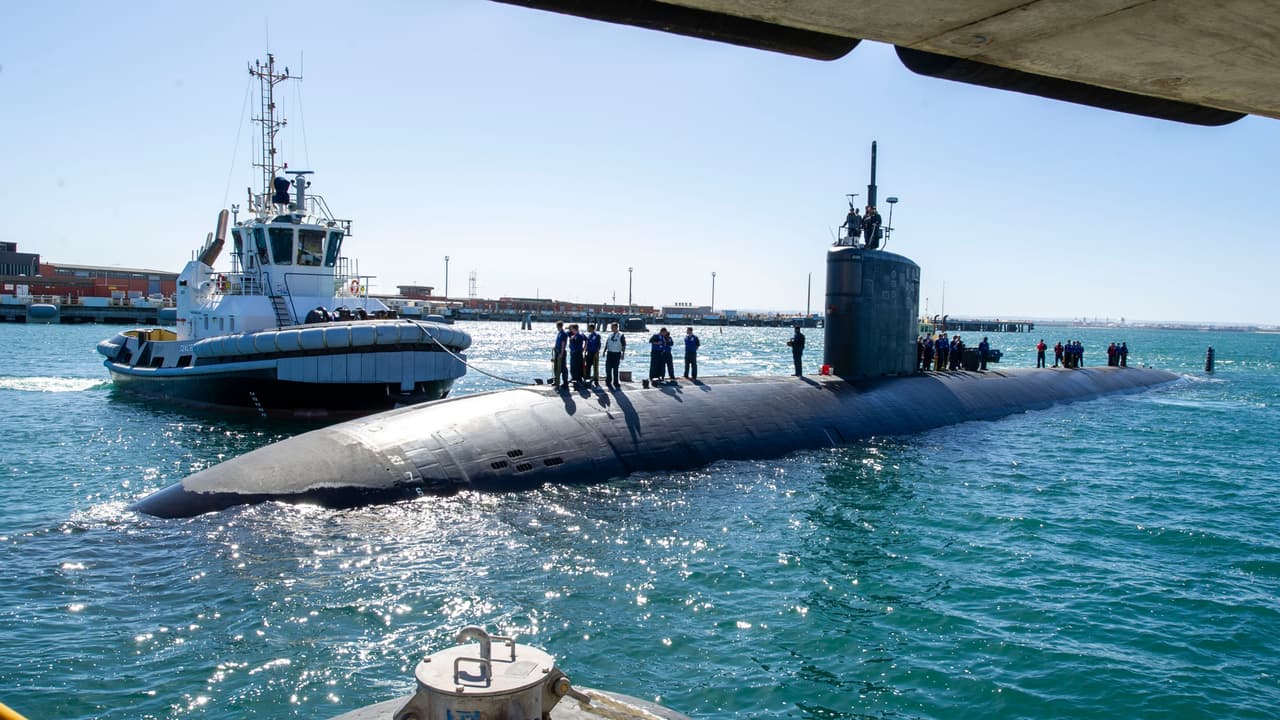
New defence laws rushed through parliament this week give the Albanese government a standing legal framework to shield US military activity in Australia from state laws and public scrutiny, even as it insists the American forces operating from the nation’s bases are only “rotational”.
The laws give US forces no new access rights, but every commonwealth facility they use automatically becomes a security zone.
They will allow Defence Minister Richard Marles to switch off state and territory laws for activity “in connection with” a foreign military’s capability, and keep temporary orders of up to 12 months secret.
Environmental, planning, cultural heritage and workplace safety laws could all be set aside, though federal environmental protections remain in place and the declarations cannot authorise the use of force within Australia.
The US Navy, which will begin rotating up to four Virginia-class submarines through HMAS Stirling, south of Perth, from late next year, has already stood up a formal shore installation there, Naval Support Activity Stirling, the same designation it uses for bases in Bahrain and Naples.
Mr Marles’s spokeswoman said Stirling “is a Royal Australian Navy base and remains as such”, adding “Australia has a longstanding, bipartisan policy of no foreign bases on Australian soil”.
Under the changes, the minister can also declare other sites “special” zones, extending the regime that has protected Pine Gap since 1952, under which photographing or sketching the site, or possessing information about it, carries up to seven years’ jail and a $152,880 fine, with no exemption for journalists.
Defence officials, including contractors, will be able to detain and search anyone they reasonably suspect of an offence in a designated zone.
The laws take effect by April 1 next year, just months before the US submarines are due to begin their rotations.
The government sold the changes as a response to a surge in drone sightings over defence bases, which freedom-of-information figures show rose from 19 in 2022-23 to 204 in 2025-26, and which Defence had limited legal power to counter. It says the powers cannot be used to stop protests or industrial action unless harm or a crime is likely.
A Labor-chaired parliamentary committee recommended the bill pass without dissent after a single public hearing, while conceding the Inspector-General of the ADF would have to oversee the new powers with no extra resources.
The Coalition backed the laws, while the Greens were the only party to campaign against them. Greens leader and defence spokesman David Shoebridge said the bill was aimed at creating US bases “by stealth”.
“Labor knows their members oppose allowing permanent US bases in Australia; they know that view is shared by millions of Australians too. So instead, we see Labor, the Liberals and One Nation smashing through this nearly 250-page bill with barely any oversight,” he said.
“This law gives the minister the power to declare ‘defence zones’ and then appoint anyone even remotely associated with the Defence forces to effectively police these zones. This power extends to appointing members of foreign militaries and weapons industry contractors.”
“None of this has a sunset, none of this has had effective parliamentary oversight, and all of it is dangerous for our independence and basic civil liberties.”
Mr Marles’s spokeswoman said: “Defence security zones can only be established under strict conditions where required to protect Defence personnel, infrastructure, equipment or operations. Nor does it give foreign defence personnel, including from the United States, powers that apply in defence security zones.”
Questions over the permanence of the US submarine presence in Australia were underscored in July, when Defence Industry Minister Pat Conroy said any deployment beyond the early 2030s was “hypothetical”.
He declared days later that Submarine Rotational Force-West was “intended to be an enduring element of US Force Posture in Australia”.

The US Navy says about 2300 Americans, including contractors and family members, will be in Western Australia by 2030. A British Astute-class boat will also rotate through Stirling from next year.
The submarine presence will add to an American military footprint that has been steadily expanding across northern Australia for more than a decade.
Up to 2500 US marines rotate through Darwin each dry season under an arrangement Julia Gillard and Barack Obama struck in 2011.
At RAAF Base Tindal, near Katherine, the US is funding a squadron operations facility and parking aprons for up to six B-52 bombers.
US forces also use upgraded airfields at RAAF Darwin and the northern “bare bases”, while the US Army is establishing a store of prepositioned equipment at Bandiana, near Albury-Wodonga.