Teile diese Geschichte
On 1 May 2003, a stubby grey jet with “NAVY 1” painted under its canopy caught the wire aboard USS Abraham Lincoln in the Pacific. On board was President George W. Bush. It was the first time a sitting president had trapped aboard an aircraft carrier, and the first time any aircraft had flown with the Navy One call sign.
The jet was an S-3B, the final version of the Lockheed S-3 Viking. Most Americans had never heard of it. Sailors had known it for three decades by a less dignified name: the Hoover, after the vacuum-cleaner whine of its engines.
Kurzinfo
Typ: Carrier-based anti-submarine and multi-mission jetBauherr: Lockheed, with LTV (Vought) and Sperry RandErster Flug: 21 January 1972, Palmdale, CaliforniaFleet entry: 20 February 1974 (VS-41)Gebaut: 187 (8 test and 179 operational)Crew: VierMotoren: Two General Electric TF34 turbofansSpitzname: Hoover, for its vacuum-cleaner engine soundFleet retirement: 30 January 2009; last flying example retired by NASA in July 2021
A submarine hunter for the jet age
The S-3 was born of a Cold War problem. Soviet submarines were getting quieter and faster, and the Navy’s carrier-based hunter, the piston-engined Grumman S-2 Tracker, was running out of road. In 1964 the Navy began the VSX programme for a jet replacement.
Lockheed had decades of land-based anti-submarine experience behind the P-3 Orion, but had built only one carrier aircraft. So it teamed with LTV, formerly Vought, for carrier know-how, and with Sperry Rand for a computerised acoustic system, the first ever fitted to an airborne submarine hunter. The team won on 4 August 1969.
“The S-3 was a unique program. We went from first contract to first contact over a submarine in just three years.”
Tom Burbage — Former Navy test pilot and Lockheed S-3 programme head, at the Viking’s 2009 retirement (Code One)
The first aircraft was rolled out at Burbank on 8 November 1971 and christened Viking, the winner of a name-the-plane contest. It was trucked to Palmdale, and on 21 January 1972 company pilots John Christiansen and Lyle Schaefer took it up for a 90-minute first flight. The first carrier trap came aboard USS Forrestal on 26 November 1973.
Plane Encyclopedia’s history of the Lockheed S-3 Viking, from VSX to retirement.
Four seats, one computer
The Viking’s secret was integration. Two General Electric TF34 turbofans gave it the range and endurance to patrol for hours, and a crew of four worked sonobuoys, radar and other sensors tied together by a central computer, a first for a submarine hunter, that let four people do work once spread across much bigger patrol aircraft.
Training squadron VS-41 received the first aircraft on 20 February 1974, and VS-29 made the first deployment aboard USS John F. Kennedy in July 1975. Lockheed built 187 S-3As in all, eight test aircraft and 179 for the fleet, before production ended in 1978.
 The S-3’s compact layout: a NASA Glenn S-3B (N601NA) shows its high wing, underslung TF34 turbofans and the four-seat cockpit, here at Grand Junction, Colorado, in 2009. Photo: Louis DePaemelaere, USAF / public domain
From the 1980s the fleet was upgraded to S-3B standard, with better sensors to find quiet Soviet boats and the ability to carry Harpoon anti-ship missiles. The airframe also spawned specialists: seven US-3A carrier-onboard-delivery transports and 16 ES-3A Shadow electronic-intelligence jets that replaced the ageing EA-3B Skywarrior.
The Swiss Army knife
When the Soviet submarine threat faded, the Hoover found new work. With the KA-6D Intruder gone, the S-3B became the carrier’s main overhead tanker, passing fuel from a wing-mounted buddy pod. In the 1991 Gulf War, Vikings from seven squadrons transferred more than fifteen million gallons of fuel over seven months, flew surface reconnaissance, and even delivered printed air tasking orders to the fleet.
“The S-3 stayed in the fight for almost four decades.”
Vice Adm. David Architzel — Former S-3 pilot with more than 3,400 hours, at the Viking’s retirement ceremony, January 2009 (Code One)
In Operation Iraqi Freedom in 2003, Viking crews transferred nearly nine million pounds of fuel during major combat operations. On 26 March 2003, an S-3B of VS-38 “Red Griffins” flew the type’s first attack mission, disabling Saddam Hussein’s ocean-going yacht with a laser-guided Maverick missile. Lockheed’s own magazine admitted the Viking briefly became a media darling.
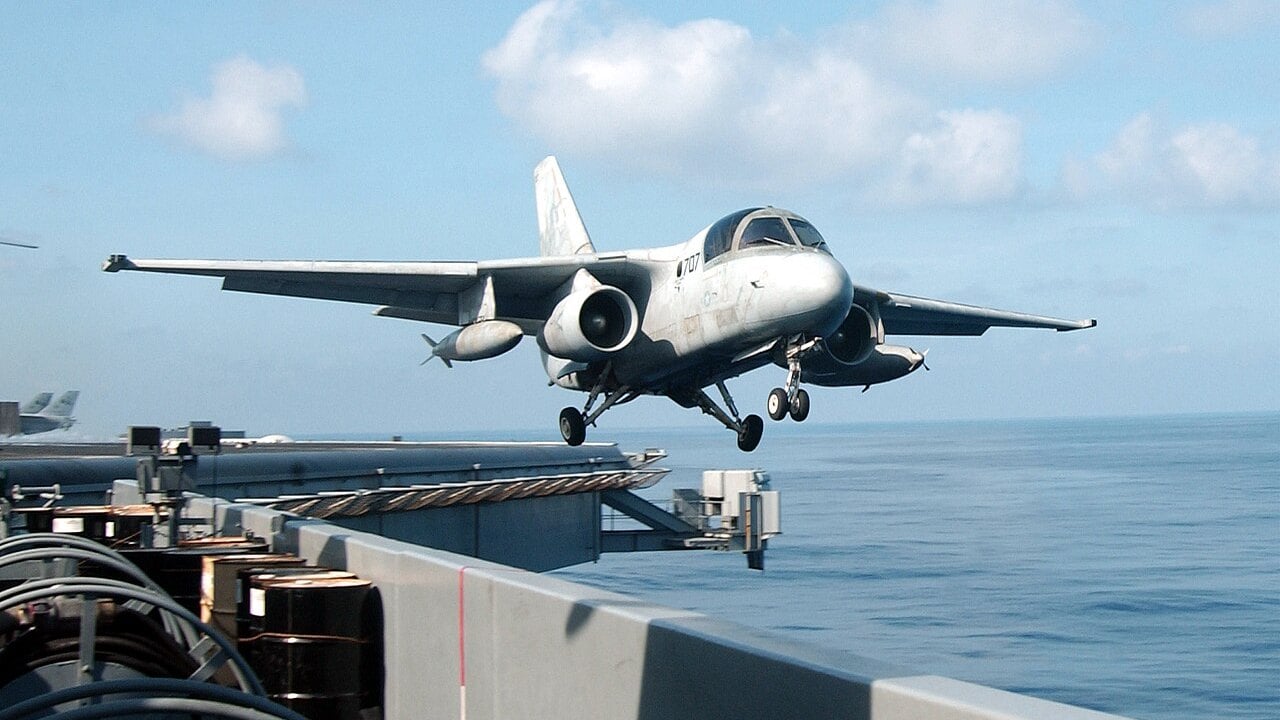
An S-3B Viking catapult launch from an aircraft carrier.
Navy One
Five weeks later came the flight that made the Hoover famous. The aircraft, BuNo 159387 of VS-35 “Blue Wolves”, had been accepted by the Navy as an S-3A in May 1974 and had just flown combat missions over Iraq from Abraham Lincoln during a ten-month deployment. On 1 May 2003 it carried the President out to the carrier for a televised address.
 1 May 2003: S-3B Viking “NAVY 1” of VS-35, with President George W. Bush aboard, comes in to trap on USS Abraham Lincoln. US Navy photo by Photographer’s Mate Airman Gabriel Piper / public domain
Weeks later, in July 2003, VS-35 flew the jet on its last flight from North Island to Naval Air Station Pensacola. It now belongs to the collection of the National Naval Aviation Museum.
Sundown, and one last job for NASA
Navy One was also the beginning of the end. To cut the number of types on carrier decks, the Navy decided in 2004 to retire the Viking along with the F-14 Tomcat, spreading its many jobs across other aircraft, including the F/A-18E/F Super Hornet as the carrier tanker. VS-22 “Checkmates” made the last S-3 catapult launch from USS George Washington on 28 May 2008.
The Navy retired the Viking from fleet service at NAS Jacksonville on 30 January 2009, after some 1.7 million flight hours with 18 squadrons. A handful stayed on in Navy service for range support at Point Mugu, California. But the very last one flying belonged to NASA.
 The last flying S-3B departs NASA Glenn in July 2021 for retirement at the San Diego Air and Space Museum. Photo: NASA/GRC/Jordan Salkin / public domain
NASA’s Glenn Research Center in Cleveland acquired an S-3B in 2004, stripped out its weapons systems in 2006 and flew it almost daily for research, from helping define command-and-control radio standards for drones in US airspace to imaging harmful algal blooms on Lake Erie. In July 2021 it flew off to retirement at the San Diego Air and Space Museum.
“This is the last S-3B flying today anywhere in the world. It’s been a workhorse for NASA, but we just can’t source its unique parts anymore.”
Jim Demers — Flight Operations Manager, NASA Glenn Research Center, 2021
AP Archive footage of President Bush arriving aboard USS Abraham Lincoln in the S-3B “Navy One” on 1 May 2003.
Not bad for a jet built to listen for submarines. In 35 years of fleet service the Hoover hunted Soviet boats, fuelled strike packages, sank a dictator’s yacht and flew a president. Then it went back to work for science.
Sources: Lockheed Martin (Code One magazine and 30 January 2009 release), National Naval Aviation Museum (Naval History and Heritage Command), NASA Glenn Research Center, US Navy
Teile diese Geschichte
Häufig gestellte FragenWhat was the Lockheed S-3 Viking?
The Lockheed S-3 Viking was a four-seat, twin-turbofan US Navy carrier jet built to hunt submarines. It first flew on 21 January 1972 and entered fleet service in February 1974. Later S-3Bs also served as tankers, surface-search and strike aircraft until the Navy retired the type from fleet service in January 2009.
Why was the S-3 Viking called the Hoover?
S-3 Viking crews nicknamed the aircraft the Hoover because its two General Electric TF34 turbofan engines sounded like a very large vacuum cleaner. The official name Viking came from a Navy and contractor name-the-plane contest when the first aircraft was rolled out at Burbank in November 1971.
How many S-3 Vikings were built?
Lockheed built 187 S-3As between 1971 and 1978, eight test aircraft and 179 operational aircraft. Many were later upgraded to S-3B standard, seven became US-3A carrier-onboard-delivery transports and 16 were converted to ES-3A Shadow electronic-intelligence aircraft.
Which aircraft was Navy One?
Navy One was S-3B Viking BuNo 159387 of Sea Control Squadron 35. On 1 May 2003 it carried President George W. Bush to USS Abraham Lincoln, making him the first sitting president to trap aboard a carrier and the first use of the Navy One call sign. It is now at the National Naval Aviation Museum.
When was the S-3 Viking retired?
The US Navy retired the S-3 Viking from fleet service at NAS Jacksonville on 30 January 2009 after about 1.7 million flight hours. A few S-3s stayed on to support the Point Mugu range in California, and NASA Glenn Research Center retired the last flying S-3B in July 2021.
What did NASA use the S-3B Viking for?
NASA’s Glenn Research Center flew an S-3B from 2004, rebuilt in 2006 with civilian avionics and satellite communications. It helped define command-and-control radio standards for drones in US airspace and carried hyperspectral imagers to study harmful algal blooms on Lake Erie before retiring in 2021.