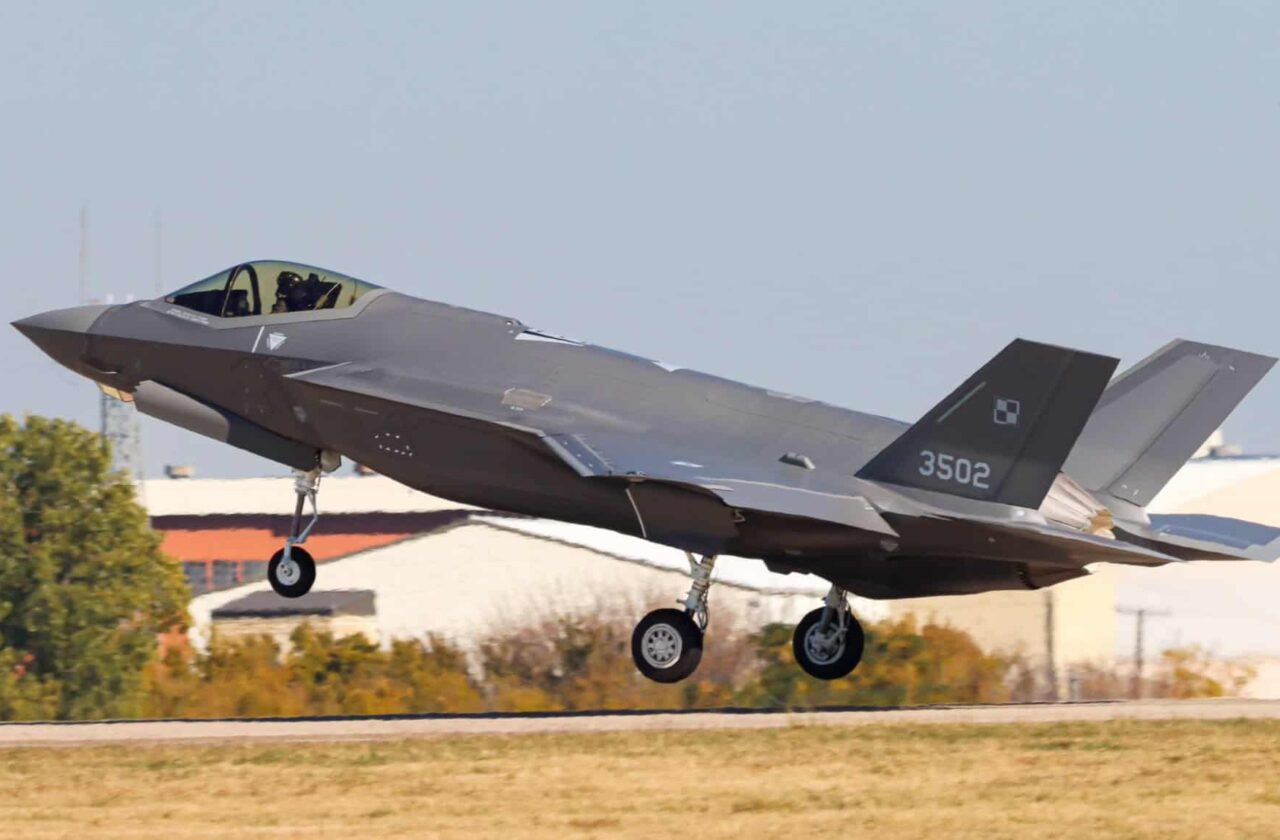
On November 23, Poland asked members of the North Atlantic Treaty Organization to consider intercepting Russian missiles heading toward Allied airspace while they are over Ukraine. Presented in Brussels at a meeting of NATO ambassadors, the proposal produced no concrete decision following the initial discussions. Warsaw thus intends to act before a projectile reaches its border, while several Allies fear that such an intervention would bring them into direct engagement with Russian forces.

MetaDefense · The selection

01 / of 10Franco-Belgian VBAE light armored vehicle program requires a change in acquisition model

02 / of 10Gripen, Typhoon, F-16 and Rafale: are the Ukrainian Air Force aiming to seize air superiority from Russia?

03 / of 10Russia adopts a 2027–2029 defence budget unsustainable without strategic victory

04 / of 10Taurus Neo: Berlin, Madrid and Stockholm agree to acquire MBDA’s cruise missile, and perhaps more..

05 / of 10Britain’s £298bn Defence Investment Plan depends on resources that remain uncertain

06 / of 10Construction begins on ORP Huragan, the third Polish Miecznik-class frigate

07 / of 10The first 5 KF41 Lynx assigned to a Ukrainian brigade represent a decisive gamble for Rheinmetall

08 / of 10For Naval Group’s Blacksword Barracuda, 2027 will be a decisive year in Greece and Egypt

09 / of 10Risk of conflict between Turkey and Israel grows amid intervention in Syria

10 / of 10Satellites, sonar and sensors: the APL seeks total underwater detection in the China Seas against the US Navy
Kh-101 missiles and the air alert in Poland
The move followed the incursion of Russian Kh-101 cruise missiles into southeastern Poland on November 20 during an attack on Ukraine. Debris was found in Nowy Lipowiec, Rudnik and Mołodycz, near an area where several thousand European troops were taking part in exercises. The regional prosecutor’s office in Lublin opened an investigation to establish the trajectory of these missiles, the circumstances of their fall and whether their entry into Polish territory was intentional.
Two Swedish JAS 39 Gripen fighters had joined Polish F-16s to track the threats detected during the attack. A Swedish pilot locked onto a suspected missile without opening fire, as poor weather conditions prevented positive visual identification. The Gripens remain primarily based in Sweden, but have a forward operating location at Mińsk Mazowiecki enabling refueling, limited maintenance and, in a crisis, rearming. This presence relies on a Swedish team of 8 people.
The alert also led the Polish Air Navigation Services Agency to evacuate the control tower at Rzeszów-Jasionka Airport for the first time. Nine people, including 6 operational staff members, moved to a temporary shelter while flight operations were suspended. Traffic resumed after the evacuation was lifted. Located in southeastern Poland, the airport is one of the main transit points for military and humanitarian aid destined for Ukraine.
A further incident occurred on November 23, when a Russian drone entered Polish airspace during another raid on Ukraine. Polish forces authorized its destruction before calling off the interception after it changed course and returned to Ukraine, to limit the risks to civilians. On September 9 and 10, 2025, 19 Russian drones had already entered Poland. Polish and Allied aircraft had then shot down those deemed dangerous.
Warsaw advocates intercepting missiles over Ukraine
Warsaw is drawing on the security cooperation agreement signed with Kyiv on July 8, 2024. It provides for the 2 countries to examine, with their partners, the feasibility of intercepting missiles and drones flying toward Poland while they are over Ukraine. Polish Foreign Minister Radosław Sikorski defended this interpretation on November 25, stating that _“a missile or drone approaching our airspace already constitutes a direct threat to us”_. In his view, an intervention requested by Kyiv would constitute self-defense.
Such a mission would, however, have to be approved by the Allies and coordinated with the Ukrainian authorities. Radosław Sikorski called for in-depth consultations with the Polish military and NATO headquarters before any decision. On the same day, Polish Deputy Minister of National Defense Cezary Tomczyk indicated that the Alliance had so far ruled out this possibility. According to him, _“NATO has decided that this procedure is not an option. That is the position we maintain at present”_.
Interceptions conducted deeper over Ukrainian territory would place Allied aircraft within range of Russian radars and long-range air defense systems. Crews would also have to positively identify each target and take into account its trajectory, the potential fall of debris and the presence of civilians on the ground. Polish Defense Minister Władysław Kosiniak-Kamysz had already indicated that no single country had the capabilities needed to carry out such a mission on its own.
Poland strengthens its air defenses along the border
The Polish government is also preparing a no-fly zone extending several dozen kilometers along its eastern border. Two draft regulations have been added to its work program to facilitate action against objects crossing the border without authorization. A new procedure already allows pilots to identify a hostile target using radar data and other available information, without relying exclusively on visual identification, as had prevented the Swedish Gripen from opening fire on November 20.
Poland has also asked its allies for additional patrols, early warning systems and air and missile defense assets. Following the Brussels meeting, the Supreme Allied Commander Europe ordered the deployment of an AWACS airborne warning and control aircraft to Poland. NATO is also examining Poland’s reconnaissance requirements, while the first Allied contributions of personnel and equipment have begun arriving in the country.
Moscow has warned that it reserves the right to retaliate if countries allied with Kyiv shoot down Russian missiles over Ukraine. This warning now accompanies the consultations underway in Brussels, without altering the request submitted by Warsaw. In the absence of a collective agreement, the measures announced remain focused on monitoring and protecting Polish territory, while the authorities in Warsaw continue their efforts to enable intervention before their border is crossed.