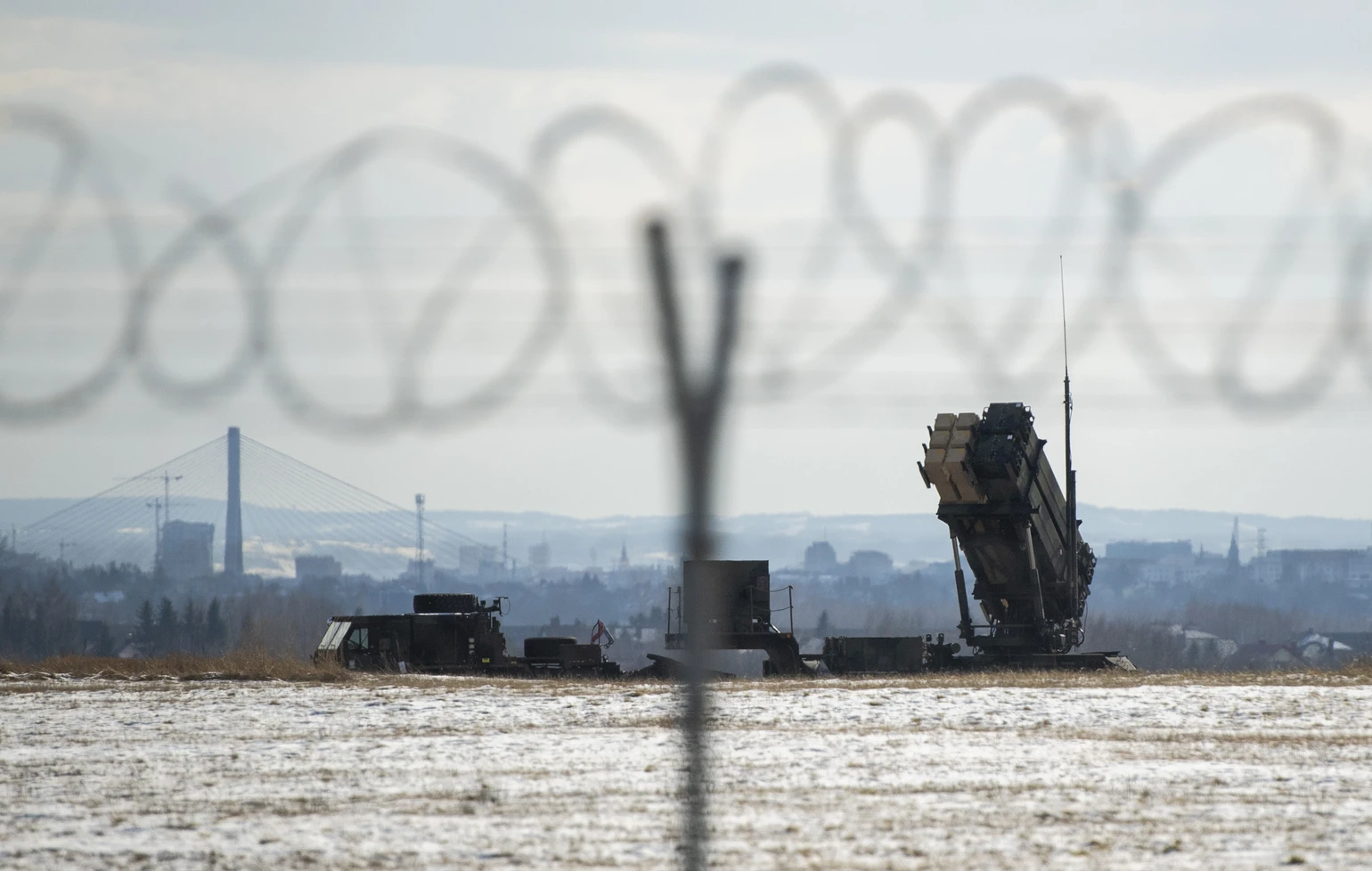
“I can guarantee that NATO will defend every inch of Polish territory,” NATO Secretary General Mark Rutte declared emphatically the other day, without specifying, however, when and under what conditions this might happen. After all, neither the incursion of some 20 Russian drones into Poland last autumn nor the “fall” of at least three Russian cruise missiles on its territory and a drone’s brazen flight through its airspace in the past few days has prompted NATO to invoke Article 5 of the Washington Treaty. Nor, for that matter, has it prompted Poland itself to use its air defenses to shoot down these Russian missiles and drones.
First it was inclement weather; then it was the target flying “not far” beyond the border (“only” 20 km in) and “not for long” (“only” nine minutes) in Polish airspace, plus fears of harming civilians. These, according to official explanations, are what prevented the Polish military from destroying Russian aerial targets, even when it had permission to do so.
Incidentally, on the night of 19–20 November, when a whole three missiles were heading for Poland, the weather in Ukraine was not great either. But the latter’s Air Force shot down 380 drones that night (102 of them jet-powered), 79 cruise missiles (Kh-101/Kalibr) and three ballistic missiles (Iskander-M/S-400/Zircon).
As for the duration of the airspace violation, let us recall that in November 2015 a Turkish F-16 shot down a Russian Su-24 that had crossed 2.19 km of Turkish airspace, after just 17 seconds!
So, in the fifth year of Russia’s full-scale aggression and of daily missile and drone attacks, Poland’s conduct in this situation and its officials’ explanations leave many Ukrainians puzzled, irritated or simply smiling wryly.
It would be unfair to say that the Poles have buried their heads in the sand entirely or are blind to the Russian threat. Since 2022, they have more than doubled defense spending and launched a large-scale rearmament drive. In 2026, Poland is spending 4.81 percent of GDP on defense, and the draft budget for 2027 earmarks 4.5 percent of GDP for military needs.
Yet the Poles are desperately trying to convince themselves and everyone around them that Russia will not dare attack them.
“Russia fears the strong. And it will not attack the strong,” a senior official in President Nawrocki’s chancellery told Ukrainian journalists. “Yes, Russia is a threat to Poland. But I do not see it threatening a large-scale kinetic operation. Russia’s main target now is Ukraine. Not just Donbas, but the conquest of all of Ukraine.”
“Russia will not open a second front,” agrees the head of the respected Polish think tank, the Centre for Eastern Studies (OSW), Wojciech Konończuk. During a discussion (organized last month by the Mieroszewski Centre as part of a study visit by Ukrainian journalists to Warsaw), the expert commented as follows on the first case in NATO’s history of Russia striking a member state’s territory with a cruise missile, which flew some 100 km (!) into Poland on 30 July 2026: “It was a signal. It is a deliberate Russian program to intimidate European countries—their societies and elites.”
“The main problem is how to respond to this. The Russians understand that Europe is deeply afraid of a military response to Russia’s actions,” the analyst admitted, before drawing a paradoxical conclusion: “This testing by Russia also shows its weakness.” Really? And here we were thinking that Russia was thereby vividly demonstrating the weakness and indecision of Europe and NATO, where lethal missiles and drones landing on their territory are treated as “testing the reaction” and “mere intimidation.”
This approach shows not only in deeds (or rather, the lack of them) but even in vocabulary. The Poles, like other Alliance members, do not speak of Russian “shelling,” an “attack,” let alone an “assault” or “Russian aggression against Poland.” As they put it, Russian missiles and drones on Polish territory simply “fall.”
According to Polish MEP Michał Dworczyk (who served in the previous right-wing government, holding senior posts in the Defense Ministry and the Prime Minister’s Chancellery), both the current government and its predecessor face a certain psychological barrier to acting against Russia in response to provocations. “Unfortunately, this problem affects the entire political class and part of the senior officer corps,” Dworczyk said on Polsat News. He cited the example of Ukraine, which fights not only on its own territory or in Russia but also conducts operations in third countries. “What the Ukrainians are doing today is unthinkable for the Polish political class and a large part of the military,” the MEP observed. He believes that if sabotage occurs on Polish soil, Warsaw could respond in kind, with “inadvertent incidents” on Russian territory organized by “persons unknown.”
Or Poland could, as Ukraine has repeatedly proposed, help shoot down Russian missiles and drones over western Ukraine before they reach Poland. But no. On this issue, Warsaw speaks with one voice: it is not currently possible to shoot down targets over Ukraine; Poland is a member of the Alliance, so any operation outside NATO requires consultations with partners; and the priority is to strengthen Ukraine’s air defenses so that Ukraine can shoot down targets over its own territory itself. We heard this position in President Nawrocki’s chancellery; at the Foreign Ministry, where the minister, Radosław Sikorski, explained that he personally supports Ukraine on this, “since it is a threat to Poland too,” but that “NATO has integrated defense, and this is not entirely a Polish matter”; and at the Defense Ministry, where Deputy Minister Paweł Zalewski candidly admitted: “Putting an air-defense umbrella over western Ukraine is unrealistic right now. Although I, and many other politicians in Europe, would gladly back such a decision.”
In what they do (or fail to do), Polish politicians have to keep an eye not only on Brussels and Washington but also on the mood of their voters, especially with the next parliamentary elections less than a year away, the campaign already under way and the influence of Russian disinformation increasingly visible.
According to the sociologist Łukasz Mazurkiewicz, CEO of the ARC Rynek i Opinia research company, there is “a strong desire in Polish society for Poland not to be dragged into the war.” Poles think: “We have achieved a lot in recent years, we have a lot to lose, and we must be careful.” Most Poles, Mazurkiewicz says, oppose sending Polish troops to Ukraine. And according to Jakub Banaszek, the mayor (officially “president”) of Chełm, a border town where the wail of sirens warning of approaching Russian drones is heard more often than anywhere else, some residents believe that “Poland is being dragged into a war that is not ours.” What is more, as the leader of one right-wing party told Ukrainian journalists, “a theory is going around” in Polish society that it is actually Ukraine that “wants to drag Poland into the war, and so it carries out acts of sabotage and pins the blame on Russia.” It is hard not to agree with Mazurkiewicz, who observed that the long-standing belief that Poles are immune to Russian disinformation no longer reflects reality, because that immunity has noticeably weakened. Russian disinformation, meanwhile, is becoming ever subtler, more sophisticated and more targeted.
Polish society not only does not want war (which we Ukrainians understand perfectly), but is not especially worried that war might come knocking at Poland’s door too. “Wanting to believe in the best is a universal human trait,” says Mazurkiewicz. “Poles believe that because their country is a NATO member and the US is its main ally, they are safe and protected against war.”
So far, NATO’s response to the “fall” of three Russian cruise missiles on Polish territory, apart from Rutte’s promise to “defend every inch of Polish soil”, has been a plan to deploy an AWACS airborne early warning aircraft to Poland, which is meant to help the Polish military track and respond to air threats more effectively.
In Warsaw, we put the same question to virtually every Polish politician we met: “How many more Russian missiles and drones have to hit Poland before NATO considers it aggression and invokes Article 5?” Nobody gave us a clear answer. Foreign Minister Sikorski, commenting on the vagueness of the much-debated article, explained that Article 5 of the North Atlantic Treaty does not commit member states to go to war automatically, since it requires a binding political decision in the event of an attack, and that when the Washington Treaty was signed, the Americans went as far as they were prepared to go at the time. A senior official in President Nawrocki’s chancellery described the Russian strikes as “escalation just below the threshold of war,” aimed at “destroying the supply routes for aid and weapons to Ukraine and frightening Poland.” Yet one of the Polish president’s closest associates also wondered aloud: “So what counts as aggression? If 20 drones flew towards Alaska or Berlin, would that count as aggression?”
The clearest “threshold” between “escalation of hybrid war” and “aggression against a NATO country” was drawn by a senior Polish diplomat: “If people die, if there are human casualties.” How many people must die, and whose citizens they must be, for NATO to treat it as aggression remains an open question.
As for Warsaw’s “main ally” and President Trump, who, as we were assured in Nawrocki’s chancellery, “loves Poland,” the US president not only failed to condemn Russia for the strikes on Poland but also remarked that “Putin accidentally launched a drone and a few small missiles into Poland.” This, even though the Polish prime minister, Donald Tusk, called the incident a “deliberate provocation” by Russia, and Deputy Defence Minister Zalewski confirmed that Russia had acted deliberately.
A month ago, before the three cruise missiles arrived, Paweł Zalewski assured Ukrainian journalists: “I talk to the Pentagon every day. There is no doubt what this cooperation is for: to fulfil our NATO commitments. Daily cooperation with the Americans leaves no doubt about how they will act [if Russia attacks Poland].” At the same time, the seasoned Polish politician stressed: “Countries under threat must also prepare to defend themselves. Allies help those who defend themselves.” That is true. Ukraine is the proof.