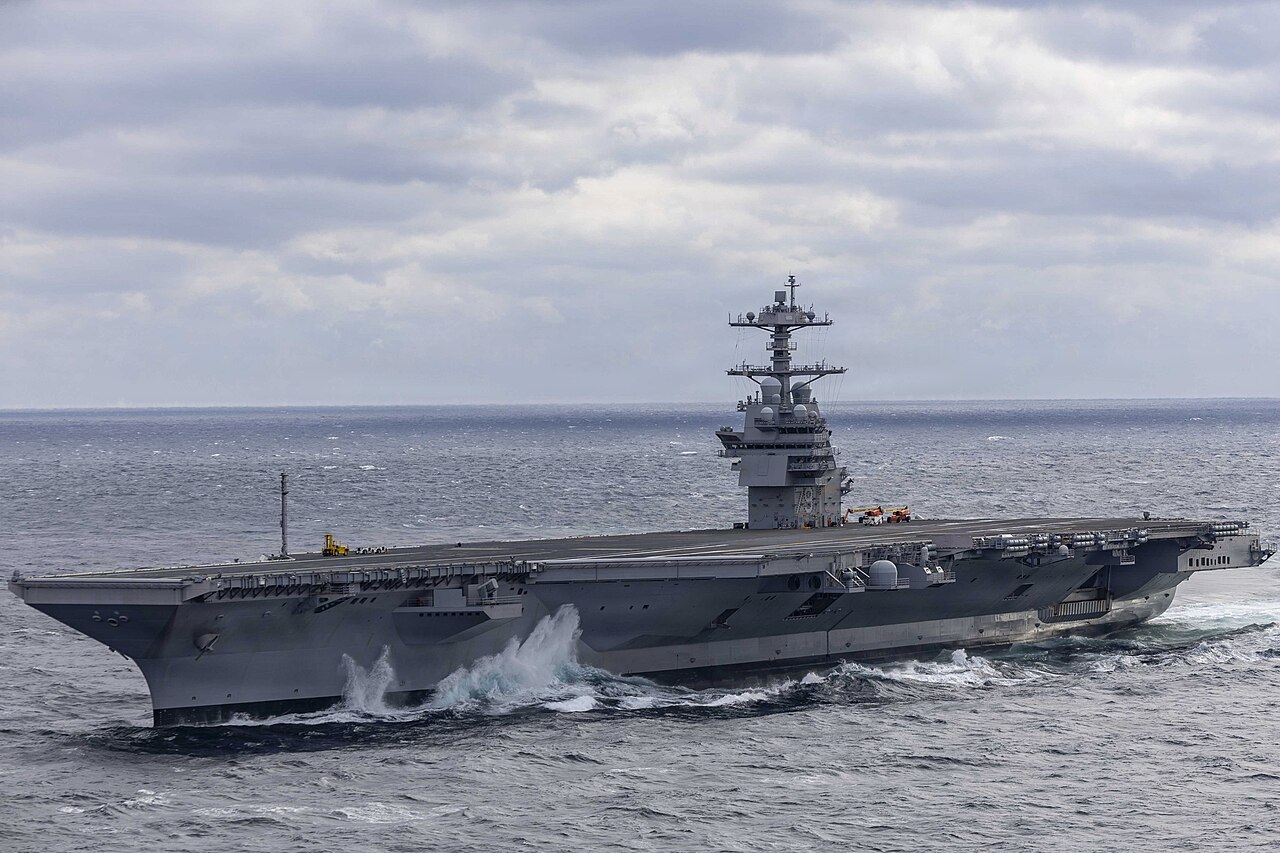

USS Doris Miller’s sister ship John F. Kennedy. Pre-Commissioning Unit John F. Kennedy (CVN 79) transits the Atlantic Ocean during Builder’s Sea Trials, Jan. 28, 2026. Builder’s Trials provide an opportunity to test ship systems and components at sea for the first time, and make required adjustments prior to additional underway testing. (U.S. Navy photo by Mass Communication Specialist 2nd Class Kaitlin Young)
Petty Officer 2nd Class Kaitlin Young, Public domain, via Wikimedia Commons
The U.S. Navy has ended one of the most charged naming disputes in recent military history. CVN-81 — the future Ford-class carrier long assigned the name USS Doris Miller — will keep its World War II hero’s designation, a Navy spokesperson confirmed to USNI News, shutting down months of speculation that the vessel could bear a sitting president’s name for the first time ever in American naval history.
Months of Uncertainty, Settled Days Before the Keel Laying
The official word came just two weeks before the ship’s ceremonial keel laying, scheduled for December 5 at HII’s Newport News Shipbuilding facility in Virginia. A spokesperson for Acting Navy Secretary Hung Cao told USNI News on November 20 that there is “no intention to change” the carrier’s name. Military Times subsequently confirmed the decision in its own reporting on November 23.
The controversy emerged in August 2026, when CNN reported that Navy leadership was considering renaming the carrier and had begun referring to it internally by its hull designation, CVN-81. Three people familiar with the internal discussions told CNN that Acting Secretary Cao’s office was actively considering a renaming and reviewing the official policies that govern how Navy ships are designated. The White House and Pentagon declined all public comment through the summer and into fall — until November, when the quiet finally broke in Miller’s favor.
Who Was Doris Miller?
Born in Waco, Texas, on October 12, 1919, Doris “Dorie” Miller enlisted in the Navy in September 1939, at a time when Black servicemembers were largely restricted to support roles. Assigned to the battleship USS West Virginia as a mess attendant, he was collecting laundry below decks on the morning of December 7, 1941, when Japanese aircraft struck Pearl Harbor.
What Miller did in the minutes that followed defined his legacy. Despite having no experience with the weapon, Miller helped move wounded sailors, including his mortally wounded commanding officer, to safety before manning an anti-aircraft machine gun and firing at the attacking Japanese aircraft. Miller later said he believed he had hit one plane, but the Navy did not officially credit him with shooting down an aircraft. Miller was 22 years old.
For his courage that morning, Miller received the Navy Cross on May 27, 1942, in a ceremony presided over by Admiral Chester Nimitz aboard the USS Enterprise at Pearl Harbor. The medal — now the Navy’s second-highest award for combat valor — made Miller the first African American in U.S. history to earn that distinction.
He did not survive the war. On November 24, 1943, the escort carrier USS Liscome Bay was struck by a Japanese submarine torpedo during the Battle of Makin in the Pacific. The ship sank in minutes, taking 702 officers and sailors with her — the deadliest carrier loss in U.S. naval history. Miller was among those killed. He was 24 years old.
A Name Born in Trump’s Own First Term
The layers of irony surrounding this debate were not lost on observers. It was the Trump administration itself that originally honored Miller with the carrier’s name. Then-Acting Secretary of the Navy Thomas Modly made the announcement on January 20, 2020 — Martin Luther King Jr. Day — at a ceremony on Joint Base Pearl Harbor-Hickam. Modly said the idea had come from a group of retired Black admirals who proposed Miller as the right person to grace a warship of this magnitude.
At a White House event held shortly after, Trump referenced the naming and joked about being passed over: “They won’t give me that honor. That’s a big boat. That’s a big ship.” The fact that his second administration was later reported to be weighing precisely that honor for himself drew sharp backlash from veterans advocates and civil rights groups alike.
Miller’s Family: ‘This Is American History’
When CNN first broke the August story, Miller’s surviving relatives were caught entirely off guard. Thomas Bledsoe, Miller’s great-nephew and the family’s official spokesperson, told CNN that the news landed as “quite a shock” and that the family had not been consulted by the Navy at any point. Following the November 20 confirmation, Bledsoe released a formal statement that placed the decision in the widest possible frame.
“Doris Miller’s legacy is not just our family’s history; it is American history,” Bledsoe wrote. “His courage deserves to be remembered, honored, and recognized for generations to come.”
What Comes Next for CVN-81
The December 5, 2026, keel-laying ceremony marks a formal construction milestone for a carrier that has been taking shape at HII’s Newport News Shipbuilding yard in Virginia. The Navy’s current schedule calls for the carrier to be delivered in February 2034, two years later than previously projected, because of shipyard construction constraints. It is not expected to be commissioned into active service before 2034.
A parallel effort continues to push for a posthumous Medal of Honor for Miller — the country’s highest military decoration and a step above the Navy Cross he earned in 1942. Any such award requires both congressional approval and President Trump’s signature. No timeline for that decision has been set.
© {{Year}} Latin Times. All rights reserved. Do not reproduce without permission.