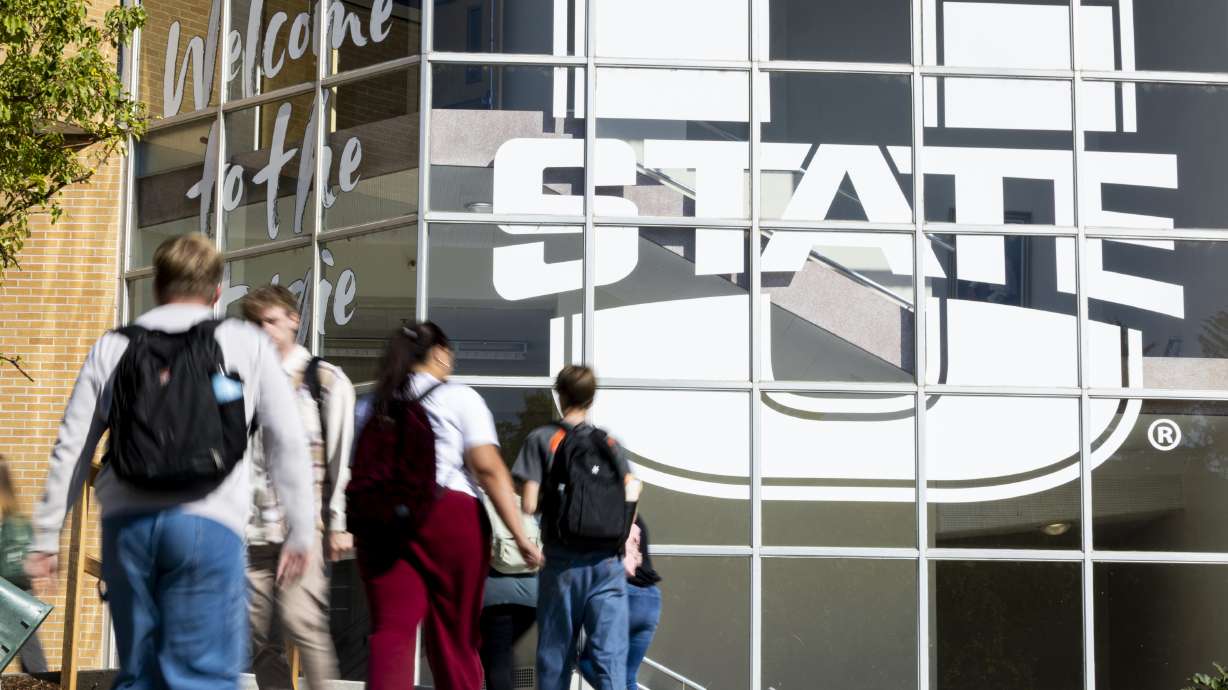
LOGAN — Utah State University is no stranger to space.
It has launched undergraduate-built satellites into space. Its Space Dynamics Laboratory supplied pivotal parts to the now-famed James Webb Space Telescope and researchers have worked directly with NASA to develop a hybrid rocket motor that could help astronauts land on and take off from the Moon in future Artemis missions — to name a few ventures into the cosmos.
Now, the university is looking to become the future home of the NASA-led United States Space Academy after submitting a proposal on Utah’s behalf.
A Trump administration executive order signed in August directed the establishment of the first United States Space Academy and NASA published a Request for Information seeking “input from governors or their designees interested in hosting and sponsoring the up-and-coming academy in their state,” according to a release from NASA.
The proposed academy would be a federal academy intended to advance American interests in space, with the administration citing the importance of space to national security, economic growth, scientific discovery and technological innovation.
“USU has played a vital role in space exploration through the education and training of engineers, scientists, and business professionals who continue to advance the technologies which make space missions possible,” USU President Brad Mortensen said in a statement. “USU is the logical place for the Space Academy to call home.”
Certainly, the Space Dynamics Lab is a big part of the university — and state’s — pitch to build the academy in Utah. Established in 1982, the lab is a university-affiliated research center sponsored by the U.S. Space Force and specializing in multi-domain defense, science and space exploration, satellites, sensors and instruments and autonomous systems.
The university’s proposal named Davis County as the preferred location for the permanent campus and Eagle Mountain as an alternative site, with plans to welcome approximately 300 Space Academy students to USU’s Logan campus in fall 2028 and open the permanent campus at one of the proposed locations in fall 2031.
Utah Gov. Spencer Cox touted Utah’s role in “decades of space exploration” as a case for the academy coming to Utah.
“Utah State University is uniquely positioned and equipped to lead our nation into the future as the home of the U.S. Space Academy and lead the way in preparing the next generation of astronauts, scientists, engineers, operators, entrepreneurs, civil servants to ensure that they are capable of advancing American interests in space,” Cox said in a statement.
USU said it can provide real-world experience in national security and civil space programs, with students at the academy getting hands-on training and mentoring through internships, co-ops, early-career employment and student research opportunities.
“Utah already has an incredible foundation. From the Space Dynamics Laboratory and Hill Air Force Base to the Utah Test and Training Range in Dugway, our universities and technical colleges, and aerospace companies across the state, the work is already happening here,” Aaron Starks, president and CEO of Utah aerospace and defense company 47G, said in a statement. “Bringing those strengths together could give Academy students the chance to learn from the people who are designing, building, testing and operating systems that matter to our nation.”
The Key Takeaways for this article were generated with the assistance of large language models and reviewed by our editorial team. The article, itself, is solely human-written.