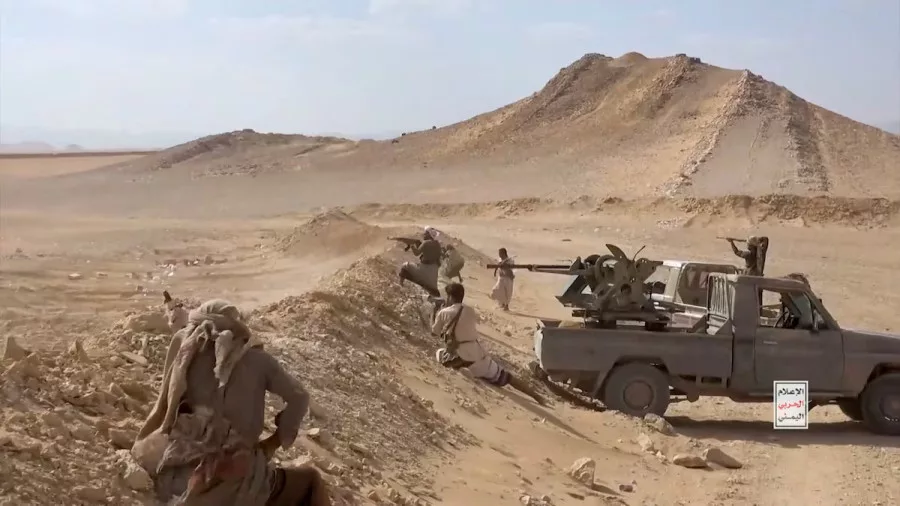
Washington. Reports have surfaced that US President Donald Trump called off US airstrikes against the Houthis at the last moment. With this, Houthi fighters have intensified efforts to capture strategic high grounds in Yemen on Monday. It is said that their objective is to separate the Red Sea coast from the remaining areas under the control of the Saudi-backed government.<
/p>
The Iran-backed Houthi group has expanded its control at a rapid pace this month, spreading the ongoing conflict in the Middle East to new areas. This has also increased the risk to global energy supplies. Although Saudi Crown Prince Mohammed bin Salman has repeatedly urged the US to participate in the ongoing war in Yemen, Washington has so far refused.<
/p>
‘The New York Times’ has reported that following the Saudi Crown Prince’s latest request, the Trump administration had prepared to launch airstrikes against the Houthis on Sunday. However, the newspaper mentioned that Trump ordered to stop the attack at the last moment while US soldiers were loading bombs onto the planes.<
/p>
The report could not be independently confirmed immediately. The US military’s Central Command has forwarded questions about this to the White House. The White House has also not responded immediately to the email seeking comment.<
/p>
Four sources told Reuters that Yemeni President Rashid al-Alimi, based in Riyadh, of the Saudi-backed and internationally recognized government of Yemen, had called Trump on Sunday seeking US military assistance. According to one Yemeni and one Western source among them, Trump did not make a direct commitment to provide military assistance during the phone call.<
/p>
As tensions escalated, Saudi capital Riyadh appeared to have been attacked for the first time on Saturday. Explosions were heard and smoke was seen around the airport. The Houthis claimed to have fired missiles towards the Saudi capital. The Saudi side has not commented on this.<
/p>
Fierce Fighting for High Grounds<
/p>
The Houthi group, which has controlled the capital of Yemen since 2014, also captured areas along the Red Sea coast this month. During that time, Saudi-backed government forces were forced to retreat.<
/p>
According to the Houthis, Saudi Arabia has targeted their positions in the high grounds with hundreds of airstrikes in recent days.<
/p>
According to the United Nations, about 700 people have died and thousands have been injured in the latest round of fighting. About 130,000 Yemenis have been displaced from their homes within their own country. Additionally, more than 3,000 people have crossed the Red Sea by boat to reach Africa.<
/p>
According to five sources from the Yemeni army, the Houthis are now trying to capture the strategic high grounds known as Mount Kahbub. These mountains are in two provinces, Taiz and Lahj, and separate the Red Sea coast from southern Yemen, which is under government control.<
/p>
Sources said that the main fighting is taking place around Ras al-Ara, in the coastal area of the Indian Ocean leading from the outskirts of the rugged Al-Waziah mountainous region of Taiz province and Bab al-Mandeb at the mouth of the Red Sea towards the government base in Aden.<
/p>
According to Yemeni political analyst and veteran journalist Mohammed al-Kadhi, after losing the Bab al-Mandeb area, the government forces currently appear to be mainly on the defensive. On the other hand, despite facing intense airstrikes, the Houthis are trying to maintain their military momentum.<
/p>
According to him, these mountainous areas can play a crucial role in determining whether the Houthis can permanently retain the territories they have recently captured. Furthermore, whether the government forces can preserve the strategic locations necessary for a counter-attack also depends on the control of these areas.<
/p>
Risk to Saudi Oil Exports<
/p>
The escalating conflict between Saudi Arabia and the Houthis has created a difficult situation for Trump. On one hand, he is under pressure to support Saudi allies, while on the other hand, he appears unwilling to further expand the war he initiated.<
/p>
The US had conducted airstrikes against the Houthis for two months starting in early 2025. However, Trump stopped those attacks after a ceasefire. Since then, the US has been staying away from the conflict in Yemen.<
/p>
As the Houthis expand their control over the Red Sea, the main alternative route used by Saudi Arabia to export oil, bypassing potential blockades through the Strait of Hormuz, is also at risk.<
/p>
In response, Saudi Arabia has increased oil exports through Hormuz. Some tankers are transporting oil through Hormuz, braving wartime risks. It is reported that they are charging up to a quarter of the oil price for this.<
/p>
These tankers transfer the oil to other ships after reaching the Indian Ocean. Then the oil is sent to customers in Asia and other regions.<
/p>
According to traders, Saudi Arabia has sold 60 million barrels of oil this month and next month. The oil will be loaded from near Oman, across Hormuz. According to satellite data, Saudi oil exports through Hormuz have reached 2.9 million barrels per day in recent days. In August, this was only 700,000 barrels per day.<
/p>
This has helped to some extent in controlling the price of crude oil in the world market. The price of crude oil, which reached about $110 per barrel last week, has now fallen back to around $100. However, consumers and industries are still paying record prices for some refined fuels. The retail price of diesel in the US reached an all-time high again on Monday.<
/p>
Regarding the recent attack in Hormuz, the UK Maritime Trade Operations (UKMTO) reported that a missile or other object was fired at a ship heading towards the Strait. Some crew members were slightly injured in the incident. UKMTO also reported that a gas tanker had been attacked earlier.<
/p>
Diplomatic efforts in the broader Middle East conflict are almost stalled after the temporary agreement between the US and Iran in June collapsed within a few weeks. Iranian President Masoud Pezeshkian is scheduled to travel to New York on Tuesday to attend the UN General Assembly.<
/p>