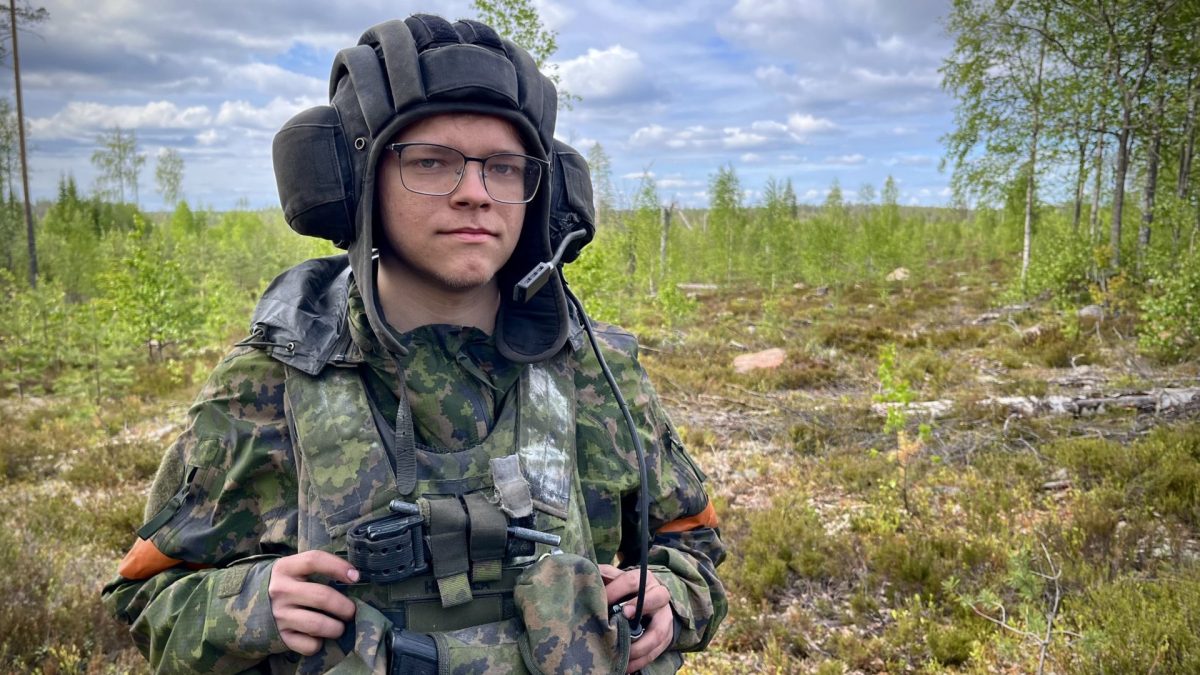
Just four months ago, 19-year-old Gabriel Qawariq was playing video games at home. Now, his life resembles one. Crouched on the forest floor in eastern Finland, holding an assault rifle, the teenager is part of a military drill preparing troops for war.
Qawariq is one of Finland’s annual 20,000 conscripts. National service is compulsory for men, who are usually drafted between the ages of 18 and 25, and voluntary for women. Conscripts can choose between military or non-military service, working at sites such as hospitals, schools or museums.
The i Paper has been granted access to a major Finnish military exercise; the final test in the service programme for conscripts like Qawariq.
Shorts
Scroll to previous short
Scroll to next short

money
How quickly triple lock could end – and possible replacement

The future of the triple lock has been thrown into question after reports Andy Burnham is being told to scrap the scheme to fund his social care plans.
Experts say that at some point, the policy will have to be replaced with a way of increasing the state pension that is “more sustainable”.
A ‘double lock’
A double lock linked to either earnings growth or inflation has been suggested as a possible alternative.
Tom Selby, director of public policy at AJ Bell, said the starting point for this would determine what a “reasonable value” for the state pension should be, most likely as a percentage of median earnings.
After deciding that figure, Selby said, you put in place “a sensible plan to reach that level”.
Link to earnings
Maike Currie, vice president of personal finance at PensionBee, said the simplest replacement would be an earnings-only link. This would mean the state pension broadly maintains its value relative to working people’s incomes.
 Experts warn large numbers of people withdrawing from their pensions is a concern (Photo: Getty Images)
 ‘Your wife can choose to make other personal pension contributions’
(Photo: AN Studio/
Moment RF/Getty)
But the Institute for Fiscal Studies has previously recommended introducing the ‘smoothed’ earnings link, which means pensioners receive inflation protection if inflation exceeds earnings.
Simple link to inflation
Former pensions minister, Steve Webb, said another approach could link the state pension to inflation.
This approach would create “big savings”, he said.
But it would also substantially weaken the state pension at a time when millions of retirees are coming up to state pension age with very modest private savings.

Explained
2 min read
Who will be the most affected?
Currie said the triple lock being scrapped would impact people of all ages.
“For someone close to retirement, scrapping it could have a more immediate impact on their expected income,” she said.
As for younger generations, “the effect could potentially be greater over the long term, as smaller annual increases compound over decades”.

Exclusive
3 min read

3 min read
How AI could help screen for type 2 diabetes
Artificial intelligence (AI) technology could be used to analyse speech to screen people for the disease, a study suggests.
 Diabetologist doctor waiting for result from glucose testing in diabetes clinic. – stock photo. (Photo: Getty)
What you need to know
The tool was trained using more than 63,000 voice samples from more than 21,000 people in the UK and US.
It was trained to detect changes in speech which have been linked to type 2 diabetes, such as increased hoarseness and an inability to control breath.
The study found that the speech model gave a higher risk score to those who reported having type 2 diabetes 80 per cent of the time.

5 min read
How effective is it?
Giedre Cepukaityte, research scientist at tech company thymia, said the technology “opens a new route to screening for diabetes”. But she emphasised it is “not a replacement for a blood test”.
The technology performed well across different ages and genders, but its performance was lower on black patients.
It also wasn’t as effective with recordings from people with heart disease, high blood pressure or obesity.

Analysis
2 min read
AI gets a cautious welcome
Dr Lucy Chambers, head of research impact and communications at Diabetes UK, said: “AI-based technologies could help identify more people who may benefit from diagnostic blood tests, but it’s crucial that they are rigorously designed and tested to make sure no-one slips through the net.”
 The latest incidents of AI models going rogue expose a gap in the way tech companies are currently held to account when their systems behave unexpectedly (Photo: Boris SV/Getty)

Newsletter (£)
5 min read
 Caption: SYDNEY, AUSTRALIA – MARCH 07: Actor Rowan Atkinson in character as Mr Bean arrives at Bondi Beach to promote his new film “Mr Bean’s Holiday” on March 7, 2007 in Sydney, Australia. The film will open in cinemas in Australia on March 29.(Photo by Lisa Maree Williams/Getty Images)
Photographer: Lisa Maree Williams
Provider: Getty Images
Source: Getty Images AsiaPac
Copyright: 2007 Getty Images
news
Peppa Pig and Mr Bean are attracting foreign students to UK
More than half of international students are influenced by British fictional characters when deciding to study at universities here.
2,500 UK-based students from the US, China, India, Pakistan and Nigeria were surveyed for the British Council.
What are the key findings?
It found that 83 per cent of international students said British culture was an important reason why they decided to study here.
59 per cent said fictional British characters were a draw, with 19 per cent citing Peppa Pig and 21 per cent Mr Bean as examples.
British cultural icons like Princess Diana and David Beckham were also a major influence.

2 min read
Importance of soft power
A majority (62 per cent) of respondents said the UK music scene had been a major or strong influence on their decision to study here.
 Caption: MANCHESTER, ENGLAND – FEBRUARY 28: (EDITORIAL USE ONLY) Harry Styles performs ‘Aperture’ on stage during The BRIT Awards 2026 at Co-op Live on February 28, 2026 in Manchester, England. (Photo by Gareth Cattermole/Getty Images)
Photographer: Gareth Cattermole
Provider: Gareth Cattermole/Getty Images
Source: Getty Images Europe
Copyright: 2026 Getty Images
 Singer Dua Lipa performs live on stage (Photo: Mauricio Santana/Getty Images)
Among those who cited music, Ed Sheeran was the top named artist with 18 per cent, followed by Dua Lipa, Coldplay and Harry Styles.
What does this mean?
 Caption: The Wilkins Building at the main quad at the University College London’s (UCL) campus in London, U.K., on Sunday, April 4, 2021. The University offers undergraduate degree programs in anthropology, biochemistry, chemistry, economics, geology, and mathematics, as well as renders graduate degree programs in archaeology, architecture, computer science, and engineering. Photographer: Betty Laura Zapata/Bloomberg via Getty Images
Photographer: Bloomberg
Provider: Bloomberg via Getty Images
Source: Bloomberg
Copyright: Betty Laura Zapata
Catriona McCarthy, the British Council’s interim director for education, said the results tell us it is “crucial” that Britain remains “culturally vibrant” in order to retain its status as a global leader in higher education and attract the best students from around the world.

3 min read

How to be more grateful for daily life in five easy steps
Gratitude
The world feels like a difficult place at the moment, and it can feel very hard sometimes to find things to be thankful for; when we are overwhelmed, we have less capacity to notice and reflect on the good things. Yet, ironically, proactively cultivating gratitude is one of the things that can actually help us feel less stressed.
NHS GP dR RADHA

The science
Research has shown that feeling or expressing thanks can actually alter our brain.
The balance of neurotransmitters change; more serotonin and dopamine (feel good chemicals) are produced.
This can be long lasting if we make gratitude a regular habit.
We also get a decrease in our cortisol (stress hormone) levels which helps lower anxiety.
Being grateful can strengthen the nerve pathways which triggers positive emotion.
How can we build gratitude?
 Caption: Two adult brothers enjoy a warm embrace in a sunny park. They stand beside a decorative fence surrounded by lush greenery, showcasing a strong bond and happiness in the moment.
Photographer: Beatriz Herrera
Provider: Getty Images
Source: iStockphoto
Copyright: beatrizherreragonzalez@gmail.com
Change your words
Instead of seeing something as a problem, try to see the opportunities within it.
Journal
Our brains are very receptive and what we read or write can alter our emotional system.
 Caucasian mid adult patient writing a diary while recovering in the hospital ward – stock photo. (Photo: Getty)
 ‘One question is how to achieve such a longevity hack when most of us have relationships that unsettle us,’ says Dr Amir Levine (Photo: Oliver Rossi/Getty)
Express it
This will not only make you feel good, but you will also get a positive response from others.
How can we build gratitude?
Notice more
Throughout your day, try to notice all the things that are going well; has someone opened a door for you, or smiled?
 Exercise with people you love (Photographer: Morsa Images/Getty/Digital Vision/Abel Mitj? Varela)
 Caption: Group of Happy Asian senior women friends shopping and having lunch at restaurant on summer holiday vacation. Healthy elderly woman enjoy outdoor lifestyle meeting and eating food together.
Photographer: CandyRetriever
Provider: Getty Images
Source: iStockphoto
The basics
By being thankful for the small things every day, we are far more likely to be and stay healthy so that we can enjoy them.
What to do
Gratitude can lead to feelings of optimism, lower our blood pressure, and improve sleep quality.
Write down what potential good aspects there are to the things you don’t feel like doing, or even what could be worse about it.
Spend a few minutes writing down three things that you are looking forward to that day, or the good things that have happened to you that day.
Say thank you to yourself for the things you have achieved, or managed to get through and changed that day.
Sales of battery
electric vehicles hit a record high last year.
Leon Poultney, a writer who specialises in cars, gives his EV recommendations, and the ones that should be avoided.

Renault 5 E-Tech
Starts at £22,995 for the smaller battery
Available with either a 40kWh battery or a larger 52kWh pack, that offers almost 255 miles, the latest, retro-inspired Renault 5 is both a joy to behold and a hoot to drive.
The interior has been lavished with a level of detail that’s typically reserved for more expensive cars.


4 min read
Mercedes-Benz CLA
A champion of EV efficiency

It offers a remarkable 491 mile range on a single charge from the 85kWh battery.
It is a technological masterclass inside with the ability to option screens that span the entire width of the dashboard, including an optional display for the front passenger.
Priced from £37,400

2 min read

Porsche Macan GTS
It’s a lot of money to part with, but this is arguably all the car you will ever need.
The £89,000 Macan is a premium SUV that somehow manages to blend Porsche’s reputation for dynamics and sporty driving with everyday practicality.
The 95kWh batteries can go from 10 to 80 per cent in as little as 21 minutes from the fastest public charging outlets.
Kia EV 9
With the business class-style six seat configuration costing a staggering £76,995, it is by far the most expensive Kia ever made, but it backs up its financial demands with a suite of genuinely useful and impressive onboard technology.


MG IM6
It’s fast, goes a long way between stops and charges relatively quickly but the interior is bland, the onboard technology is infuriating and the experience is devoid of emotion.
BYD Dolphin Surf
All of its gadgetry can’t disguise the fact that performance is weak, even for a typically zippy EV, the ride is fussy at slower speeds and it’s not in the least bit enjoyable to drive on a country road.

While good value (prices start at £17,935) for the 200-mile max range, there are more interesting options from Hyundai, Citroen and Renault for similar money.
Leapmotor T03

It attempts to wow with tech, much of which hinders, rather than helps.
There’s no tangible benefit over mounting your phone to the dash.
Simply an average driving experience, adequate range and slow charging speeds.

2 min read

The kitchen gadgets and products a food editor swears by, all under £25
The kitchen gadgets under £25
 Caption: best kitchen gadgets
Victorinox paring knife
It’s comfortable to hold, with a point sharp enough for scoring pastry.
ProCook cast iron pan
For unbeatable searing and heat-retention, cast iron is the top choice.


Tesco chopping board
Priced at just £22, I’ve yet to find another board that matches it for sheer value and quality.
The kitchen gadgets under £25
Pyrex jug
It is the perfect vessel for blending smooth sauces, melting butter, or warming stock. It won’t stain like plastic and the red measurements never fade.


Salter scales
“I’ve had my slim little set of Salter Disc Scales for over a decade, and I’m delighted to see they are still made to exactly the same reliable design today.”
Microplane grater
It uses photo-etched stainless steel teeth that stay razor-sharp for a decade, something the lookalike copycats simply can’t match.
Braun hand-held blender
It’s an essential for everything from making velvety soup to getting the lumps out of white sauce.
Bodum cafetiere
As well as delivering great results, cafetieres are easy to clean and there’s no ongoing filter paper costs or pod recycling to deal with.

5 min read
The kitchen gadgets under £25
Oxo peeler
What truly sets it apart is the chunky, rubberised handle that absorbs pressure and stays completely non-slip, even if your hands are wet. It is inexpensive and incredibly durable.


Falcon pie dish
Made by fusing porcelain onto heavy-gauge steel for smooth durability, it is dishwasher, freezer, hob, air-fryer and oven-safe.
The golden rules for a happy, secure relationship
Psychiatrist and neuroscientist Dr Amir Levine, author of bestselling book Attached, explains why we behave the way we do in love.
 Caption: Happy woman walking with male partner in vineyard during sunset. Elderly couple are touring in field against sky. They are enjoying during weekend.
Photographer: Morsa Images
Provider: Getty Images
Source: Digital Vision
Golden rules for happy relationships
Start with your own behaviours
The foundation of a secure, connected life is being what I call CARRP: that means being consistent, available, responsive, reliable and predictable. All of these qualities can be enacted in small gestures every day.
 Side view of affectionate happy couple sitting in the cozy cafe. – stock photo. (Photo: Getty)
 Son’t assume your partner knows how you think (Photo: ljubaphoto/Getty/E+)
Express your needs
People need consistency and connection to feel safe. This is not, ‘You hurt my feelings by never replying to me’, it’s more ‘this is the kind of contact that helps me feel secure’.
Golden rules for happy relationships
 Unhappy married couple facing away from each other in a quiet home, concept of emotional distance, loneliness in relationship and family problems – stock photo. (Photo: Getty)
The appendix ‘inflammation’ rule
If a relationship repeatedly inflames your nervous system, you need to disengage and deprioritise it.
Lean on community
You don’t need hundreds of friends. You need people and places that regularly remind you that you belong.
 Caption: Happy couples talking while walking embraced during spring day in a meadow.
Photographer: skynesher
Provider: Getty Images
Source: E+
 Candid shot happiness and togetherness Asian mother supporting daughter try to standing and walking first time and positive emotion – stock photo. (Photo: Getty)
Stop blaming childhood
Humans are much more complicated than: ‘this happened to you, therefore you are doomed to be anxious’.
 Caption: Financial problems. Worried middle-aged woman holding utility bills, managing monthly household budget, sitting on bed feeling anxious. Cost of living concept
Photographer: MementoJpeg
Provider: Getty Images
Source: Moment RF
Reach for a
secure script
When something unsettles you in a relationship, your first reaction is not always the most accurate one.
If you’re anxious, your brain may jump very quickly to: ‘this is the beginning of the end’. If you’re avoidant, your brain may say: ‘this person wants too much from me, I need to get away’. So one very practical thing you can always do is pause and ask: ‘What would a secure person do here?’
Loneliness elsewhere
When people talk about loneliness, they often assume it means you don’t have enough people in your life. But you can be surrounded by people and still feel lonely if those relationships leave you feeling excluded, ignored or disconnected.
 Frustrated lonely shy guy sitting apart of others teenagers – stock photo. (Photo: Getty)
What to do
Build a community that works for your temperament and gives you regular, reliable moments of connection.
You can still be kind to people while not treating them as someone who belongs in your inner circle.
Explain what you need. Sometimes people simply don’t realise how you are experiencing them.
Check in with people: does this person actually feel that I’m reliable? Do they experience me as predictable? That’s the only way that you can start to become more secure.

Do some foods leave
you feeling hungry rather than satiated? Experts say there are…
Foods that leave you hungrier
A bowl of cereal and glass of orange juice
More refined cereals are digested quickly, and fruit juice, whilst one of your five-a-day, contains less fibre than whole fruit. This might mean you find yourself hungry again within 1-2 hours of eating this breakfast.
 No more orange juice. (Photo via pixaby)
 It’s estimated ultra processed foods make up at least half of the average UK diet (Photo: Getty)
Swap the orange juice for a whole orange, the cereal for oats and milk or serve it with Greek yoghurt or a boiled egg. This would increase the fibre and protein content; two nutrients strongly linked with fullness.
Foods that leave you hungrier
 Caption: Gail’s croissant
Image taken from https://gails.com/collections/breakfast/products/croissant
Croissants
These pastries are made primarily from refined flour and butter, and are relatively low in protein and fibre.
Toast and jam
It is mostly carbohydrate and without protein or fibre, it is digested quickly, leaving you feeling hungry.
 Caption: Toasted bread and white background
Photographer: Daniel Tamas Mehes
Provider: Getty Images
Source: iStockphoto
Copyright: Minden jog fenntartva!
 Yakitori’s on the menu at the Japanese restaurant – but what exactly is it? (Photo: Reuters)
Sushi
Shop-bought packs can contain a lot of white rice, which is digested quickly, and the protein content is often modest.
Foods that leave you hungrier
 Sarawak laksa is one of many varieties of this noodle soup (Photo: Tham Kee Chuan/Getty)
Vegetable soup
On its own, it is often very low in protein and calories, so hunger can return quickly.
Pizza
Unless it’s loaded with veggies, it’s probably pretty low in fibre.
 Best pizza in Britain named – and owner reveals the secret to its success (Photo: James Linsell Clark/SWNS)
 The Government has announced that the sugar tax will be extended to milkshakes (Photo: Scott Suchman)
Smoothies
Liquids are generally less filling as they require little chewing which may not trigger satiety signals.
Foods that leave you hungrier
 ‘Aged 14, I started what I considered to be my own little business selling confectionary,’ writes Beauty Dhlamini (Photo: Getty)
Snack bars
They are ideal for a quick pick-me-up, but if reducing hunger is what you’re after, it’d be better to swap it out.
Low-fat yoghurt
A full-fat plain Greek yoghurt with berries and seeds tends to be much more filling due to the protein, fat and fibre.
 Which yoghurts are the best options? (Unsplash)
 Caption: BANGKOK, THAILAND – OCTOBER 17: A “KT Herbalist”, a Kratom cocktail made from Kratom, coffee and siamese herbs is seen at Teens of Thailand, a bar in Bangkok’s Chinatown on October 17, 2021 in Bangkok, Thailand. In April 2021, the start of Thailand’s third and most deadly wave of the COVID-19 pandemic, the Thai government banned the sale of alcohol in restaurants and bars, crippling the already suffering food and beverage industry. With a lack of government aid and support, some bars have shuttered their doors in hopes of reopening post-lockdown, while others shuttered their doors for good. But six months into Thailand’s most recent lockdown, Niks Anuman-Rajadhon, owner of Teens of Thailand, a gin bar located in a renovated shophouse in Bangkok’s Chinatown, decided that instead of waiting for the government to allow the sale of alcohol again, they would take advantage of Thailand’s recent legalization of Kratom. Kratom is a locally grown herbal drug with mild opioid and stimulant effects and was reclassified from a type-5 narcotic to a legal-to-grow herb in August 2021. While Thailand prepares for a tentative reopening on November 1st, the alcohol ban and curfew are set to continue, leaving business owners questioning if the country can revive its suffering tourism industry. (Photo by Lauren DeCicca/Getty Images)
Photographer: Lauren DeCicca
Provider: Getty Images
Source: Getty Images AsiaPac
Alcohol
On an empty stomach, it can actually increase your appetite.
What to eat instead
Instead of thinking about avoiding foods, think about what you can add to them.
Add beans, lentils or shredded chicken to your vegetable soup and pasta.
Thicken your smoothies with Greek yoghurt, chia seeds and oats.
Apple slices with peanut butter, yogurt with berries and hummus with oat biscuits are better snack options than a pre-made snack bar.
Have alcohol alongside a balanced meal containing protein and fibre.
“We’re getting the tanks going, learning how to get out of the tank, destroy mines, make a bridge, and then when that’s done, get back to the tank,” the teenager said, wearing a helmet, body armour and camouflage paint.
It was a sharp learning curve from his civilian, teenage life. “It’s not fun at first, but then your whole group becomes your family,” he said. “Your stamina gets better, you’re not as lazy, you make more friends, you’re more socially active.”
 19-year-old Gabriel Qawariq has been conscripted in Finland and has seen the benefits of the training (Photo: Molly Blackall)
As the threat from Russia grows, countries around Europe are re-examining their approach to military service. Lithuania, Sweden and Latvia brought back mandatory military service in 2015, 2018 and 2024 respectively, and France and Germany both recently introduced voluntary military service schemes.
There are calls for the UK to follow suit. General Sir Patrick Sanders, the then-head of the British Army, said in 2024 that the UK should “train and equip” a “citizen army”, but stopped short of advocating mandatory conscription.
This week, veterans minister Louise Sandher-Jones said that youngsters facing unemployment should “seriously” consider a career in the Armed Forces.
Last year, Whitehall announced a voluntary gap-year scheme for school-leavers to experience a paid year in the Armed Forces. In 2024, the Conservatives proposed a mandatory national service model in which school-leavers would either volunteer with local organisations or spend 12 months in the military.
But recent research suggests the Ministry of Defence faces an uphill battle to engage Gen Z with the military.
 Conscripts drill in the Kainuu brigade, Finland. National service is compulsory for men and voluntary for women (Photo: Molly Blackall)
One poll found that only 11 per cent of youngsters would fight for their country, while another survey showed that for half of young Brits, there are no circumstances in which they would go to war.
A 2024 poll ranked the Armed Forces alongside fast-food and delivery firms as the least attractive places for Gen Z to work.
But there are indications this may be changing as the Russian threat looms. Research from Serco found that 53 per cent of Gen Z and millennial respondents said the geopolitical climate is making them more open to a career in national defence – higher than older demographics.
In Finland, the results are dramatically different. A 2025 poll found that 71 per cent of Finns aged 18 to 25 were prepared to fight “in all situations”. More than a third want Finland to spend more on defence, even if it meant cuts to other public services.
Most Finnish military personnel who spoke to The i Paper attribute this to two factors; the geographical proximity to Russia, and the history of violent conflict with the country.
Finland shares an 830-mile border with its hostile neighbour, by far the longest of any Nato member and second in Europe after Ukraine.
Finns have also seen first-hand the Russian aggression that Europe is preparing for, having been invaded in 1939 and forced to cede 11 per cent of its territory – still living memory for some Finns.
 Conscripts undertake a training drill in Finland (Photo: Molly Blackall)
Before his conscription, 20-year-old Aapo Heikkilä was finishing school and working a summer job in a zoo. Now, he is in the final stage of an 11-month stint with the military, after receiving a conscription letter in the post and choosing military, rather than civilian, service.
Heikkilä’s spell in the forces began with six weeks of basic training, before he spent four months in specialised tank operations, followed by five months of readiness exercises.
“Life now is pretty different,” he said. “I’ve worked at a zoo, and this is a rather radical change from that. I can’t have as much free time as before, and I can’t see my friends, but I’ve made new friends here.”
After his service, Heikkilä will go to university to study civil engineering, but won’t leave the military behind entirely. All conscripts are transferred to the reserves after completing national service so they can be called upon in times of emergency, and they undergo regular refresher training to keep their skills up to speed.
This model means almost one million people could be mobilised from a population of just 5.5 million.
Finland also provides training to both civilian and military leaders in either national or regional defence courses, with several associations promoting survival, home economics, and first aid skills.
 A conscript waiting on a mock medical intervention during a war drill in Finland (Photo: Molly Blackall)
Unlike the UK, the “overwhelming majority” of young Finns want to complete the service, Heikkilä said.
“For many people, it can be a little boring, a task you have to do, but everybody is ready to do it. And there are also many people who just want to do it, like women who don’t have to serve. We have many women here serving; our tank driver is a woman who came here voluntarily.”
It is “definitely” the proximity to Russia which creates this willingness, along with “our history”, Heikkilä said.
“We’ve seen it many times before, that we have to have a strong defence because of what lies in the east. I think when compared to the rest of the western world we are much more on the front line. If somebody asked you to defend your country, it means to defend from an invasion, while in some other countries that might mean to go to the other side of the globe.”
He said the model has made Finland stronger, adding: “Personally, I wouldn’t be so calm about our situation if we didn’t have a huge army.”
 A conscript takes his position during a war drill. The ‘overwhelming majority’ of young Finns want to complete their service (Photo: Molly Blackall)
While there is little prospect of conscription being introduced in the UK, a series of former top officials have suggested the British Government take inspiration from countries like Finland to boost preparedness at home.
Former defence minister Tobias Ellwood said that the UK should be adopting Finland’s approach of maintaining a large reserve force and upskilling the wider population to cope with emergencies. He predicted the UK will have a form of conscription within five years in response to the growing Russian threat.
Admiral Lord West, the former head of the Navy, and the former home secretary Amber Rudd have both backed France’s introduction of a voluntary military service scheme – with the caveat that it would supported by significant new funding.
Heikkilä said he would recommend national service to British youths.
“I’ve become more tolerant to different circumstances. I’ve got more grit and [am] also much more adult,” he said. “It’s not for everybody, but I think that… a lot more people could be doing it, and a lot more could be enjoying it, even.”