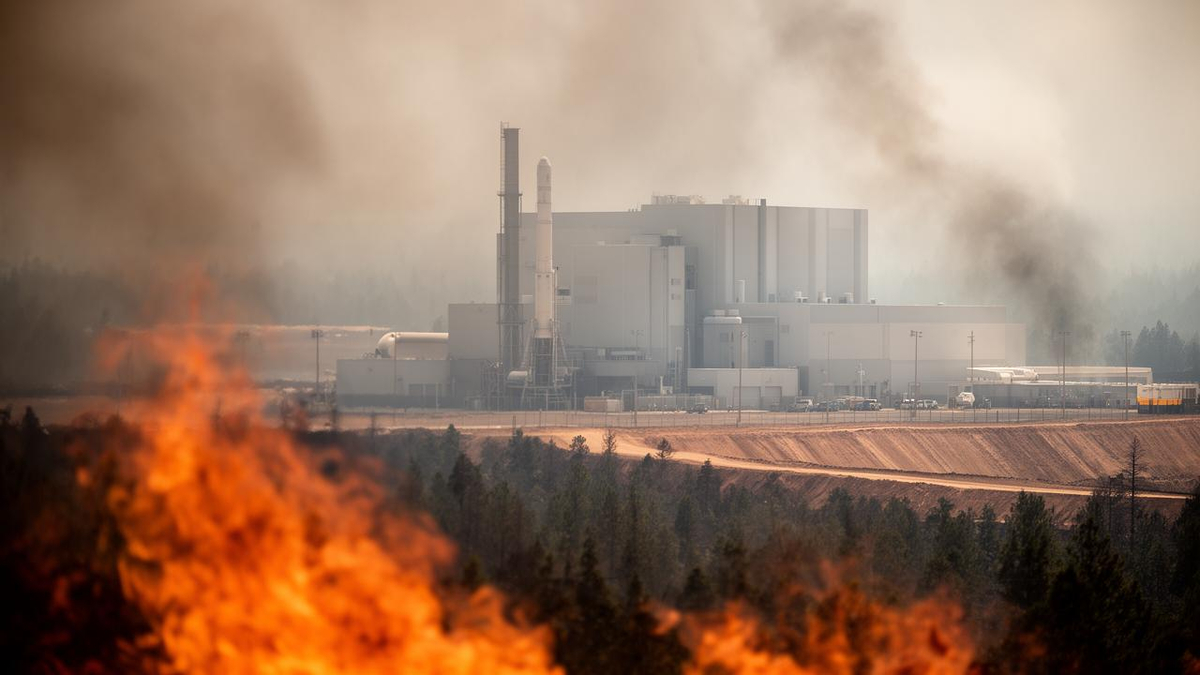
A massive wildfire engulfing the Bordeaux region in southwestern France has triggered an extraordinary crisis, forcing Europe’s core defense and aerospace manufacturers to halt factory operations en masse. The blaze has stopped production lines for the solid-propellant rocket motor of the Meteor long-range air-to-air missile — the weapon slated to arm the Republic of Korea Air Force’s KF-21 Boramae fighter — placing South Korea’s domestic procurement timeline in jeopardy.
According to the Wall Street Journal on the 30th (local time), as the wildfire raging through the forested areas west of Bordeaux threatened a dense cluster of strategic defense facilities nearby, major companies evacuated employees and initiated a full shutdown of production lines.
The most critical point of concern is the supply chain of MBDA, Europe’s premier missile manufacturing joint venture. The France-headquartered company officially announced that it had suspended operations at the nearby Roxel propulsion plant due to the fire’s impact. Roxel is a key strategic facility exclusively responsible for producing the solid-propellant rocket motors for MBDA’s flagship weapons, including the Meteor long-range air-to-air missile, the Aster surface-to-air missile, and the Exocet anti-ship missile.
South Korea’s Defense Acquisition Program Administration (DAPA) signed a formal contract with MBDA in November 2024 and has been pursuing the integration of the Meteor missile into the country’s indigenous supersonic KF-21 fighter. With the initial operational capability target for the first production batch looming at the end of this year, observers note that any prolonged production stoppage at the propulsion plant will make delivery delays unavoidable.
The wildfire’s impact extended far beyond MBDA. Thales, a powerhouse in defense electronics, shuttered three facilities that produce critical electronic equipment for the Rafale fighter jet and military helicopters. Aerospace engine manufacturer Safran also suspended operations at four nearby plants due to the fire risk. Both Safran and Thales are companies with long-standing cooperative relationships with South Korea in helicopter engines and naval power, respectively.
Airbus, a symbol of the European aerospace industry, also took a direct hit. The company halted operations at two plants in the area. This site has served as a composite production base, manufacturing fuselage sections, nose sections, and wing flaps for Airbus airliners, as well as components for Dassault and Bombardier business jets and ATR turboprop aircraft.
Dassault Aviation, the maker of the Rafale fighter, went a step further, taking emergency measures to urgently relocate sensitive military equipment stored at its production facilities to other nearby sites and an air force base. The situation was no different for ArianeGroup, the entity responsible for Europe’s space launch vehicles. The company evacuated all personnel and initiated emergency safety protocols at facilities producing rocket motors and France’s critical strategic weapon, the M51 submarine-launched ballistic missile (SLBM).
According to fire authorities, the wildfire’s spread entered a stabilization phase starting on the night of the 29th as weather conditions improved somewhat. However, containment efforts continue to face significant difficulties. Authorities have constructed a massive firebreak stretching 240 kilometers in a total-force response aimed at fundamentally preventing the flames from reaching major industrial facilities.
The fire-stricken area west of Bordeaux is not merely an industrial zone but is considered the heart of France’s defense capabilities. The region’s history dates back to royal gunpowder factories from the era of Louis XIV, and after World War II, it grew into the core hub for France’s ballistic missile, nuclear weapons, and space development programs. Experts explain that this is the result of past French government policy, which deliberately dispersed defense facilities in sparsely populated forested areas to avoid the border region with Germany.
However, observers point out that this strategic choice is now creating a paradox in the era of climate change, directly exposing strategic assets to a new form of security threat: massive wildfires.
Thibault Laconde, CEO of climate risk consulting firm Callendar, had previously investigated the wildfire exposure risk of strategic industrial facilities within France, prompted by the 2022 Uljin wildfire in South Korea that spread close to the Hanul Nuclear Power Plant. The results were alarming: of the roughly 300 high-risk facilities in France located adjacent to forests, a quarter were already found to be exposed to severe wildfire risk. A grim projection also emerged that under a moderate scenario, this proportion could surge to approximately 75% by 2050.
“These facilities are of such high strategic importance that they will be defended with every available means,” Laconde said, while warning, “The real question is what can no longer be defended elsewhere.”