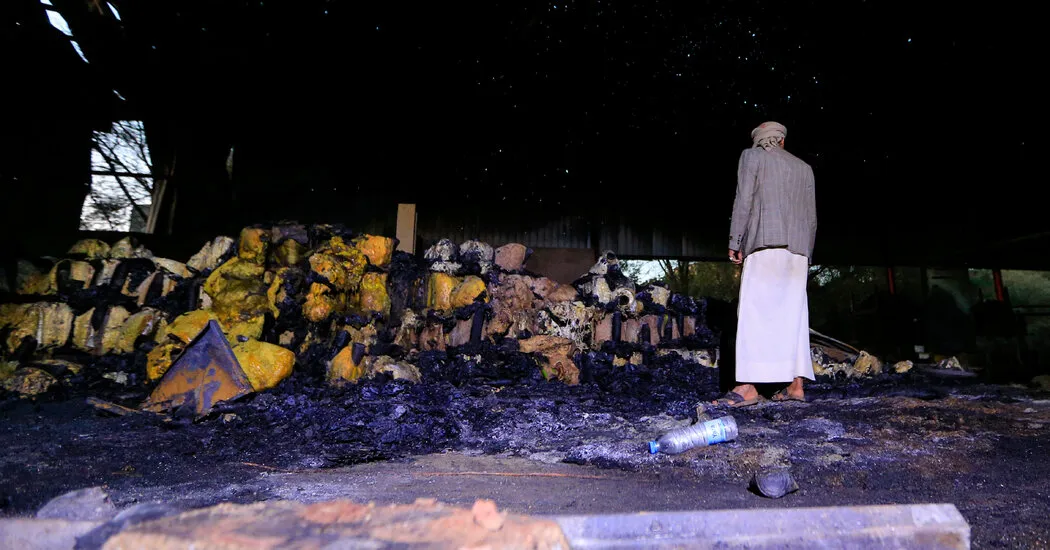
Saudi Arabia and its allies in the Yemeni government attacked the Iranian-backed Houthi militia on Monday to try to reclaim territory along the Bab al-Mandab Strait, a choke point at the southern tip of the Red Sea.
The Saudi-backed offensive was announced a day after the Yemeni government declared a full-blown war against the Houthis to retake territory it had lost to the militia over the past 12 years. The Yemeni government depends heavily on financial and military support from Saudi Arabia.
The offensive in Yemen has plunged the Middle East even deeper into conflict as the U.S.-Israeli war with Iran enters its eighth month.
On Monday night, residents in Yemen’s capital, Sanaa, heard the sounds of an explosion and fighter jets overhead. Residents in Riyadh, Saudi Arabia’s capital, heard the sounds of multiple explosions, though the Saudi authorities have not confirmed any strikes.
As of Monday evening, it was unclear how far Yemeni government forces had advanced. Official channels of militias allied with Saudi-backed forces said on Monday they had pushed into the strategic coastal district of Dhubab and severed its road access to the city of Mokha.
A spokesman for the Saudi-led military coalition, Maj. Gen. Turki al-Maliki, said it had destroyed weapons depots, storage facilities for maritime explosives, and naval mines used by the Houthis.
Hizam al-Assad, a Houthi political official, dismissed claims of major Yemeni government advances as “illusory.”
In a separate statement late Monday, the Houthis said they had responded with strikes on three sites in Saudi Arabia: an international airport in Riyadh, an oil refinery near Jeddah and a military air base in the kingdom’s southwest.
“The Armed Forces warn all international airlines using Saudi airspace to cease their flights, as it has become an operations zone for our forces, with the exception of the sacred airspace over Mecca and Medina,” the Houthi statement said.
Videos circulating on social media and verified by The New York Times showed what appeared to be Yemeni government forces near the Bab al-Mandab Strait. One video originally published by Al Ekhbariya, a Saudi news site, was filmed on the outskirts of Dhubab Airport, near the waterway. A logo on the front of a car in the video belongs to the Southern Giants Brigades, a pro-government Yemeni militia.
It was unclear whether any countries other than Saudi Arabia were participating in the air campaign. But in an emergency meeting on Monday, officials coordinating a new defense pact between Pakistan, Turkey and Saudi Arabia agreed to “move immediately” to “take the necessary measures to provide the agreed military forces and capabilities” in Saudi Arabia, Pakistan’s foreign ministry said. The statement condemned strikes on holy sites within Saudi Arabia, but stopped short of saying Pakistan or Turkey would provide military support outside of the kingdom against the Houthis in Yemen.
The United States is providing military support to Saudi Arabia during the offensive, according to one current and one former U.S. official, who spoke on the condition of anonymity to discuss operational matters.
President Trump has rebuffed Saudi government requests to direct American airstrikes. But more than 200 U.S. intelligence and military analysts are assisting the Saudi government in command centers inside the kingdom, helping to analyze and select targets in support of its Yemeni allies, the officials said. The United States is also providing aerial refueling for Saudi warplanes conducting defensive air patrols, they added.
Last month, Britain also promised to offer limited aerial refueling to Saudi warplanes for defensive purposes. It is unclear if that will extend to the new campaign. France said last month that it would send troops and other military assets to protect Saudi energy infrastructure on the Red Sea.
The Bab al-Mandab Strait has become increasingly critical to global energy markets during the U.S.-Israeli war with Iran. Saudi Arabia, one of the world’s largest oil exporters, was forced to reroute many of its shipments to the Red Sea after Iran effectively blockaded the Strait of Hormuz in March.
The Houthis, who control much of northern Yemen, took aim at the alternative route in July, declaring a blockade on Saudi shipping in the Red Sea and attacking vessels.
Last month, the Houthis gained more sway over the waterway by capturing Yemen’s Red Sea coast in a lightning offensive, trouncing the forces of the Saudi-backed government.
The Houthi triumph was a significant blow to Saudi Arabia. Together with Houthi attacks inside the kingdom, it appears to have tipped the scales of Saudi decision makers as they considered going back to all-out war with the Houthis.
The civil war in Yemen began in 2014, when the Houthis took over the capital, Sanaa, and forced out the government.
Sunday’s announcement was the second time in recent years that the Yemeni government has sought to fight the Houthis with Saudi support. In 2015, a Saudi-led intervention devolved into a grinding war that contributed to the deaths of hundreds of thousands of people from violence, hunger and disease, and failed to defeat the Houthis. A truce in 2022 established a fragile peace, until the conflict reignited.
The latest offensive by Yemen’s Saudi-backed government resembles “a replay of 2015,” said Gregory Johnsen, a nonresident fellow at the Arab Gulf States Institute in Washington, as initial government advances have appeared to push the Houthis back without completely routing them.
Renewed fighting in recent weeks has compounded the humanitarian crisis in Yemen. More than 800 people have been killed since early August, according to the World Health Organization.
Eric Schmitt contributed reporting.